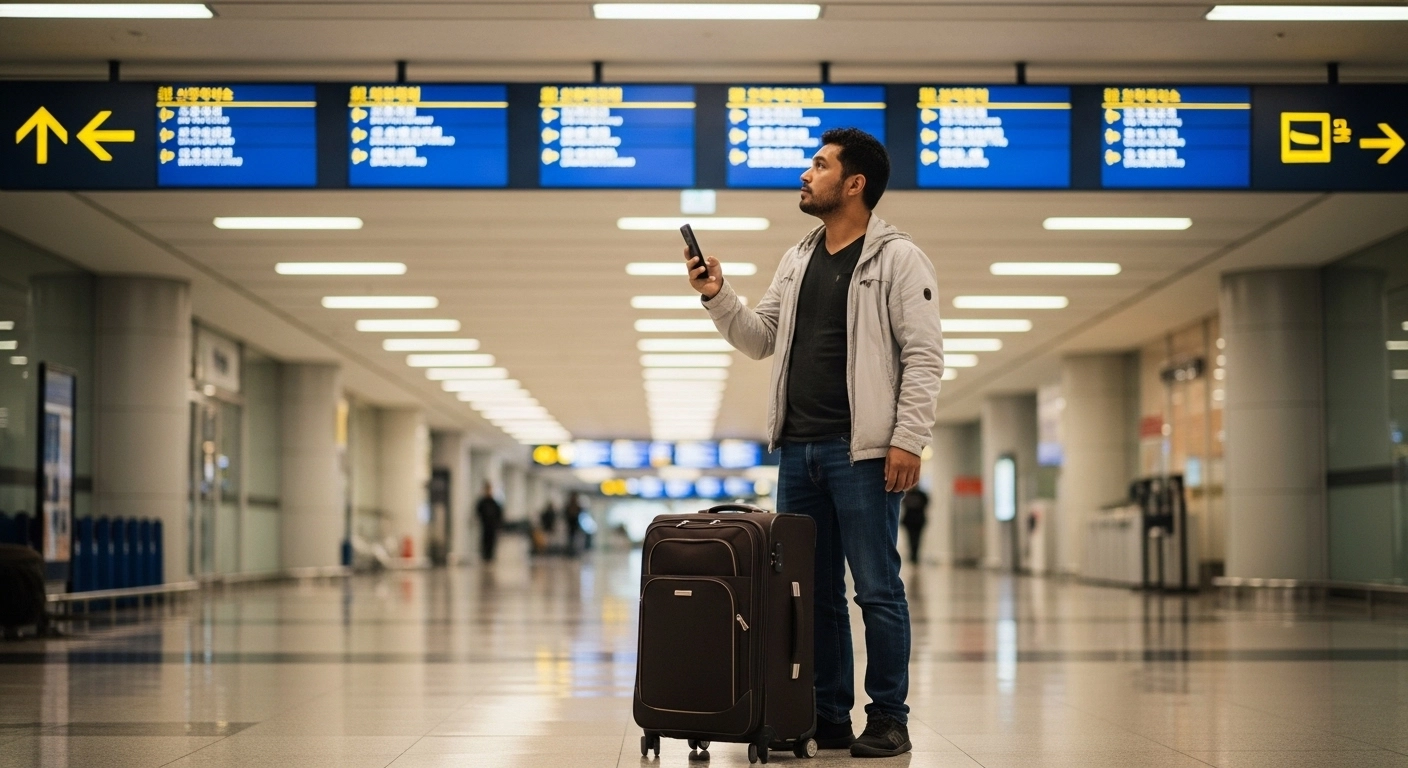
Most foreigners land at Incheon International Airport with a rough idea of how they’ll get to their accommodation — maybe a train, maybe a bus, maybe a taxi if the price feels right. The problem isn’t that airport transportation Korea foreigners deal with is complicated. It’s that the decision you make at the arrivals hall ripples into your first 48 hours in ways nobody warns you about.
By the time you’re standing outside with your bags, your phone might not have data yet, your accommodation address might be saved in a format Korean taxi drivers can’t use, and the last bus to your neighborhood may have already left. You don’t realize these things until they stack up into an unplanned ₩40,000 taxi ride at midnight — or worse, an hour of wandering around a transfer station with no connectivity.
This guide doesn’t rank transport options from “best” to “worst.” Instead, it walks through what actually goes wrong when foreigners pick airport transport without checking a few conditions first — and how to avoid those situations quietly and cheaply.
Airport Transportation Korea Foreigners Should Understand Before Landing
Here’s something that doesn’t show up in travel guides: the real cost of airport transport in Korea isn’t the fare itself. It’s what happens when your transport choice doesn’t match the conditions you’re actually arriving in.
Think about the state you’re in when you walk out of customs. You’ve been on a long flight. Your luggage is heavy — possibly oversized if you’re moving to Korea rather than visiting. Your phone situation is uncertain: maybe you bought a Korean SIM card in advance, maybe not. And the address for your temporary housing is stored somewhere in your email in a format you haven’t verified.
Korean public transport is genuinely excellent — efficient, affordable, well-connected. But it’s designed for people who already have a few things sorted: a T-money card, mobile data, and a clear destination in a format the system understands. When even one of those pieces is missing, the efficiency breaks down quickly.
Late arrivals compound everything. If your flight lands after 10:30 PM, bus routes thin out dramatically. The last AREX (Airport Railroad Express) train to Seoul Station departs around 11:40 PM, but that only helps if Seoul Station is actually close to where you’re going. Most first-time arrivals don’t realize that getting to Seoul Station and getting to their guesthouse in Hongdae or Gangnam are two very different journeys.
Main Transport Options from Korean Airports
Rather than recommending one over another, here’s what each option actually involves — including the parts that aren’t always obvious.
Airport Railroad (AREX)
AREX runs from Incheon Airport to Seoul Station, with both express and all-stop services. The express takes about 43 minutes and costs ₩11,000. The all-stop service is cheaper at ₩4,150 and takes about 58 minutes according to the official AREX schedule. Both are clean, reliable, and straightforward — if Seoul Station is your final stop. The catch is the transfer. Once you arrive at Seoul Station, you still need to get on the Seoul Metro, which requires navigating an underground complex that confuses even some locals. With two large suitcases and no data on your phone, this transfer can eat 20-30 minutes and a surprising amount of energy.
Airport Limousine Bus
These buses run fixed routes to specific neighborhoods across Seoul and surrounding cities. Fares range from ₩10,000 to ₩18,000 depending on the route. The advantage is door-to-vicinity service — some routes drop you within walking distance of major hotel clusters or residential areas. The disadvantage is timing: buses run on schedules, and late-night coverage drops sharply. You also need to identify the correct bus number for your destination, which assumes you know roughly which district you’re heading to. A foreigner going to “near Sinchon” might not immediately realize that buses 6002 or 6011 serve that area.
Taxi
Taxis from Incheon to central Seoul typically cost between ₩65,000 and ₩100,000 depending on destination and traffic. Late-night surcharges apply after midnight. The clear advantage: you hand someone an address and they take you there. No transfers, no navigation. The disadvantage is cost — and the fact that many taxi drivers struggle with addresses written in English or in formats pulled from booking platforms. If your accommodation address uses the Korean address system format with 동 (dong) and 로 (ro), the driver will find it quickly. If it’s a pin on Google Maps, things get murkier.
Late Night Transport Limitations
This is the part that catches the most people off guard. Korea has one of the safest public environments in the world, so being stranded at 1 AM isn’t dangerous — it’s just inconvenient and expensive. After roughly midnight, your options narrow to taxis, a few night buses (which require specific route knowledge), or waiting at the airport until morning services resume around 5:30 AM. Many budget-conscious travelers who planned to take the AREX end up in a taxi anyway because their flight was delayed by 45 minutes.
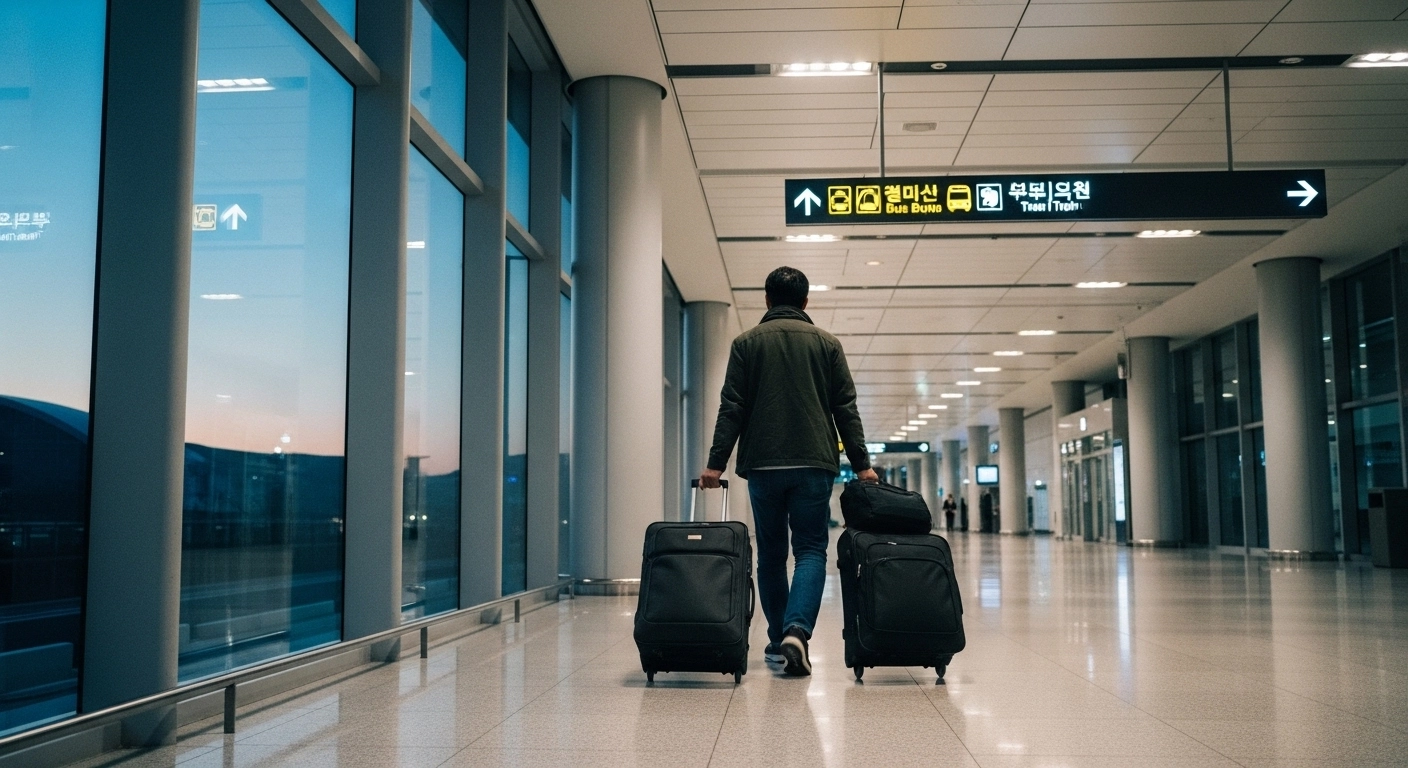
Where First-Time Visitors Often Miscalculate
These aren’t careless mistakes. They’re the kind of reasonable assumptions about airport transportation Korea foreigners often make because the system looks straightforward from the outside.
“The fastest option will save me money.” Speed matters, but not if it drops you at a transfer point where you spend another ₩15,000 and 40 minutes getting to your actual destination. A ₩4,150 AREX ride that leads to a ₩20,000 taxi from Seoul Station costs more than a ₩16,000 limousine bus that stops three blocks from your guesthouse.
“I’ll figure out navigation when I land.” This works if you have working mobile data. Without it, airport Wi-Fi gets you through customs, but the moment you step outside and need to find Bus Stop 5B on the departure level, you’re offline. Many foreigners arrive expecting their home carrier’s roaming to kick in instantly — sometimes it does, sometimes it takes hours to connect to a Korean network.
“Taxi drivers will understand my address.” Korean taxi drivers use Korean addresses and Korean navigation apps (mainly Kakao Navi or T-map). An address copied from Booking.com or Airbnb in English might not match what their system recognizes. The most reliable approach is having the address in Korean characters, ideally with the 도로명주소 (road name address) format.
“I’ll buy a T-money card on the way.” You can — convenience stores at the airport sell them. But at 11:45 PM after a 12-hour flight, finding the right convenience store and loading the card with the right amount isn’t always the smooth two-minute process travel blogs describe. Some travelers skip this step entirely and then can’t use buses or metro for their connecting journey.
“Google Maps will work fine.” It won’t — at least not for transit directions. Google Maps in Korea provides limited transit routing. Naver Map or Kakao Map are what locals use, but both work primarily in Korean. If you haven’t downloaded and set up one of these apps before landing, real-time navigation becomes a challenge. This is one of those things that’s easy to prepare in advance but nearly impossible to sort out while standing in a bus queue with luggage.
What to Check Before Leaving the Airport
This isn’t a list of advice so much as a set of conditions to verify. When it comes to airport transportation Korea foreigners often skip this step — but think of it as a pre-flight checklist you do after landing.
Your accommodation address — in Korean. Before you leave the Wi-Fi zone at arrivals, pull up your booking confirmation and find the Korean-language address. Screenshot it. If the listing only shows English, search the property name on Naver Map and grab the Korean address from there. Taxi drivers, bus information desks, and hotel shuttle services all work faster with Korean text.
Your data situation. Is your phone connected? Can you open a map app? If you pre-ordered a SIM card or eSIM, confirm it’s actually working before you walk to the transport area. If not, consider picking one up at the airport — the KT, SK Telecom, and LG U+ counters in the arrivals hall can get you connected in about 10 minutes. This one step eliminates roughly 70% of the navigation problems that follow.
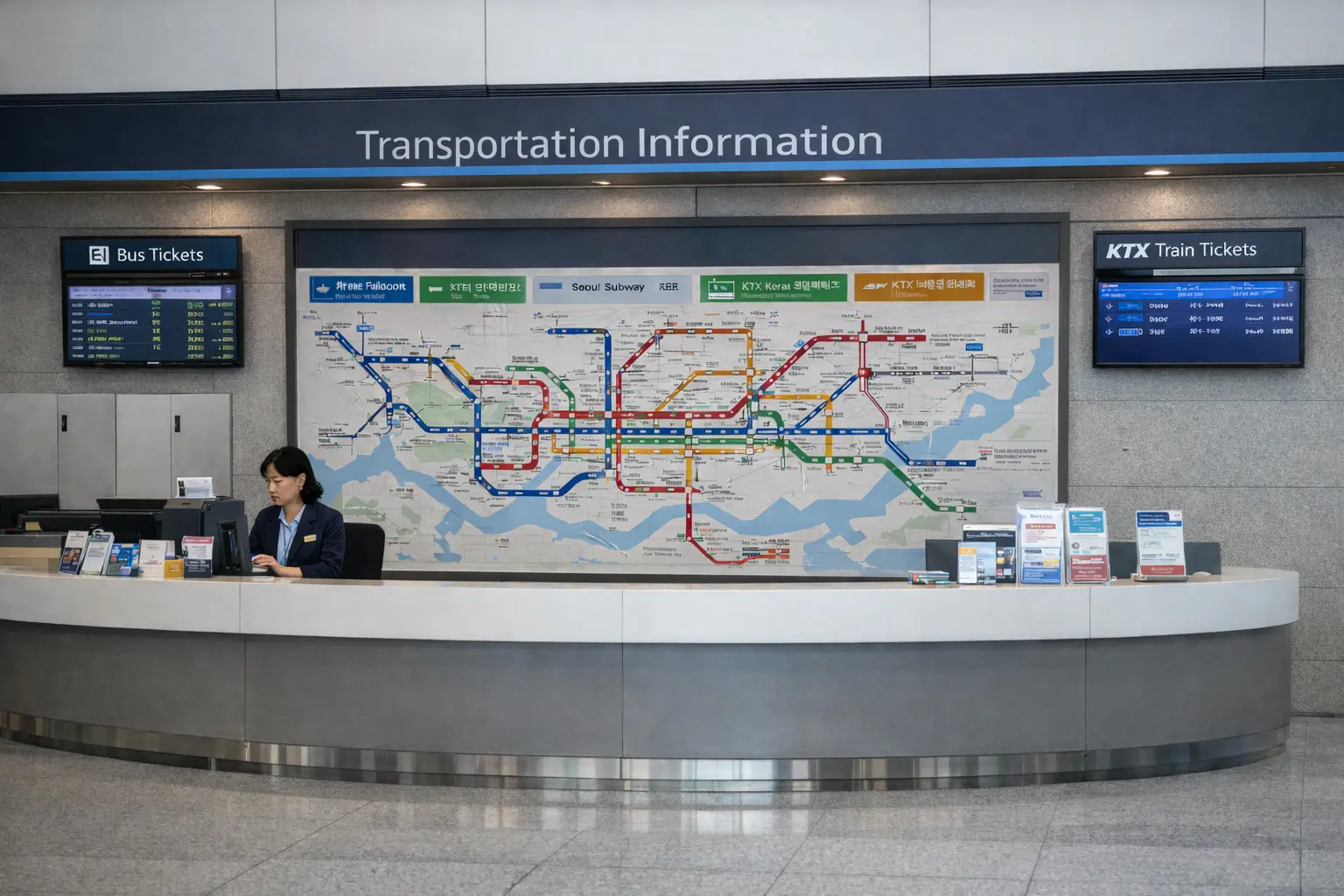
The current time and what’s still running. Check the clock. If it’s past 10 PM, your options are already narrowing. AREX express last departure is around 10:50 PM, the all-stop runs a bit later, and airport buses start thinning after 11 PM. Knowing this before you commit to a plan prevents the unpleasant surprise of arriving at a platform to find the last service already gone.
Your payment method. Korean transport runs on T-money cards and Korean payment apps. International credit cards work in taxis but not on buses. If you don’t have a T-money card yet, you can buy and load one at a convenience store inside the airport. ₩20,000 loaded is enough to cover a bus ride plus a metro transfer with some left over.
Your luggage reality. Be honest about what you’re carrying. Two large suitcases plus a backpack on AREX during rush hour is technically possible but practically miserable. If you’re moving to Korea rather than visiting for a week, the taxi cost might be worth it — not because it’s the “better” option, but because dragging heavy luggage through subway transfers at the end of a long flight is a recipe for a rough first impression of the country.
| Factor | AREX | Airport Bus | Taxi |
|---|---|---|---|
| Cost to Central Seoul | ₩4,150 – ₩11,000 | ₩10,000 – ₩18,000 | ₩65,000 – ₩100,000 |
| Travel Time | 43 – 58 min + transfer | 60 – 90 min (route varies) | 50 – 80 min (traffic varies) |
| Heavy Luggage | Manageable, but transfers are tiring | Luggage compartment available | No issue — trunk space |
| Late Night (after 11 PM) | Limited or ended | Very limited routes | Available (surcharge applies) |
| Needs Korean Address | No (fixed route) | Helpful for choosing route | Strongly recommended |
| Requires T-money Card | Yes (or single-use ticket) | Yes (or cash at some counters) | No — card or cash accepted |
How Transport Decisions Affect the First Week in Korea
This is where airport transportation Korea foreigners rely on stops being about just getting from A to B and starts affecting your broader settling-in timeline.
Arriving late at your accommodation — say, past midnight instead of the expected 9 PM — often means a missed check-in window. Some guesthouses and Airbnb hosts have lockbox systems, but others expect you during office hours. A delayed arrival can push your first full day of settling in back by 12 to 24 hours.
That delay cascades. If you planned to visit the immigration office on Day 2, a late start means you might not make it until Day 3 or 4. If you need to decide between short-term and long-term arrangements, that decision gets squeezed into fewer available days. SIM card activation, bank account inquiries, and address registration — all of these have business-hour windows that don’t flex for jet-lagged travelers.
None of this is catastrophic. But it adds up. One poorly matched transport decision on night one can quietly shift your entire first-week schedule by a day, which matters more than it sounds when some administrative tasks have specific deadlines or limited office hours.
Situation-Based Decision Guide
Rather than telling you what to choose, here are common arrival scenarios and the logic that tends to produce fewer problems.
If you’re arriving before 9 PM with light luggage and your phone has data: AREX to Seoul Station, then metro to your destination, is usually the most cost-effective route. You have time, connectivity, and mobility — the three things that make public transit work smoothly.
If you’re arriving between 9 PM and 11 PM: Check whether an airport limousine bus goes near your accommodation. If it does, that’s often the simplest path — one vehicle, no transfers, luggage stored underneath. If no bus route matches your area, AREX is still running but you’ll need to move quickly through the Seoul Station transfer.
If you’re arriving after 11 PM: Your realistic options are a taxi or waiting at the airport. If your budget allows, a taxi removes all navigation stress. If it doesn’t, the airport is clean, safe, and has 24-hour facilities. Some travelers intentionally sleep a few hours at the airport and catch the first morning AREX — which is a perfectly reasonable choice.
If you have two or more large suitcases: A taxi or airport bus with luggage storage is usually more practical than AREX, regardless of arrival time. Navigating Seoul Station’s transfer corridors with heavy bags during any time of day is physically demanding and slow.
If your phone has no data and you haven’t arranged a SIM: Consider stopping at a carrier counter in the airport before doing anything else. Ten minutes there saves an unpredictable amount of confusion later. If you skip this step, a taxi with the Korean address shown on your phone screen (from airport Wi-Fi) is the safest backup.
Final Checklist Before You Leave the Arrivals Hall
☐ Accommodation address saved as a screenshot — in Korean characters
☐ Phone has working mobile data (or you’ve decided to get a SIM at the airport)
☐ You’ve checked the current time against last-departure schedules for AREX and buses
☐ You have a T-money card loaded — or you know you’ll pay by card in a taxi
☐ You’ve matched your luggage situation to a realistic transport option
☐ You have a backup plan if your first choice isn’t available (it happens)
☐ Naver Map or Kakao Map is installed on your phone — not just Google Maps
Conclusion
Getting from the airport to your accommodation in Korea isn’t hard. Airport transportation Korea foreigners use is modern, safe, and well-maintained. What trips people up isn’t the system itself — it’s arriving without the few small pieces of preparation that make the system work in your favor.
A Korean address on your phone screen, working mobile data, a rough idea of what’s still running at your arrival time, and a realistic assessment of your luggage — that’s genuinely all it takes. From there, the choice between AREX, bus, or taxi mostly sorts itself out based on your situation.
The first move in a new country sets the tone. It doesn’t need to be perfect, but it goes a lot smoother when you’ve checked the conditions before choosing the vehicle.