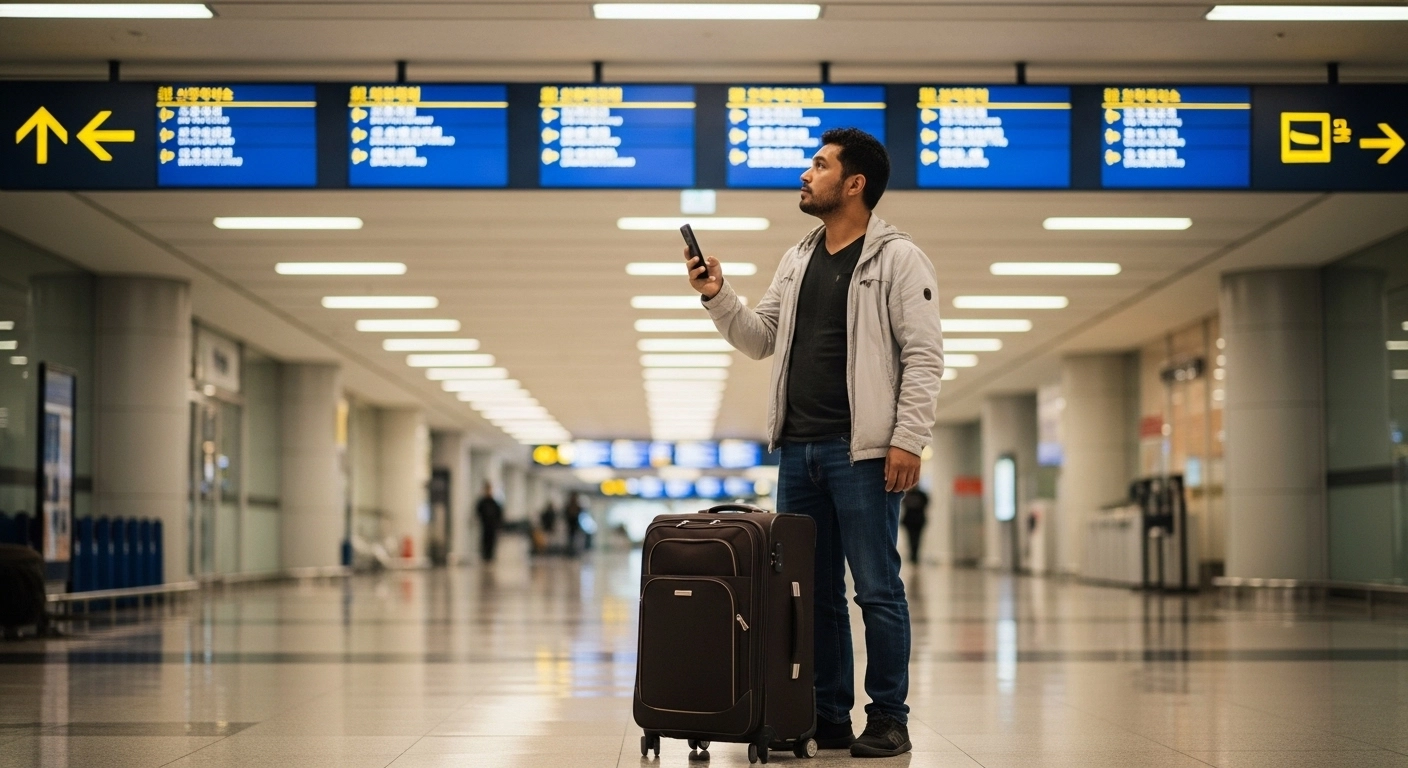
Most foreigners land at Incheon International Airport with a rough idea of how they’ll get to their accommodation — maybe a train, maybe a bus, maybe a taxi if the price feels right. The problem isn’t that airport transportation Korea foreigners deal with is complicated. It’s that the decision you make at the arrivals hall ripples into your first 48 hours in ways nobody warns you about.
By the time you’re standing outside with your bags, your phone might not have data yet, your accommodation address might be saved in a format Korean taxi drivers can’t use, and the last bus to your neighborhood may have already left. You don’t notice these things one at a time. They stack up — and end in a late-night taxi that can cost close to ₩100,000 once surcharges and tolls are added, or an hour lost in a transfer station with no connectivity.
This guide doesn’t rank transport options from “best” to “worst.” It walks through what actually goes wrong when foreigners pick airport transport without checking a few conditions first, using fares and schedules checked in October 2026.
Airport Transportation Korea Foreigners Should Understand Before Landing
Here’s something that doesn’t show up in most travel guides: the real cost of airport transport in Korea isn’t the fare itself. It’s what happens when your transport choice doesn’t match the conditions you’re actually arriving in.
Think about the state you’re in when you walk out of customs. You’ve been on a long flight. Your luggage is heavy — possibly oversized if you’re moving to Korea rather than visiting. Your phone situation is uncertain: maybe you bought a Korean SIM card in advance, maybe not. And the address for your temporary housing is stored somewhere in your email in a format you haven’t checked.
Korean public transport is efficient, affordable, and well-connected. But it’s designed for people who already have a few things sorted: a T-money card, mobile data, and a clear destination in a format the system understands. When even one of those pieces is missing, the efficiency breaks down quickly.
Late arrivals compound everything. The last AREX Express train leaves Terminal 1 at around 10:48 PM and Terminal 2 at around 10:40 PM. Regular airport limousine buses to central Seoul mostly stop between 10 PM and 10:30 PM. A flight that lands at 9:50 PM often means you reach the platform or bus stop after 10:30 — right as the easy options disappear.
Main Transport Options from Incheon Airport
Rather than recommending one over another, here’s what each option actually involves — including the parts that aren’t always obvious.
Airport Railroad (AREX)
AREX runs two kinds of trains to Seoul Station. The Express is non-stop: 43 minutes from Terminal 1, 51 minutes from Terminal 2, with an adult fare of ₩13,000 (online booking platforms often sell it for less). It runs every 30–40 minutes. The All-Stop train is the regular commuter line — around ₩5,000 by T-money depending on terminal, 59–66 minutes to Seoul Station, with stops at Gimpo Airport, Digital Media City, and Hongik University along the way. The last All-Stop leaves the airport at around 11:40 PM.
The catch is what happens after you arrive. Seoul Station is a large transfer complex, and moving to the Seoul Metro with two suitcases can take 20–30 minutes on its own. If your accommodation is in Hongdae or Mapo, getting off the All-Stop at Hongik University is often simpler than riding all the way to Seoul Station.
Fares and times as reported in 2026 guides (Ask Korea Travel, Korea Untold). Confirm on the day at the official AREX website.
Airport Limousine Bus
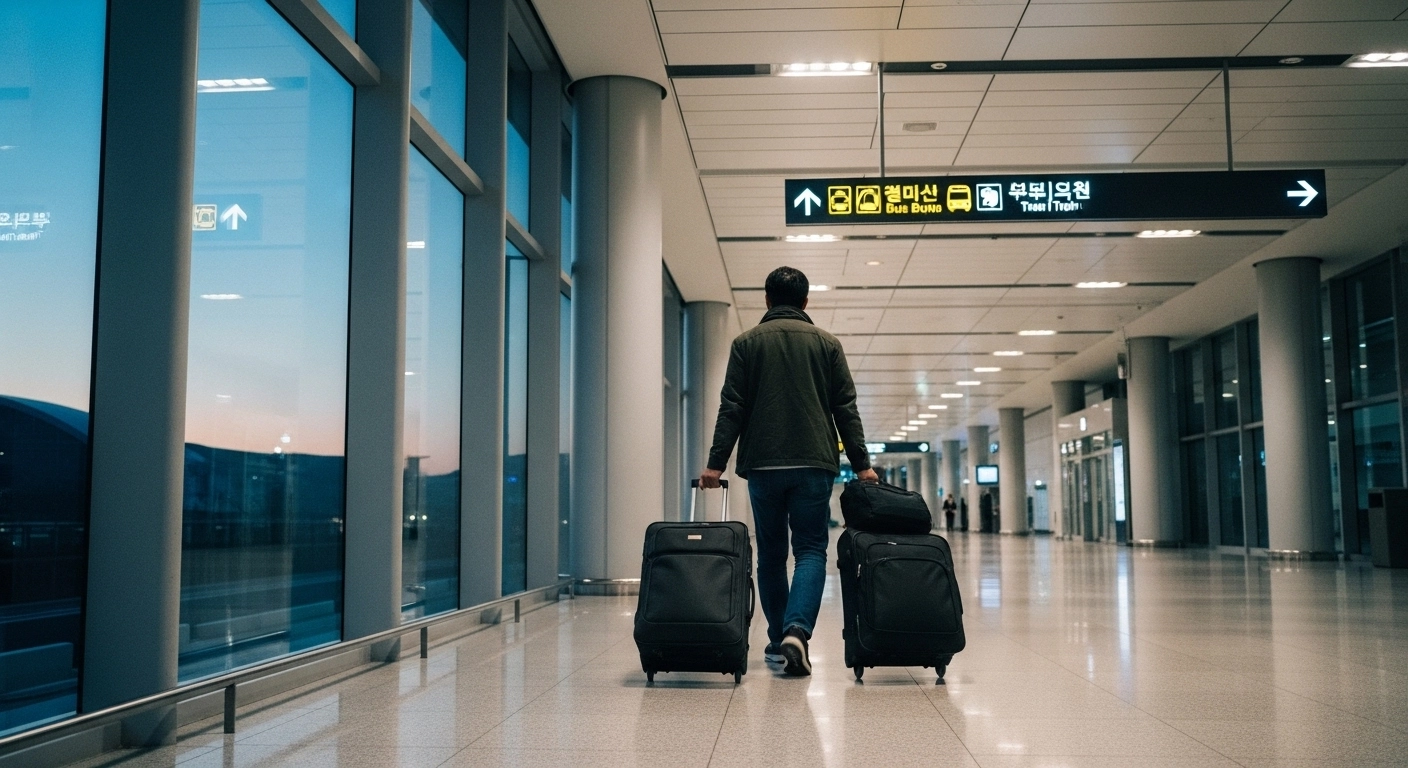
These buses run fixed routes to specific neighborhoods across Seoul and surrounding cities. Most routes into central Seoul cost ₩17,000–₩18,000 for adults — route 6701 to City Hall and Gwanghwamun, for example, is ₩18,000 and runs roughly every 25–35 minutes. The advantage is door-to-vicinity service: some routes stop within walking distance of major hotel clusters. The disadvantage is timing. Route 6701’s last departure is around 10:25 PM from Terminal 1 and 10:05 PM from Terminal 2, and most other daytime routes end in the same window.
You also need the right route number for your destination, which assumes you know roughly which district you’re heading to. The Incheon Airport bus information page lists every route; ticket counters and machines are in the arrivals hall near the bus exits.
Taxi
A taxi from Incheon to central Seoul typically runs ₩65,000–₩100,000 depending on destination and traffic, plus highway tolls. According to the Incheon Airport taxi page, the airport is a shared operating area for Seoul, Incheon, and Gyeonggi taxis, so rides to Seoul don’t carry the usual out-of-city surcharge. Late-night surcharges do apply, though, and they’re steeper than most visitors expect (details in the next section).
The clear advantage: you show an address and someone takes you there. The disadvantage — beyond cost — is that addresses copied from booking platforms in English often don’t match what a driver’s navigation app recognizes. If your accommodation address uses the Korean address system format, the driver will find it quickly. If all you have is a pin on Google Maps, it gets murkier.
| Factor | AREX Express | AREX All-Stop | Limousine Bus | Taxi |
|---|---|---|---|---|
| Adult Fare | ₩13,000 | ~₩5,000 (T-money) | ₩17,000 – ₩18,000 | ₩65,000 – ₩100,000 + tolls |
| Travel Time | 43 min (T1) / 51 min (T2) | 59 – 66 min | 60 – 90 min | 50 – 80 min |
| Last Departure | ~10:48 PM (T1) | ~11:40 PM | ~10–10:30 PM (day routes) | 24 hours |
| Heavy Luggage | Fine on board, tiring at transfers | Crowded at rush hour | Stored underneath | Trunk space |
| Needs Korean Address | No (fixed route) | No (fixed route) | Helpful for route choice | Strongly recommended |
Checked October 2026. Taxi range is an estimate for central Seoul; late-night surcharges are extra. Schedules change — confirm on the day of travel.
Late-Night Arrivals: What Still Runs After 10 PM
The part of airport transportation Korea foreigners underestimate most is the clock. Korea is a safe place to be at an airport at 1 AM. The issue isn’t danger — it’s that the cheap options end earlier than most people assume, and what replaces them costs more.
Seoul Night Buses (N-Routes)
Many first-time arrivals don’t know these exist. Incheon Airport runs a set of late-night buses into Seoul, with separate routes to Gyeonggi cities such as Suwon, Seongnam, and Uijeongbu. The Seoul routes listed on the official airport night bus page:
| Route | Final Destination | Adult Fare | T1 Boarding |
|---|---|---|---|
| N6000 | Express Bus Terminal (Gangnam) | ₩17,000 | Stop 6A |
| N6002 | Cheongnyangni | ₩17,000 | Stop 6A |
| N6701 | Dongdaemun Design Plaza | ₩18,000 | Stop 3B |
| N6703 | Gwangnaru (via Banpo, Samseong, Jamsil) | ₩18,000 | Stop 3B |
Departures run roughly every 30 minutes to an hour through the night. As one example, N6703 has listed departures at 10:20 PM, 11:00 PM, 11:40 PM, 1:10 AM, 1:50 AM, 2:35 AM, and 3:15 AM. Tickets are sold at the bus ticket counter, at self-service kiosks, or through the T-money GO app, which also allows reservations. A ₩17,000–₩18,000 night bus is still a fraction of a late taxi — but only if its route passes near where you’re staying.
Source: Incheon Airport — Seoul night buses (confirmed October 2026). N6703 sample times from Korea Bus Info.
How the Taxi Night Surcharge Actually Works
This is the detail that surprises people. Seoul’s taxi surcharge isn’t a single flat rate. Since February 2023, regular Seoul taxis add 20% from 10 PM to 11 PM, 40% from 11 PM to 2 AM, and 20% again from 2 AM to 4 AM, according to the Seoul Metropolitan Government. The airport’s own taxi page describes the same range: 20–40% between 10 PM and 4 AM.
So a ride to Hongdae that runs around ₩70,000 during the day can approach ₩100,000 if you leave the airport at midnight, once tolls are included. For two or three people splitting the fare, that’s still reasonable. For a solo traveler, it’s the moment the “I’ll just grab a taxi” plan gets expensive.
Waiting for the First Train
Some travelers wait out the night inside the terminal and take the first AREX Express — around 5:15 AM from Terminal 2 and 5:23 AM from Terminal 1. The terminals stay open overnight with seating areas and 24-hour convenience stores. If your check-in isn’t until afternoon anyway, this is a perfectly reasonable choice rather than a defeat.
Which Route Works for Your Arrival Time
Plan the airport transportation Korea foreigners rely on around the time you’ll reach the transport area, not your landing time. Immigration and baggage claim usually add 30–60 minutes.
| Time You Reach Transport | What’s Running | What Usually Works |
|---|---|---|
| Before 9:30 PM | Everything: both AREX trains, limousine buses, taxis | Pick by destination. A limousine bus if one stops near you; otherwise AREX plus metro. |
| 9:30 – 10:30 PM | AREX Express (last ~10:40–10:48), All-Stop, last daytime buses, taxis (+20% from 10 PM) | Check your bus route’s last departure first. If it’s gone, AREX is still the cheapest path. |
| 10:30 PM – Midnight | AREX All-Stop (last ~11:40), N-route night buses, taxis (+40% from 11 PM) | All-Stop if you can make it. Otherwise a night bus if its route fits your area. |
| Midnight – 5 AM | Night buses only, taxis (+40% until 2 AM, +20% until 4 AM) | Night bus, shared taxi, or wait for the first AREX around 5:15–5:23 AM. |
Most transport plans fail at the second row. A flight scheduled for 9:40 PM looks safe on paper, but a 30-minute immigration line puts you at the bus stop after the last daytime route has left.
Gimpo Airport: A Different Situation Entirely
If you’re arriving at Gimpo instead of Incheon, the airport transportation Korea foreigners face changes — mostly for the better. Gimpo sits inside Seoul’s city limits, so there’s no long highway ride and no ₩70,000 taxi. It mainly handles domestic flights plus a smaller set of short-haul international routes, including some from Japan, China, and Taiwan.
Gimpo Airport Station connects three rail lines, which is the main reason it’s easier:
| Option | Useful For | Approx. Time | Cost |
|---|---|---|---|
| Subway Line 5 | Yeouido, Gwanghwamun, Jongno | 15 – 35 min | Regular subway fare |
| Subway Line 9 | Yeouido, Gangnam (express trains) | 20 – 45 min | Regular subway fare |
| AREX All-Stop | Hongik Univ., Seoul Station | 20 – 35 min | Regular subway fare range |
| Taxi | Anywhere in Seoul | 25 – 45 min | ~₩15,000 – ₩25,000 (daytime estimate) |
With a T-money card, the rail options cost about the same as any ordinary subway ride in Seoul. And because a daytime taxi from Gimpo is a fraction of the Incheon fare, it’s a sensible default if you’re carrying a lot or simply too tired to navigate.
The same clock still applies, though. Gimpo’s subway lines stop around midnight like the rest of Seoul’s network, and the taxi night surcharge works the same way. A late domestic connection costs less here than at Incheon — but it isn’t free of the problem.
Where First-Time Visitors Often Miscalculate
These aren’t careless mistakes. They’re reasonable assumptions about airport transportation Korea foreigners often make because the system looks simple from the outside.
“The fastest option will save me money.” Speed matters, but not if it drops you at a transfer point where you spend another ₩15,000–₩20,000 and 40 minutes reaching your actual destination. A ₩13,000 AREX Express ride followed by a taxi from Seoul Station can easily cost more than an ₩18,000 limousine bus that stops a few blocks from your guesthouse.
“I’ll figure out navigation when I land.” That works if your phone has data. Without it, airport Wi-Fi covers you inside the terminal, but the moment you step outside to find the right bus stop number, you’re offline. Many travelers expect their home carrier’s roaming to connect instantly. Sometimes it does; sometimes it doesn’t.
Taxi drivers in Korea navigate with Korean apps such as Kakao Navi or T map. An address copied from a booking site in English might not match what their system recognizes. Having the address in Korean characters — ideally the road-name address (도로명주소) — removes most of that friction.
“Google Maps will be enough.” For transit directions in Korea, it often isn’t. Locals rely on Naver Map or Kakao Map, which give live bus arrivals and last-train information. Setting one up takes five minutes at home and is surprisingly hard to do while standing in a bus queue with luggage.
What to Check Before Leaving the Airport
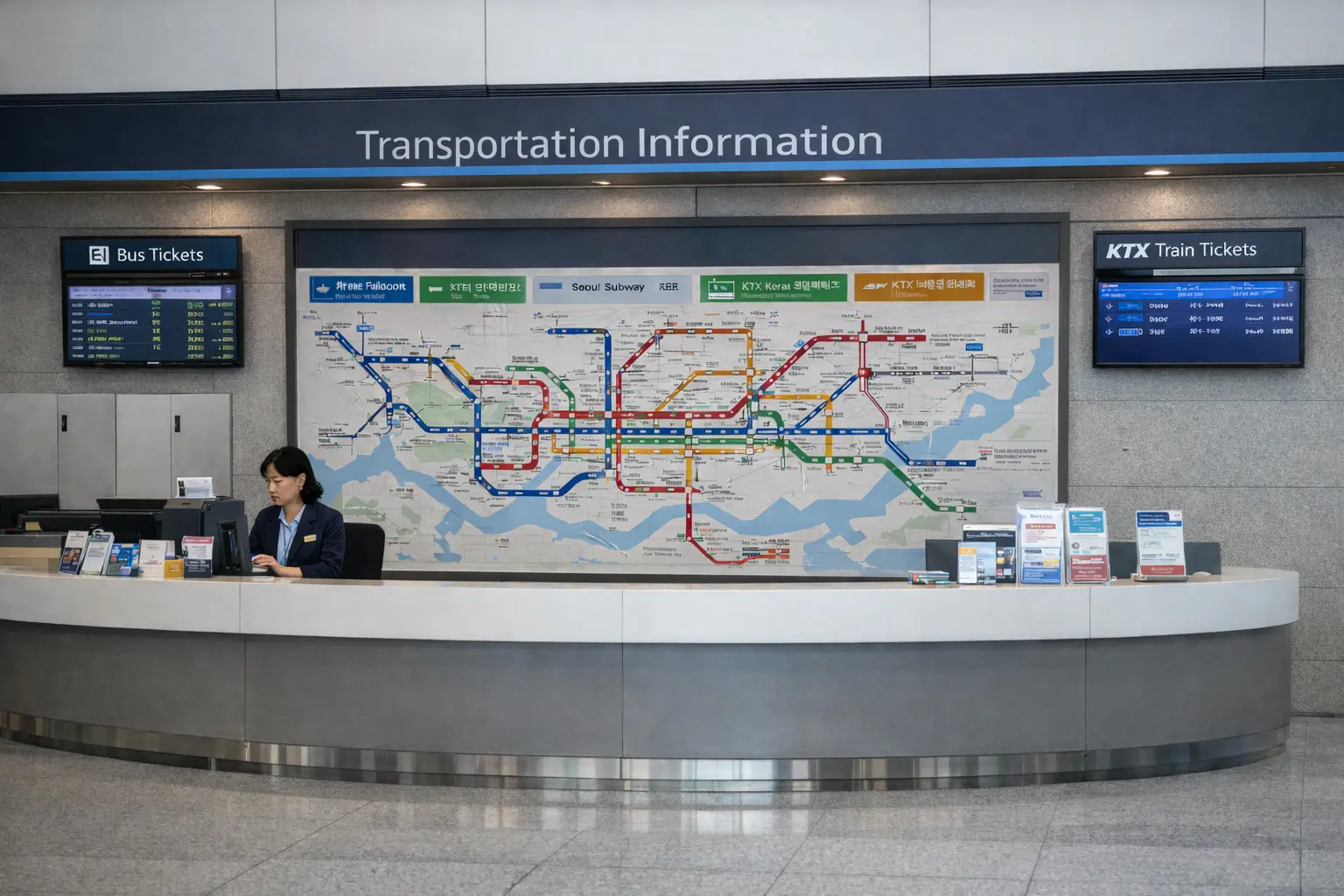
This isn’t a list of advice so much as a set of conditions to verify. When it comes to airport transportation Korea foreigners often skip this step — think of it as a pre-flight checklist you do after landing.
Your accommodation address — in Korean. While you’re still on airport Wi-Fi, pull up your booking confirmation and find the Korean-language address. Screenshot it. If the listing only shows English, search the property name on Naver Map and copy the Korean address from there.
Next, your data. Can you open a map app right now? If you pre-ordered a SIM or eSIM, confirm it works before walking to the transport area. If not, the mobile carrier counters in the arrivals hall can usually connect you on the spot. Solving this one thing first prevents most of the navigation problems that follow.
Then the clock. Compare the current time with the table above. If you’re past 10 PM, the daytime buses are probably finished and the taxi surcharge has started.
Your payment method. Subway and AREX All-Stop run on T-money. You can buy a T-money card and load it with cash at the convenience stores inside both terminals. Limousine and night buses sell tickets at counters and kiosks near the exits. Taxis generally accept major international credit cards, but carrying some Korean cash as a backup costs nothing.
Finally, be honest about your luggage. Two large suitcases plus a backpack on public transport is possible but tiring, especially through Seoul Station’s corridors. If you only need to drop bags for a few hours — say, to meet someone in the city first — both terminals have staffed luggage storage counters and lockers; prices depend on bag size and how long you leave it, so check at the counter.
How Transport Decisions Affect the First Week in Korea
This is where airport transportation Korea foreigners rely on stops being about getting from A to B and starts affecting the whole settling-in timeline.
Arriving at your accommodation past midnight instead of the expected 9 PM often means a missed check-in window. Some guesthouses use lockboxes; others expect you during staffed hours. A late arrival can push your first full day back by 12 to 24 hours.
That delay cascades. If you planned to handle paperwork on Day 2, a late start can push it to Day 3 or 4. If you still need to decide between short-term and long-term arrangements, that decision gets squeezed into fewer days. SIM activation, bank visits, and address registration all run on business hours that don’t flex for jet lag.
None of this is serious on its own. It just adds up.
Beyond the Clock: Luggage, Data, and Group Size
Arrival time narrows the options. Among the airport transportation Korea foreigners can still choose from after that, a few practical factors usually decide.
If you have two or more large suitcases: A limousine bus or taxi is usually more practical than AREX, whatever the time. The train itself is fine; the stairs and transfer corridors afterwards are the problem.
If your phone has no data and you haven’t arranged a SIM: Stop at a carrier counter before anything else. If you skip that, a taxi with the Korean address on your screen is the safest fallback, because it needs no navigation from you.
If you’re traveling with one or two other people: Run the math on a shared taxi. Three limousine bus tickets at ₩18,000 come to ₩54,000 — closer to a daytime taxi fare than most people expect, without the walk from the bus stop.
Traveling light with working data? Public transport almost always wins. AREX plus one metro line is cheap, predictable, and unaffected by traffic.
Final Checklist Before You Leave the Arrivals Hall
Seven quick checks cover most of what goes wrong with airport transportation Korea foreigners arrange on their own.
☐ Accommodation address saved as a screenshot — in Korean characters
☐ Phone has working mobile data (or a plan to get a SIM at the airport)
☐ Current time checked against last AREX and bus departures
☐ T-money card bought and loaded — or a card ready for the taxi
☐ Luggage matched to a realistic option
☐ Naver Map or Kakao Map installed — not just Google Maps
☐ After 10:30 PM: night bus route or taxi stand identified, and surcharge expected
Questions That Come Up Most
Can I pay with a foreign credit card?
Taxis generally accept major international cards. For buses, tickets are sold at counters and kiosks in the arrivals hall; card acceptance can vary by machine, so having some Korean won helps. Subways and the AREX All-Stop work most smoothly with a T-money card loaded with cash. If you plan to use one card for everything in Korea, our guide to foreign card payment in Korea covers where it tends to fail.
Is a taxi alone late at night safe?
Yes. Licensed taxis in Korea are metered and regulated, and the main risk at night is cost, not safety. Use the official taxi stands outside arrivals rather than accepting offers from people approaching you inside the terminal.
What if I land after every train has stopped?
This is the most common late-night question about airport transportation Korea foreigners ask. Check the night bus routes first — if one passes near your accommodation, it costs ₩17,000–₩18,000 instead of a surcharged taxi. If none fit, the choice is a taxi or waiting in the terminal for the first AREX Express around 5:15–5:23 AM.
The Bottom Line
Getting from the airport to your accommodation in Korea isn’t hard. Airport transportation Korea foreigners use is modern, safe, and well run. What trips people up is arriving without the few small pieces of preparation that make the system work in their favor.
A Korean address on your screen, working data, an honest look at the clock, and a realistic view of your luggage — that’s most of it. After that, the choice between AREX, bus, or taxi mostly sorts itself out.
The first move in a new country sets the tone. It doesn’t need to be perfect. It just goes smoother when you check the conditions before choosing the vehicle.
Last reviewed: October 2026. Sources: Incheon Airport night buses, Incheon Airport taxi information, Seoul Metropolitan Government taxi fares, and 2026 AREX fare guides. Fares and schedules change — confirm on the day at arex.or.kr or airport.kr.