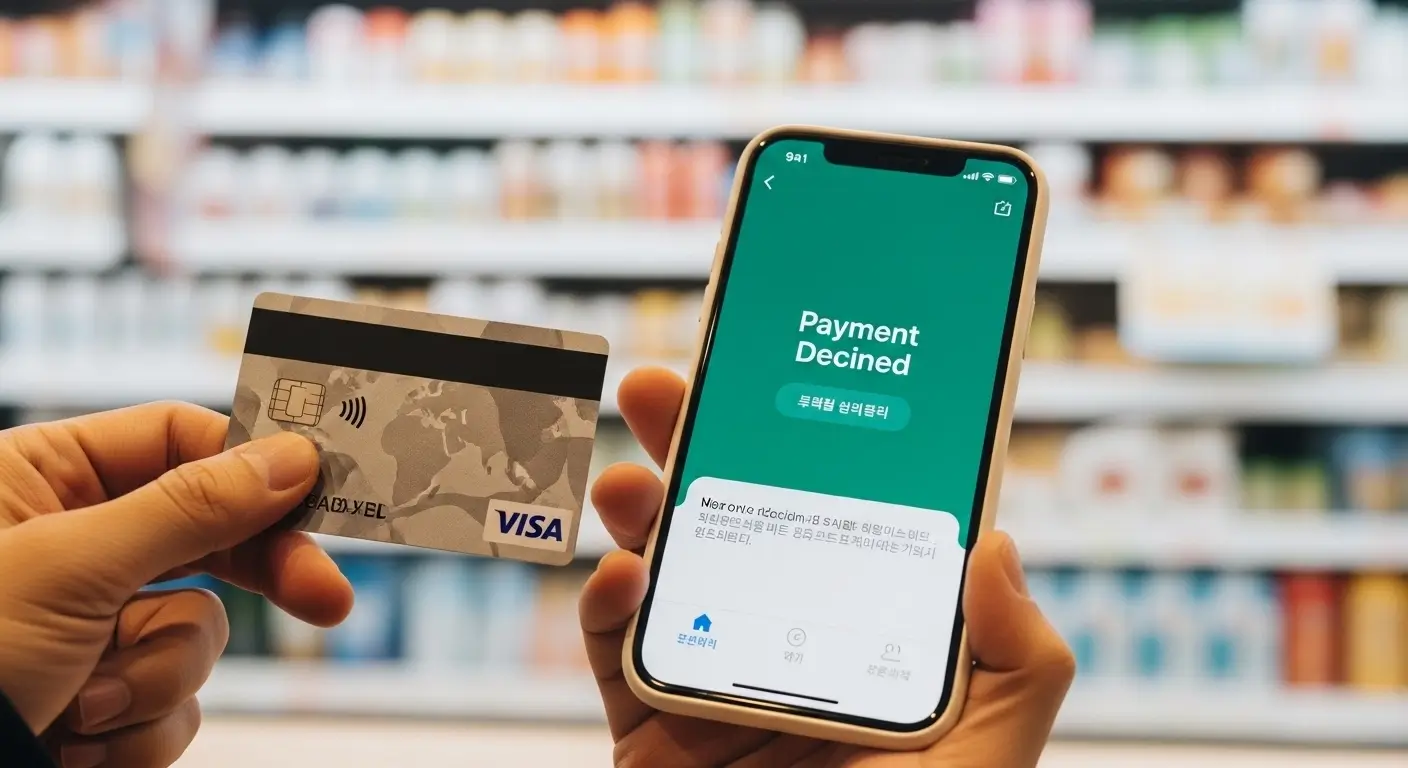
Foreign card payment in Korea works smoothly at most convenience stores and cafés — until it doesn’t. Swipe at a GS25 counter and you’re done in seconds. Try to subscribe to a Korean streaming service, top up a mobile plan online, or pay through a Korean app, and the same card that never fails you at home suddenly stops being useful. No clear error message. Just rejected.
The frustrating part isn’t that Korea rejects foreign cards across the board. Most international Visa and Mastercard transactions go through fine at physical point-of-sale terminals. The problem is a specific category of transactions — online checkouts, in-app purchases, and certain domestic service payments — where Korea’s payment infrastructure wasn’t designed with foreign cards in mind. This isn’t a policy decision. It’s a structural problem that traces back to how Korean payment systems were built decades ago.
There are three specific situations where foreign card payment in Korea breaks down — and each one breaks for a completely different reason. If you’ve already been rejected at a Korean checkout with no explanation, the answer is almost certainly one of them.
Why Korean Payment Systems Work Differently from What You’re Used To
Korea’s online payment infrastructure developed in relative isolation during the late 1990s and early 2000s. A combination of government security mandates and a domestic-first development culture pushed Korean services to build their own verification systems rather than adopt international standards. The global payment rail was there — Visa and Mastercard networks exist in Korea — but the software layered on top was built for Korean users only.
The result is a payment ecosystem built around a core assumption: the person paying has a Korean phone number, a Korean national ID (주민등록번호) or Alien Registration Card (외국인등록증), and a card issued by a Korean bank. The payment gateway verifies against these identifiers. Foreign cards are often accepted at the hardware level — the terminal reads your chip without issue — but fail at the software level when the gateway tries to confirm your identity and finds nothing it recognizes.
Since 2021, Korea has made real regulatory moves to phase out legacy authentication requirements. The Financial Services Commission of Korea has pushed for greater international compatibility in payment systems. But implementation is uneven. Large international-facing merchants have adapted. Domestic-facing services largely haven’t.
Your card isn’t the problem. The system just doesn’t know who you are — and it won’t proceed until it does.
Common Mistakes Foreigners Make When Paying in Korea
Most payment failures follow predictable patterns. The causes aren’t random — they’re built into how the systems work. Recognizing these early saves a lot of trial-and-error at checkout.
Assuming “Visa accepted” means the card works for everything. The Visa or Mastercard logo at a merchant signals that the physical terminal can process your card. It says nothing about the payment gateway handling the backend verification. Many Korean merchants display international card logos but route transactions through domestic-only gateways that can’t process foreign cards regardless of what the terminal sticker says.
Trying to pay for domestic Korean services directly. Streaming platforms like Watcha and Wavve, domestic app store billing in Korean-region accounts, and most Korean subscription services are built for Korean residents. They require a Korean payment method by design — not as an oversight. Using a foreign card here isn’t a workaround they forgot to patch. It’s a category they don’t serve.
Another thing that catches people: many Korean payment flows require phone number verification before the payment processes — even for physical delivery orders. No Korean number registered in your name means this step fails silently. The card never gets attempted. It looks like a payment failure. The real block happened one step earlier.
And the same card won’t behave the same way everywhere. A card that clears Lotte Mart’s self-checkout may fail completely on Lotte Mart’s website. Not occasionally — consistently. Physical and digital transactions in Korea don’t share a pipeline the way they do in most countries. A working card at the counter tells you exactly nothing about what happens online.
The 3 Hidden Blocks: Where Foreign Card Payment in Korea Actually Fails
These three blocks account for the overwhelming majority of foreign card payment failures in Korea. Each has a distinct cause and requires a different response. Knowing which one you’re dealing with is the difference between finding a workaround and spending an hour switching cards that all hit the same wall.
Block 1: Identity Verification (본인인증) — Phone-Based Authentication
Before many Korean transactions complete, the system runs an identity verification (본인인증) step. Not optional fraud screening layered on top. It’s embedded in the payment flow itself — the system sends a one-time code to a Korean phone number registered under your name, and the transaction simply won’t move forward until you enter it.
Foreign SIM, roaming number, Korean tourist SIM that isn’t registered under your real name — any of these and the step fails. The checkout page throws a generic error or freezes. No message explaining what actually went wrong. Just stopped.
The part that trips people up most: this fires before your card is ever attempted. A perfectly valid Visa or Mastercard never enters the picture. This is also why getting your ARC approved doesn’t automatically fix online verification problems — ARC and phone number registration are separate systems with separate requirements. One doesn’t substitute for the other.
Block 2: Domestic-Only Payment Gateways (PG사)
Korean e-commerce runs through payment gateway companies (PG사) that sit between the merchant and the card networks. Major Korean PG operators — KG이니시스, NHN KCP, KakaoPay, Toss Payments — were historically built for Korean card issuers only.
When a merchant uses a domestic-only PG, your international card hits a gateway that simply cannot process it. The Visa or Mastercard network is never reached. The transaction fails at the PG layer before any card communication begins. You see a payment declined message, but the merchant may not even know their setup doesn’t support international cards — it’s a vendor infrastructure issue, not something that varies card by card.
Some Korean PG operators have added international card support in recent years, typically for merchants who explicitly requested it. Merchants who advertise foreign card payment (해외카드 결제) have usually opted into international-compatible gateway settings. Outside that group, gateway compatibility is the merchant’s problem — and there’s nothing on your end that changes it.
Block 3: 3D Secure Authentication Mismatch
3D Secure — the system behind “Verified by Visa” and “Mastercard SecureCode” — exists globally, but Korea implemented its own domestic version called secure click authentication (ISP 안심클릭). This system communicates with Korean card issuers only. When a Korean merchant initiates a 3D Secure check, the authentication request goes to Korea’s server. Your foreign bank’s system doesn’t respond to Korean authentication server requests the same way Korean banks do.
The practical result: your bank may internally approve the transaction and send you a notification that a payment was attempted. But the Korean gateway never receives the confirmation it expects, and the payment drops. You end up with no charge, no order confirmation from the merchant — and a record at your bank showing the attempt happened.
This is the hardest block to diagnose because it operates below what you can see or control. The Bank of Korea’s payment system framework acknowledges the ongoing standardization effort with international 3D Secure protocols, but merchant-level implementation continues to vary significantly across sectors.
What Actually Determines Whether Your Card Works in Korea
Understanding why foreign card payment in Korea fails differently across contexts comes down to four factors — none of which are about your card type or the name on the front.
Physical vs. online transaction. This is the single biggest variable. Physical POS terminals in Korean retail process international cards reliably in most cases. Online checkout routes through a different pipeline — one that introduces all three blocks above. The same card that works at a pharmacy counter may fail completely on that pharmacy’s website. This isn’t an anomaly. It’s the norm.
The merchant’s PG configuration. If the merchant uses an international-compatible PG and has explicitly enabled foreign card processing, the transaction has a reasonable chance. If the gateway is domestic-only, it won’t work regardless of what your card issuer says. This is entirely on the merchant’s side — there’s nothing you can influence as a customer.
Whether the checkout triggers 본인인증 matters more than any card-level factor. Most physical retail skips it entirely. The moment an online flow asks for a Korean phone number, the card becomes irrelevant — the block happens before any payment attempt begins.
One thing worth knowing if you’re troubleshooting: cards from digital-first banks like Wise and Revolut sometimes get further through the 3D Secure step than traditional bank cards. Their backend systems are more recently built and occasionally respond to non-domestic authentication requests. It’s marginal — not a fix — but if you’re rotating through cards trying to find one that works, this is the one to try last rather than first.
For anything involving KakaoTalk payments or Kakao-integrated services specifically, there’s an additional authentication layer on top of the standard gateway requirements. The details are in the guide on KakaoTalk verification failures for foreigners in Korea.
Decision Guide: Which Payment Method Fits Your Situation
The right approach depends on how long you’re staying and what category of payment you’re dealing with. There’s no single setup that covers everything.
Short stay (under 30 days), physical retail only. Your Visa or Mastercard works at most retail terminals without issue. Keep ₩50,000 notes as a backup for places that don’t take cards at all. For transit and convenience store payments, a T-money card handles things reliably with no identity verification required — available at any convenience store or subway station ticket machine.
You need to pay for Korean online services or apps. Foreign card payment in Korea is unreliable for domestic-facing services. Watcha, Wavve, Melon, and most Korean app store billing require a Korean payment method by design. The only consistently reliable path is a Korean bank account linked to an ARC, which comes with a Korean debit card these services accept. Without an ARC, there’s no clean workaround.
Booking through international-facing Korean businesses — airlines, hotel chains, large e-commerce platforms — is a different category. These merchants have set up their PGs to handle foreign cards, and 본인인증 typically doesn’t come into it. Visa and Mastercard go through. Amex is noticeably more hit-or-miss even here.
Long-term stay or work visa holder. Opening a Korean bank account is the most complete solution available. A Korean debit card resolves the PG compatibility issue, the 본인인증 requirement once linked to a Korean phone number, and the 3D Secure mismatch — all in one step. Most long-term residents eventually do this. Doing it earlier rather than after repeated payment failures is worth the effort.
If your card fails and you genuinely can’t tell why, try switching from Wi-Fi to Korean mobile data before assuming the card is the issue. Some Korean PG systems flag transactions coming from foreign IP addresses regardless of what card is being used. Same card, Korean mobile data — sometimes it clears when the same payment on your home-country router doesn’t. Payment setup is only one of several tasks that stack up in the first month, and seeing them side by side makes the sequence easier to plan.
Quick Checklist Before You Pay in Korea
- Is this a physical or online transaction? (Physical is far more reliable for foreign cards)
- Does the merchant explicitly list foreign card (해외카드) acceptance on their site?
- Does any step in the checkout flow ask for a Korean phone number?
- Are you using Visa or Mastercard? (Amex acceptance is significantly more limited in Korea)
- Have you notified your home bank about card use in Korea to prevent auto-blocks?
- Is your phone on a Korean SIM in case a verification code is needed at any step?
- Is there a T-money card or cash backup available if the card payment fails?
FAQ — Foreign Card Payment in Korea
Why does my card work in a Korean store but fail on the same store’s website?
Physical and online payment systems in Korea run through completely separate infrastructure. The in-store terminal processes your card directly through the international card network — your Visa reaches Visa. The online store routes the same payment through a Korean payment gateway that may not accept foreign cards, or includes a 본인인증 step that the physical terminal skips entirely. One working tells you nothing useful about the other. They are not connected systems in the way most people assume.
Is there any way to use foreign card payment in Korea for domestic apps and streaming services?
For services designed for Korean residents — Watcha, Wavve, Melon, domestic app store billing — there’s no reliable workaround using a foreign card alone. These services require a Korean payment method by design, not by accident. The practical path is a Korean bank account with an ARC, which provides a Korean debit card these services accept. Some services allow purchase through Google Play or Apple App Store using an internationally-charged account, but this varies by service and isn’t consistent. Without an ARC, foreign card payment in Korea simply doesn’t reach these domestic platforms.
Will Wise or Revolut work better than my regular bank card for paying in Korea?
At physical retail, Wise and Revolut perform comparably to standard bank Visa or Mastercards — generally reliable. For online transactions, these cards occasionally handle the 3D Secure authentication step more smoothly because their backend systems are more recently built. But they face the same domestic gateway restrictions and 본인인증 requirements as any other foreign card. They represent a marginal improvement in some scenarios, not a complete fix. A Korean SIM registered in your name combined with a Korean bank account remains the only complete solution for domestic online payment failures in Korea.
Conclusion
Foreign card payment in Korea isn’t a broken system — it’s a system built for someone else. Physical retail mostly works. International-facing Korean merchants mostly work. The friction is concentrated and predictable: online checkout, anything that triggers 본인인증, and payment gateways that were never configured to handle foreign cards at all.
The three blocks don’t have the same fix. 본인인증 failing means you need a Korean SIM registered in your name — switching cards won’t help. A domestic-only gateway means only a Korean bank account solves it. A 3D Secure mismatch is the one case where trying a Wise or Revolut card on Korean mobile data sometimes gets you through when nothing else has.
Most people who stay more than a few weeks end up opening a Korean bank account eventually. One step, most of the friction gone. Until then, knowing which block you’re hitting at least means you stop wasting time at the checkout screen doing the wrong thing.