
KTX booking for foreigners follows different payment rules than most travelers expect. The train runs on schedule, the app exists in English, and your card has worked at convenience stores across Seoul — but the checkout screen rejects it anyway. That specific failure, at that specific moment, is what this article is about.
The gap isn’t random. Korea’s rail payment infrastructure runs through domestic systems that treat international cards differently at several points in the process — not just at the final payment step. By the time most foreign visitors see the error message, they’ve already passed at least two checkpoints where the system quietly filtered them out.
If you’re planning to use KTX during your stay and you hold a foreign-issued card, knowing where those checkpoints are before you attempt to book is what separates getting a seat from scrambling for alternatives at the station gate.
Why This Catches Foreigners Off Guard
Most people assume that if a card works at a convenience store (편의점) or a restaurant in Korea, it will work anywhere. For KTX, that assumption breaks.
Korail (한국철도공사) operates its booking system through payment gateways built primarily around domestic Korean cards. International cards — Visa and Mastercard included — go through an additional processing layer that involves identity verification (본인인증), 3D Secure authentication, and in some checkout paths, a Korean phone number or resident registration number (주민등록번호).
None of this is flagged during the booking process. The system doesn’t say “your card type requires additional steps.” It either processes or rejects. For many foreign visitors, that rejection arrives with no error message that explains which specific step failed — just a generic payment failure notice and no clear path forward.
That’s the core friction point with KTX booking for foreigners: the system wasn’t designed with international cardholders in mind, and the failure messages reflect that gap.
Common Mistakes Foreigners Make at KTX Checkout
These aren’t unusual oversights. Most happen because the booking interface doesn’t signal that anything is wrong until the final step.
Entering a Name That Doesn’t Match the Card
Korail’s booking form asks for a passenger name. Many people enter it in Korean order (가나다 순 — family name first) or with slight variations from the embossed name on their card. When the payment gateway checks this against the card issuer’s records, even a minor mismatch can trigger a silent rejection. Enter your name exactly as it appears on your card, character by character — including spacing and hyphenation.
Attempting Payment Without 3D Secure Enabled
International cards that don’t have 3D Secure (카드 본인확인) activated through the issuing bank frequently fail at the authentication stage. This isn’t a Korail setting — it’s a card-level configuration. Enabling it requires contacting your bank before your trip, not at the checkout screen.
Mixing Platforms Mid-Booking
Starting on the Korail website (레츠코레일), switching to the app (코레일톡), or attempting a third-party platform after a failed transaction doesn’t reset the payment state cleanly. Each platform maintains its own session, and an incomplete transaction on one can interfere with a fresh attempt on another. Start over on a single platform after clearing your browser cache.
Trying to Verify Without a Compatible Korean Phone Number
Certain ticket categories and discount fares trigger an SMS verification (문자 인증) step that requires a Korean number. Tourist USIM cards sometimes pass this check. MVNO (알뜰폰) plans sometimes don’t. The outcome depends on your specific carrier and plan type — this connects directly to the broader pattern covered in phone number verification for foreigners in Korea.
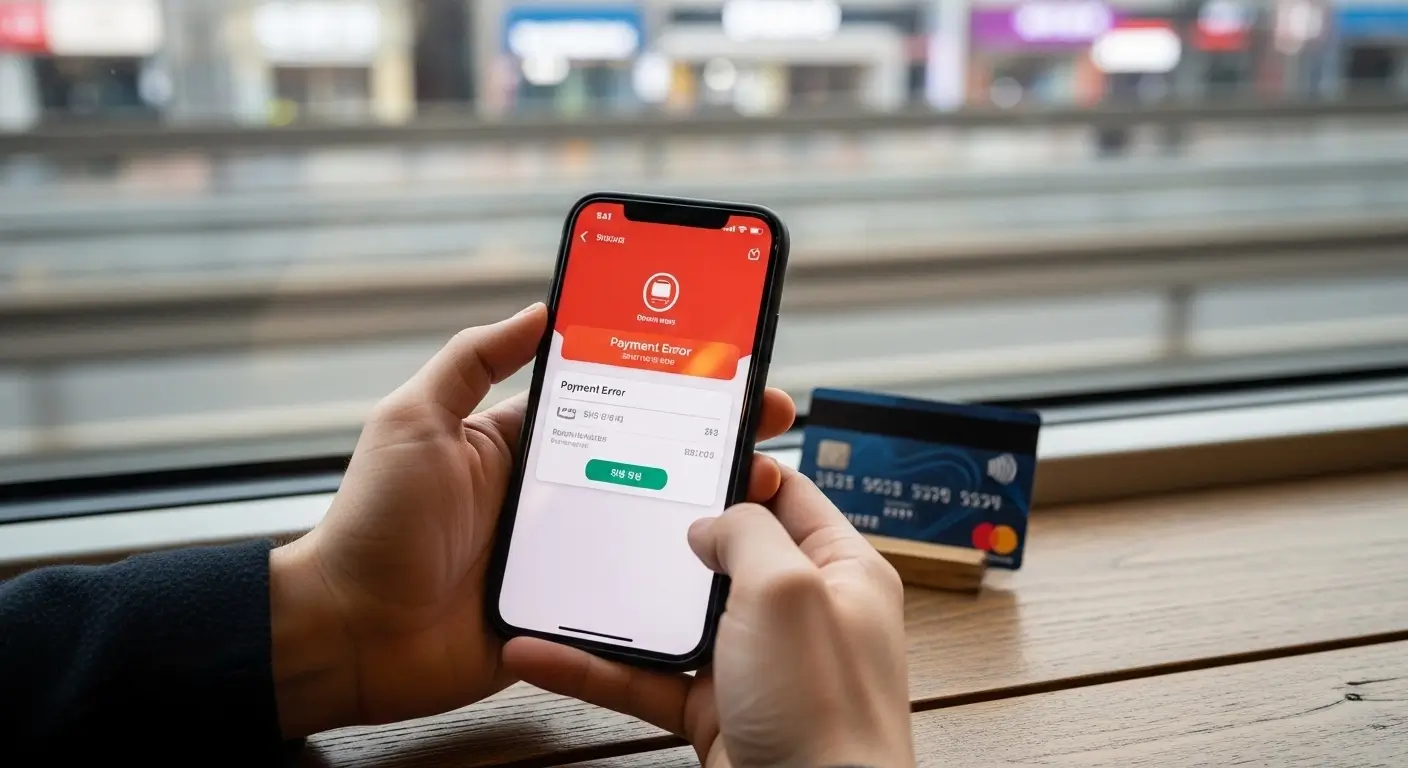
Where KTX Booking for Foreigners Gets Blocked
There are three distinct points in the checkout flow where foreign cards encounter system-level friction. Identifying which one is causing the failure helps narrow down what needs adjusting before the next attempt.
Block 1: Payment Gateway Mismatch
Korail routes transactions through Korean payment processing companies (PG사 — Payment Gateway 사업자). These gateways are certified primarily for domestic card processing and handle international cards as a secondary function. Some card networks — particularly those issued outside the US, UK, or Japan — aren’t in the gateway’s supported list at all.
One thing worth knowing if you’re troubleshooting: switching card networks (for example, from a regional debit card to a globally issued Visa credit card) sometimes resolves the failure — not because of a fee difference, but because of gateway compatibility. The system accepts the card type, not the card itself.
Block 2: Identity Verification Checkpoint
This is the most common point of failure. Korean e-commerce systems frequently require 본인인증 (identity verification) before completing higher-value transactions. For domestic users, this runs through a resident registration number or phone-based authentication. Foreign visitors have neither — or have phone setups that don’t pass the verification check.
Whether you hit this checkpoint depends on the ticket type, the fare category, and which version of the booking interface is active. It’s inconsistent enough that the same card can succeed one day and fail the next if Korail pushes an interface update that routes through a stricter verification path.
Block 3: Browser and Environment Filters
Older versions of Korail’s website used ActiveX-based security modules that don’t function on non-Korean browsers or operating systems. That architecture has mostly been retired, but residual compatibility gaps remain — particularly in special fare categories or group booking flows. Using an updated Chrome browser on desktop provides the most stable checkout environment for KTX booking for foreigners.
For the structural reasons why foreign cards specifically struggle with Korean online payment systems, the breakdown in foreign card payment in Korea covers the three underlying blocks in detail — and KTX is one of the most common places where all three converge at once.
Korail Website vs App vs Third-Party: Different Rules Apply
The platform you use for KTX booking matters more than most travelers realize — different platforms route payment differently, and some remove the identity verification friction entirely.
Korail Official Website — letskorail.com
The official Korail booking site supports international card payment in principle, but the checkout flow varies by fare type. Standard adult fares on major routes — Seoul to Busan (부산), Seoul to Daegu (대구), Seoul to Gwangju (광주) — tend to process more cleanly than discounted or promotional fares, which may trigger the identity verification checkpoint. Membership account creation also sometimes introduces additional phone-based verification steps that catch foreign visitors.
Korail Talk App — 코레일톡
The mobile app runs a slightly different payment flow than the website. Some users report more consistent international card acceptance through the app, particularly when a card is registered in advance rather than entered cold at checkout. It also handles seat selection and post-booking changes more smoothly on mobile. That said, the underlying payment gateway is the same — the app doesn’t fundamentally bypass the blocks, it just surfaces them in a slightly different sequence.
Third-Party Booking Platforms
Services like Klook, 12Go Asia, and Rail.ninja act as intermediaries — they purchase tickets directly through Korail’s system and handle international payment processing on their end. This removes the direct card verification friction for the traveler. The trade-offs: a service fee per ticket (typically ₩1,000–₩5,000), slightly reduced seat availability on peak routes, and refund policies that differ from Korail’s own terms.
There is no single correct platform for KTX booking for foreigners. Each path has different trade-offs depending on your card type, residency status, and how much flexibility you need after booking.

Decision Guide: Which Path Matches Your Situation
The right approach depends on your specific setup. Below is a situation-based framework — not a recommendation, but a set of conditions that typically point toward one path working better than another for KTX booking for foreigners.
| Your Situation | Path That Usually Works | What to Watch |
|---|---|---|
| Tourist, no ARC, Visa or Mastercard | Third-party platform | Service fee applies; confirm refund policy before buying |
| Foreign resident with ARC and Korean number | Korail website or app direct booking | Name entry must match card embossing exactly |
| Tourist with 3D Secure enabled card | Korail app (register card in advance) | Use Chrome on desktop if app checkout fails |
| Group booking or special discount fare | Station ticket office (매표소) | Staff can process foreign cards at the counter; bring your passport |
| Unsure whether card has 3D Secure active | Third-party platform or ticket office | Contact your bank before departure to check and enable |
If you’re uncertain about your card’s 3D Secure status or what “international payment enabled” actually means on your specific card, the situations in paying in Korea as a foreigner explain how these settings interact with Korean payment systems.
Before You Book: A Quick Checklist
Run through these before attempting KTX booking for foreigners online. Most payment failures at checkout are preventable at this stage.
- Card name format: Confirm the passenger name you’ll enter matches your card’s embossed name exactly — including family name order and any hyphens
- 3D Secure activation: Contact your card-issuing bank to confirm international 3D Secure is active before you leave your home country
- Browser environment: Use an updated Chrome browser on desktop for the most compatible checkout experience on letskorail.com
- SIM card SMS capability: Know whether your Korean SIM supports SMS verification — tourist USIM cards vary on this, and the carrier matters
- Platform decision: Decide in advance whether you’re booking directly through Korail or via a third-party platform, based on your situation in the table above
- Station fallback plan: If online booking fails, the ticket office (매표소) at major stations — Seoul (서울역), Busan (부산역), Daejeon (대전역) — accepts foreign cards with passport identification; build in time for this option before peak departure windows
- Refund conditions: Confirm cancellation terms before purchasing, especially on third-party platforms — their policies differ from Korail’s direct cancellation rules
Frequently Asked Questions
Can I use Visa or Mastercard for KTX booking for foreigners on the Korail website?
Yes, but with conditions. Both networks are accepted in principle. Payment succeeds when 3D Secure is active, the cardholder name matches the booking name exactly, and the transaction passes the gateway’s international card compatibility check. Standard adult fares on major routes have a higher success rate than discounted or promotional fares, which tend to trigger additional verification steps. If direct booking fails after checking all three conditions, third-party platforms remove most of this friction for a small service fee per ticket.
Why does PASS app verification fail during KTX checkout?
PASS app authentication (패스 인증) is built for Korean telecom subscribers. Foreign nationals on tourist SIM cards or MVNO plans fall outside the verified subscriber base that PASS can authenticate. The detailed breakdown is in why PASS app verification fails for foreigners — but during KTX checkout specifically, the practical fix is to choose a booking path that doesn’t trigger PASS verification rather than attempting to resolve the PASS authentication itself.
Is buying a ticket at the station ticket office a reliable fallback?
For most foreign visitors, yes. Major station ticket offices (매표소) accept foreign cards with a passport for identification — no Korean phone number or resident registration number required. The limitation is seat availability on peak travel days, and you need to be at the station ahead of your journey. According to the Ministry of Land, Infrastructure and Transport (국토교통부), Korail station counters are required to provide in-person service for all passengers regardless of nationality. On busy routes like Seoul–Busan on Friday evenings or around major holidays (설날, 추석), window inventory runs out faster than online availability — factor this in if you’re relying on same-day purchase.
Does having an ARC card change how KTX booking for foreigners works?
It helps significantly, but doesn’t eliminate all friction. ARC holders (외국인등록증 소지자) with a registered Korean phone number can complete the identity verification step that blocks most tourists. The payment step still requires 3D Secure compatibility and correct name entry. Foreign residents with a Korean bank account (한국 은행계좌) linked to a local card have the smoothest direct booking experience on the Korail platform — effectively the same checkout flow as a Korean domestic user.
Conclusion
KTX booking for foreigners doesn’t fail because the train system is inaccessible — it fails because the payment infrastructure was built for domestic users and treats international cards as an edge case. The verification checkpoints, gateway compatibility requirements, and name-matching rules exist for Korean cardholders and create friction for everyone else.
Knowing which of the three blocks — gateway mismatch, identity verification, or browser environment — is likely to apply to your situation means you can choose the right platform before the checkout screen delivers a dead end.
For most short-term visitors, a third-party platform removes the friction entirely. For residents with an ARC and a Korean number, the direct Korail platform works reliably once the card is set up correctly. And when online booking fails completely, the station ticket office is there — slower, but dependable.
Check the platform comparison table and the checklist before your travel date. That’s usually enough to get a seat.