
The part of adjusting to Korea that causes the most neighbor tension isn’t noise or parking. It’s garbage.
Recycling korea foreigners deal with here operates on a system that looks obvious from the outside — colored bags, labeled bins, specific collection days. But the actual rules change by district, by building type, and sometimes by block. A bag that’s correct in Mapo-gu might get rejected in Gangnam-gu. Food waste containers that work on your floor might use a completely different system in the building across the street.
None of this gets explained during move-in. Landlords assume you already know. Real estate agents skip past it entirely. And there’s almost never an English version posted anywhere near the bins. The assumption is that everyone learned the system growing up — which leaves anyone who didn’t standing in front of a trash area at 10 PM, holding a bag they’re not sure is legal. Getting the sequence right before your first collection day prevents most of the problems that follow.
Why the Sorting Sequence Matters More Than the Rules
Korea’s waste system isn’t a single national standard. Each local district government (구청, gu-cheong) sets its own collection days, bag types, and sorting categories. The Ministry of Environment (환경부) provides the framework, but the actual enforcement happens at the building or block level.
That’s why memorizing a general recycling guide doesn’t help much. The specific recycling korea foreigners need to follow depends on rules posted — usually only in Korean — near the building’s trash collection area. And those rules depend on your building type.
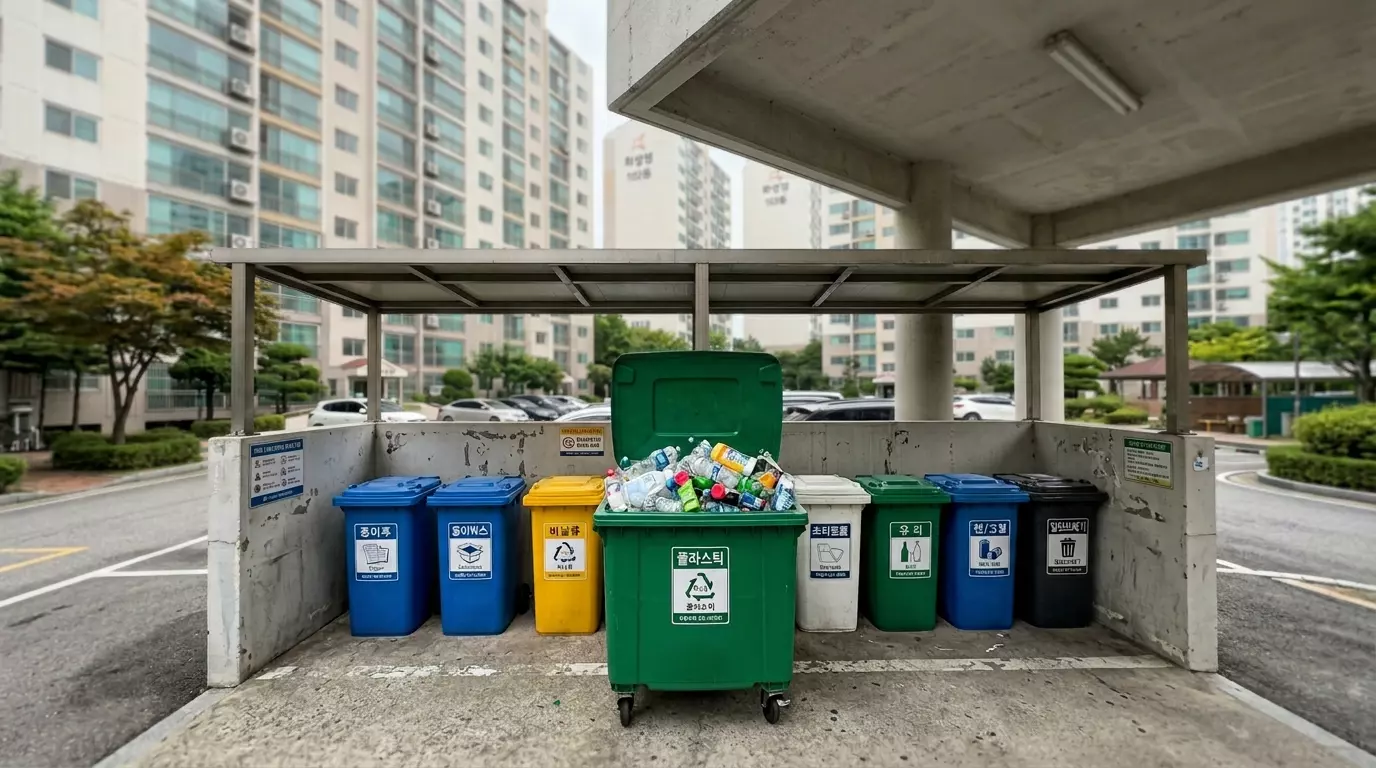
Apartments in large complexes typically have a dedicated waste room (분리수거장) with separate bins already labeled. Smaller villas (빌라) and one-rooms usually share a curbside spot with neighbors, and collection only happens on specific nights. Knowing which setup you’re in determines everything else — from when you put bags out to what kind you need to buy.
If you try to sort correctly but miss the schedule, the bags sit. If you buy bags but get the wrong district’s version, they get tagged. The sequence matters because each step depends on the one before it.
Step 1 — Check Your District’s Collection Schedule
Before buying bags or sorting anything, you need to know when trash and recycling get picked up in your specific area. In most districts, general waste (일반 쓰레기) collection runs two to three nights per week, while recyclables are collected on different days.
The schedule varies not just by district but sometimes by neighborhood within the same district. Two streets apart can have different pickup nights. This is the first layer of recycling korea foreigners have to decode on their own.
Here’s how to find yours:
If you live in a large apartment complex, the management office (관리사무소) usually has the schedule posted on the first floor or near the waste room. Ask the building guard or manager — they’ll know the exact days. For villas and one-rooms, check the notice board near the entrance. Some buildings tape the schedule directly onto the wall near the trash area.
If nothing’s posted and you can’t read what is, your district office website lists collection schedules — search for “[your district name] 분리수거 요일” in Naver. Most district offices also run a phone line, though Korean language ability helps there. One workaround: the Clean Seoul app (서울시 분리배출) covers Seoul districts and shows schedules by address, though it’s Korean-only.
Getting this step right matters because in many neighborhoods, putting bags out on the wrong night triggers a fine. The standard penalty ranges from ₩50,000 to ₩100,000 depending on the district — and it’s enforced through CCTV near designated collection spots.

Step 2 — Get the Right Bags Before Trash Piles Up
In Korea, you can’t throw general waste into any bag. The system requires jongnyangje bags (종량제 봉투) — district-specific, paid garbage bags that serve as both a container and a disposal fee. Using the wrong bag, or a regular plastic bag, results in the trash being left behind with a fine sticker attached.
Each district prints its own jongnyangje bags. Mapo-gu bags only work in Mapo-gu. Songpa-gu bags are rejected in Gangnam-gu. If you moved from one district to another, leftover bags from the old district are useless in the new one.
You can buy them at most convenience stores, supermarkets, and some hardware stores. Bags come in different sizes — typically 5L, 10L, 20L, and 50L. A pack of ten 20L bags usually costs between ₩2,000 and ₩5,000 depending on the district. Ask for “종량제 봉투” at the counter if they’re not on the shelf.
One thing that confuses people: jongnyangje bags are only for general waste — the stuff that doesn’t go into recycling or food waste. Recyclables go into separate bins without special bags. Mixing recyclables into a jongnyangje bag defeats the purpose and wastes money. This bag system is one of the first practical aspects of recycling korea foreigners need to internalize.
If you’re moving into a new place and haven’t set up your address registration yet, you can still buy bags at any store in your district. No ID required.
Step 3 — Handle Food Waste Separately
Food waste (음식물 쓰레기) never goes into the regular jongnyangje bag. Korea processes it separately — usually into animal feed or compost — and the system for disposing of it depends on your building.
Large apartment complexes almost always have RFID-enabled food waste bins (음식물 처리기) on the ground floor or in the basement. You hold your resident card or a registered tag against the sensor, the lid opens, and you dump the food waste inside. The system weighs what you put in and charges a per-use fee to your building maintenance bill.
Villas and smaller buildings usually don’t have RFID bins. Instead, you buy small food waste bags — also district-specific, different from jongnyangje bags — and place them out on designated nights. These bags are usually yellow or green and smaller than regular waste bags. They cost around ₩200–₩400 each.
The confusion usually hits around what counts as food waste. The general rule: if an animal can eat it, it’s food waste. If not, it goes into general waste.
Food waste: fruit peels, leftover rice, vegetable scraps, bread, meat scraps, tea leaves.
Not food waste (goes into general trash): bones, shellfish shells, nutshells, fruit pits, onion skins, corn cobs, eggshells. These items don’t decompose the same way and get rejected at processing facilities.
That distinction catches nearly everyone at least once. If the building’s RFID bin rejects your deposit or a food waste bag gets tagged, it’s almost always because something non-food-waste ended up inside. Among all the steps in recycling korea foreigners struggle with, food waste sorting produces the most repeat violations.
A Few Things Worth Clarifying
Can I use regular plastic bags instead of jongnyangje bags?
No. Using a regular bag — supermarket bags, trash bags from home country, or any non-designated bag — means the waste won’t be collected. It’ll be left at the spot with a sticker, and the fine can reach ₩100,000. Even clear bags that look similar don’t pass. The district name and logo must be printed on the bag.
What happens if I put trash out on the wrong night?
It stays. And if CCTV identifies who left it, a fine notice gets sent — either to your mailbox or through your building’s management office. In large complexes, the management office sometimes absorbs the first offense and gives a verbal warning. In smaller buildings, the fine goes directly to the person registered at that address. Wrong-night disposal is one of the fastest ways recycling korea foreigners get penalized, and most districts enforce it actively — especially in residential areas near main roads.
Do all apartments have RFID food waste bins?
No. Most large apartment complexes built after 2010 have them. Older complexes and nearly all villas or one-room buildings use the bag system instead. Some districts are retrofitting smaller buildings with shared RFID bins on the street, but availability varies. Ask your landlord or building manager which system your building uses before you buy food waste bags.
Where can I find recycling rules in English?
There’s no single official English-language recycling guide that covers all districts. The Korea Environment Corporation (한국환경공단) publishes some materials, but district-specific details are almost always in Korean only. This language gap is a core reason recycling korea foreigners attempt often starts with confusion. The most reliable method is photographing the sorting guide posted near your building’s bins and using a translation app. Some expat community groups maintain translated charts for popular districts — Naver Cafe groups and Facebook groups for Seoul neighborhoods often have these pinned.
Step 4 — Sort Recyclables by Category
Recyclables go into designated bins without a paid bag — just sorted and clean. Most collection spots have separate sections for five to eight categories, though the exact breakdown depends on the district.
The standard categories across most areas:
Paper (종이류): newspapers, cardboard, paper bags, envelopes. Flatten cardboard boxes before placing them. Coated paper, wax-coated cups, and paper with food residue go into general waste instead.
Plastics (플라스틱): bottles, containers, packaging marked with the recycling symbol. Remove caps and rinse. Labels don’t need to be removed in most districts, but some stricter areas require it. Styrofoam is a separate category in many buildings.
Glass (유리): bottles and jars only. Rinse them out. Broken glass or ceramics go into general waste — not the glass bin. Some buildings have color-sorted glass bins (clear, green, brown) but most smaller buildings just have one.
Cans (캔류): aluminum and steel cans, including food cans. Rinse and crush if possible. Aerosol cans should be empty before disposal — puncture if your building’s rules require it.
Vinyl/Plastic bags (비닐류): clean plastic bags, wrap, and film. This is separate from rigid plastics in most districts. Bundle them together rather than tossing one at a time.
Clothes and textiles (의류): some complexes have a separate bin for old clothing. If not, municipal collection boxes (usually white or green metal bins) are placed at intervals along major streets.
The number one rule that applies everywhere: rinse containers before recycling. Food residue on a plastic container or glass jar means it gets rejected at the sorting facility and ends up in landfill anyway. Two seconds of rinsing makes the difference. Across every category of recycling korea foreigners handle, this single habit prevents the most issues.
Step 5 — Dispose of Bulky Items the Right Way
Furniture, mattresses, large electronics, and anything too big for a regular bag falls under 대형폐기물 (large waste) — and Korea doesn’t let you put these out with normal trash. This step sits outside the daily routine of recycling korea foreigners learn first, but it comes up fast when moving in or out.
You need to request a pickup sticker from your district office first. This can be done online through your district’s website or, in many areas, through the 여기로 app. Select the item type, pay the fee (usually ₩3,000 to ₩15,000 depending on size), and receive a confirmation sticker or number. Attach it to the item and place it at the designated spot on the scheduled date.
Putting large items out without a sticker is an easy way to get a ₩100,000+ fine. The item will sit there untouched while a notice works its way back to the registered occupant of your unit.
Electronics have additional rules. Small electronics — hair dryers, keyboards, old phones — can often go into dedicated e-waste bins at community centers or large apartment complexes. Larger electronics like refrigerators, washing machines, and air conditioners require a separate pickup arranged through the Korea Environment Corporation or your district office. When you’re setting up your apartment, ask the previous tenant or landlord whether any large-item disposal was left unfinished — inheriting someone else’s dumped furniture with no sticker can become your problem.
Where Recycling Korea Foreigners Usually Go Wrong
After the individual steps make sense, the problems that actually generate fines and neighbor complaints tend to cluster around the same patterns. These are the five scenarios where recycling korea foreigners run into repeatedly during the first few months.
Wrong timing. Putting bags out in the morning when collection happens at night, or on Tuesday when your street collects on Wednesday. Most collection runs happen between 8 PM and midnight — not in the morning. Bags left out during the day attract complaints and stickers faster than bags left on the wrong night.
Wrong bag, right district. Some people buy jongnyangje bags from the correct district but grab the wrong type — food waste bags instead of general waste bags, or a size that doesn’t match what the building allows. In certain large complexes, the management office only accepts 20L or smaller bags. Check before buying in bulk.
Recyclables in jongnyangje bags. This is money wasted. Any recyclable item in a paid general waste bag adds cost for no reason and reduces your recycling rate — which some apartment complexes now track per unit. Pull out plastics, cans, paper, and glass before tying the bag shut.
Food waste mixed with bones or shells. The RFID bin rejects the weight, or the bag gets tagged with a violation notice. Bones, shells, and hard pits go into general waste — this is the single most common mistake foreigners make with food waste sorting in Korea.
Not rinsing recyclables. A container with sauce or food residue contaminates the bin. In buildings where neighbors share collection space, one contaminated bag can cause complaints directed at the entire floor. Rinse takes seconds; the social friction lasts longer.
The Bottom Line
Korea’s recycling system isn’t hard once you’ve done it twice. The difficulty is entirely in the first week, when you don’t know your schedule, don’t recognize the bag types, and can’t read the signs near the bins. Most of the stress around recycling korea foreigners experience disappears once those basics lock in.
Start with the schedule and the bags. Everything else — food waste, recyclable sorting, large items — builds on those two things being right. Photograph the notice near your building’s trash area on the day you move in. Buy a pack of the right jongnyangje bags from the nearest convenience store that same day.
From there, the system becomes routine faster than you’d expect.