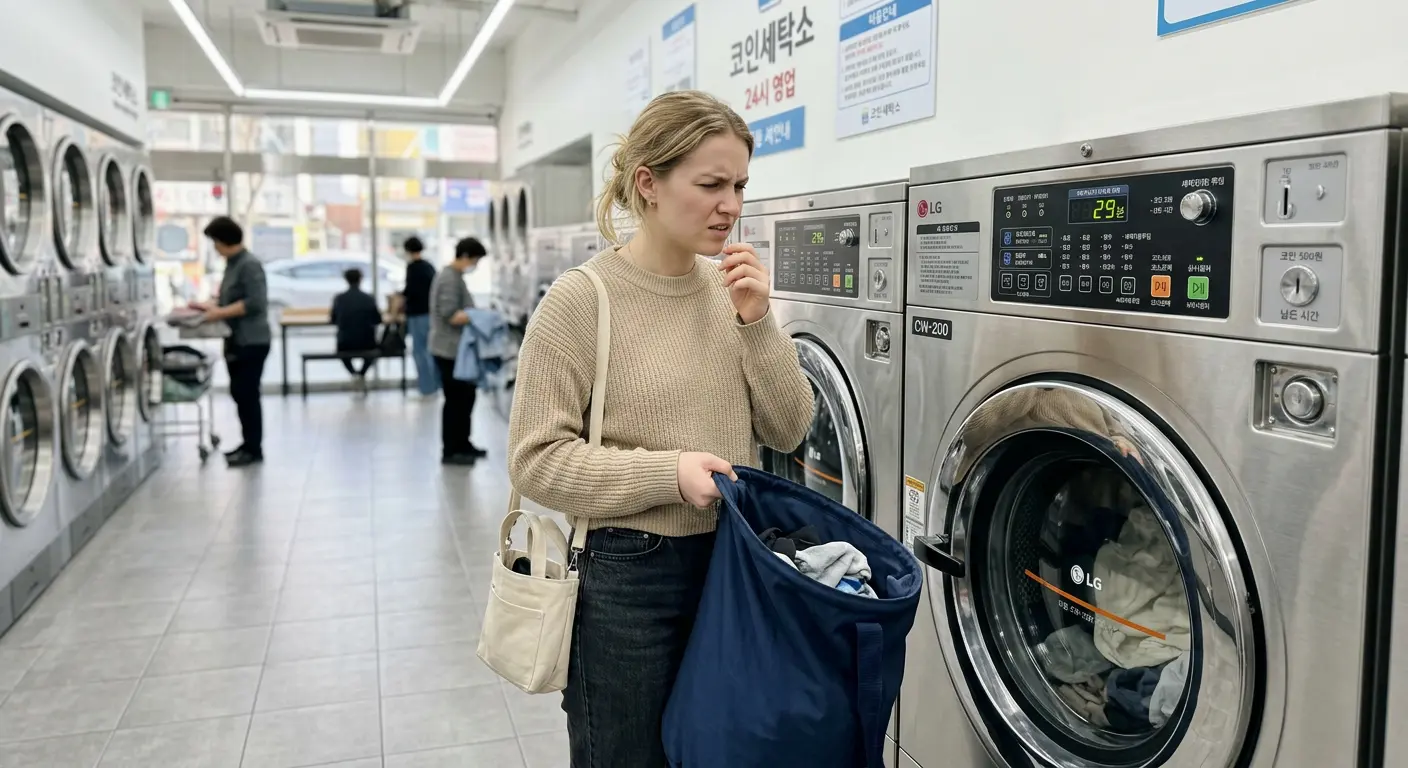
What happens when you walk into a Korean laundromat for the first time, bag of dirty clothes in hand, and every single button on every machine is in Korean? No staff at the counter. No instruction sheet on the wall in English. Just rows of industrial machines humming in an empty room.
This is the first surprise most people face at a korean laundromat foreigners rely on during their stay — the experience looks familiar from the outside, but the details inside don’t match what you’re used to. The machines are large and modern, the space is clean, and the prices seem reasonable. But between the Korean-only controls, the coin-or-app payment split, and the separate dryer fees nobody mentions upfront, a simple laundry run can stall before a single cycle starts.
The gap between what works immediately and what quietly blocks you is wider than it looks. Knowing which parts need preparation — and which don’t — saves both time and money from the first visit.
What Korean Laundromat Foreigners Usually Expect
If you’ve used a laundromat anywhere else in the world, the mental picture is roughly the same: walk in, load clothes, insert coins or swipe a card, press start, wait, switch to dryer, done. Maybe there’s a detergent vending machine near the entrance. Maybe the instructions have icons universal enough to follow without reading.
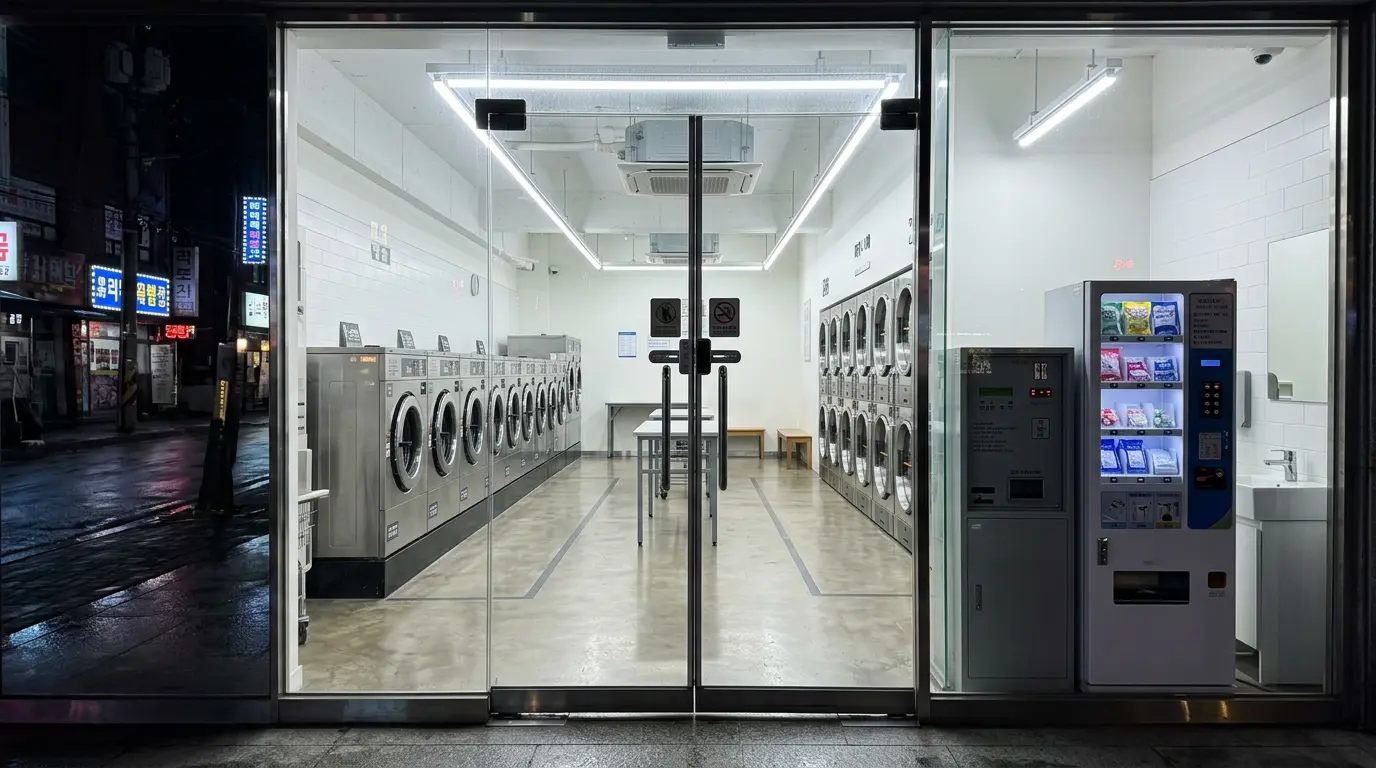
Korea’s coin laundromats (코인세탁소 or 셀프 빨래방) look exactly like this from the outside. They’re usually well-lit, 24-hour, unmanned spaces with large commercial-grade washers and dryers lined up neatly. Some newer chains even have café-style seating areas and free Wi-Fi. The machines themselves are often from brands like LG or Samsung, though commercial-only brands like Roper (로퍼) are also common.
That familiarity is what catches people off guard. Because the gap isn’t in the equipment. It’s in the interface, the payment options, and the assumptions the system makes about what every customer already knows.
What Works Without Any Setup
The good news is that several things at a korean laundromat foreigners visit work from the moment you step inside — no registration, no app, no Korean language skill needed.
Coin-operated machines still exist. Many laundromats, especially in university areas and older neighborhoods, accept ₩500 and ₩1,000 coins directly. You feed coins into the slot, select a cycle (the big round button), and the machine starts. A standard wash cycle runs 30 to 40 minutes and costs around ₩4,000 to ₩6,000 depending on machine size and location.
Most locations also accept T-money cards (교통카드) — the same transportation card you use on buses and subways. If you already carry one for transit, you can tap it on the machine’s card reader without needing any extra setup. This is often the easiest payment path for foreigners who haven’t opened a Korean bank account yet.
Detergent is usually auto-dispensed. Unlike some laundromats abroad where you bring your own, the majority of Korean coin laundromats have built-in detergent and fabric softener that release automatically during the wash cycle. The cost is already included in the machine fee. A few older or budget locations require you to buy detergent separately from a small vending machine on-site — but this is the exception, not the rule.
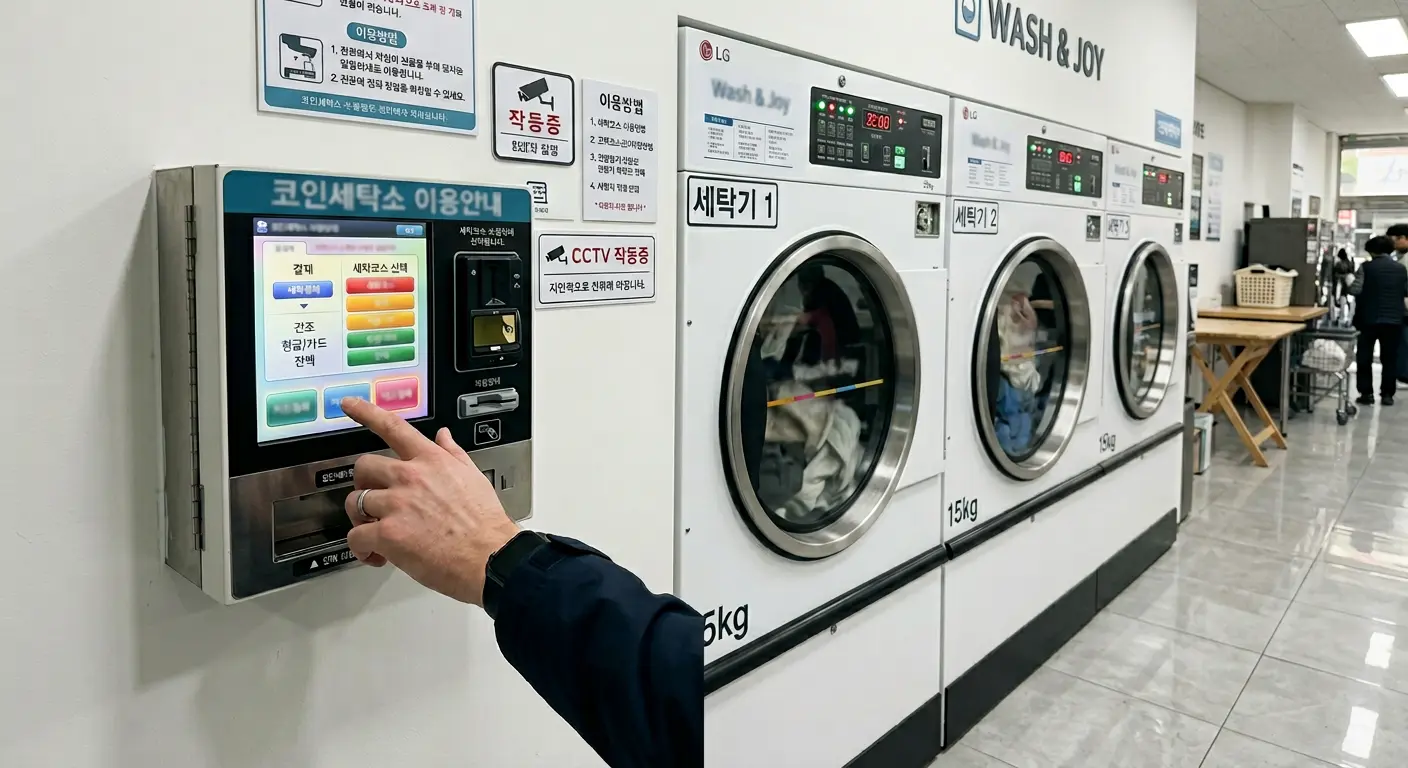
Dryers are always available separately. Korean coin laundromats typically have more dryers than washers, because many Korean apartments lack built-in dryers. A 30-minute drying cycle usually costs ₩3,000 to ₩4,500, with additional time available in ₩500 increments. You’ll need to move your clothes from the washer to a dryer yourself — they’re separate units.
Where the System Quietly Locks You Out
Here’s where the korean laundromat foreigners experience diverges sharply from the familiar picture.
Every button is in Korean. The cycle selector, water temperature options, spin speed, and special modes (like blanket wash, antibacterial cycle, or extra rinse) are all labeled in Korean. There are no English subtitles, no universal icons on most panels. The key labels you’ll encounter are 표준 (standard), 침구세탁 (bedding), 헹굼 (rinse), and 탈수 (spin). If you press the wrong button — say, selecting a 60-minute bedding cycle when you just need a basic 30-minute wash — there’s no way to cancel or get your money back. The machine starts the moment payment is accepted.
Newer chains are shifting to app-only or QR payment. Locations run by franchise brands like WashTeria (워시테리아) or Laundry Express (런드리 익스프레스) increasingly require payment through a Korean app. That means a Korean phone number for registration, and in some cases a linked Korean payment method. If the machine only shows a QR code and no coin slot, you’re locked out without a Korean phone setup.
There’s no one to ask. Korean coin laundromats are unmanned (무인) by design. No attendant, no help desk, no phone number posted on the wall. If the machine jams, if you accidentally select the wrong cycle, or if the dryer eats your coins without starting — you’re on your own. Some chains have a customer service number printed on the machine, but it’s a Korean-language automated line.
Dryer costs aren’t obvious upfront. The sticker price on the washer doesn’t include drying. A single load that costs ₩5,000 to wash will cost another ₩3,500 to ₩4,500 to dry. Thick items like towels or blankets often need 45 to 60 minutes of drying, which pushes the total cost for one load to ₩10,000 or more. This shows up in expat forums regularly as a surprise. If you’re doing laundry weekly, the monthly cost adds up to ₩40,000–₩50,000 — a recurring expense that catches most people off guard.
Workarounds That Save the Trip
None of these blocks are permanent. Each one has a workaround that takes less than five minutes to set up — if you know about it before you walk in.
For the Korean-only buttons, use your phone’s camera translate function. Both Google Translate and Papago (a Korean-made app that handles Korean text more accurately) offer real-time camera translation. Hold your phone over the control panel, and the Korean text converts to English on your screen. Save a screenshot of the translated panel during your first visit so you don’t need to translate again next time. The buttons you’ll use most are 표준 (standard wash), 세탁 시작 (start wash), and 건조 시작 (start dryer).
For payment, carry a T-money card loaded with at least ₩20,000. You can top up T-money at any convenience store in Korea using cash. This bypasses both the coin shortage problem and the app-only payment wall. If the machine only takes coins, convenience stores near laundromats can usually break a ₩10,000 bill into ₩1,000 coins if you ask — but calling ahead or checking a machine’s payment options on Naver Map saves the trip.
For finding locations, search 코인세탁소 or 셀프빨래방 on Naver Map or Kakao Map. Many listings include user photos that show whether the machines have coin slots, card readers, or QR-only payment. This one check before leaving your apartment can prevent wasted trips. Some listings also show real-time machine availability at chain locations.
One thing worth knowing if you’re troubleshooting dryer costs: running two shorter dryer cycles often dries clothes better than one long one, because you can shake and redistribute the clothes in between. This also lets you pull out already-dry items and save on the second cycle.
3 Assumptions That Break the Process
Most problems at a coin laundry in Korea trace back to one of three wrong assumptions made before leaving the apartment.
Assumption 1: “I can pay with my credit card or cash bills.” Most coin laundromats don’t accept international credit cards. Many don’t accept Korean credit cards either — the machines are designed for coins, T-money, or a specific app. Showing up with only a ₩50,000 bill and no coins means you can’t start a single machine. The workaround is simple — T-money card or pre-collected ₩1,000 coins — but you have to know this before you go.
Assumption 2: “The dryer is included in the wash price.” It never is. Washing and drying are separate transactions on separate machines. The pricing display on the washer shows only the wash fee. Budget for roughly double what the washer display shows if you need to dry your clothes as well.
Assumption 3: “There will be someone to help if something goes wrong.” There won’t be. If the machine takes your payment but doesn’t start, if your clothes get stuck, or if you can’t figure out which button to press — the only resource is whatever you brought in on your phone. Downloading a translation app and having the laundromat chain’s customer service number saved beforehand is the closest thing to backup you’ll get.
Matching Your Laundry Setup to Your Stay
How you handle laundry in Korea depends almost entirely on your living arrangement and how long you’re staying.
If you’re staying in a guesthouse or one-room apartment, check whether the unit includes a washing machine before signing the contract. Most furnished one-rooms (원룸) in Korea come with a built-in washer as part of the standard appliance package — “full option” (풀옵션) listings almost always include one. If your unit has a washer, you’ll only need a coin laundromat for occasional large loads like blankets or winter coats that don’t fit in the compact home machine.
For short-term stays — under 90 days, tourist visa, hotel or Airbnb — a coin laundromat is usually your primary option. Hotels sometimes offer laundry services, but the per-item pricing is steep. Hotels in tourist areas often charge ₩8,000 to ₩20,000 per item for laundry service. A full load at a nearby coin laundry costs ₩5,000 total.
If your apartment has a washer but no dryer — which is common — you might still visit a korean laundromat foreigners use nearby specifically for the dryer. Many residents in Korea do this: wash at home, carry damp clothes to the laundromat, and only pay for the ₩3,500 drying cycle. This halves the per-visit cost and is especially useful during Korea’s rainy season (장마, typically late June through July) when air-drying indoors leaves clothes with a musty smell.
For utility costs and what’s included in a Korean apartment, the details in the utilities setup guide cover what starts automatically and what doesn’t — including water and electricity billing that affects home laundry costs. Korea’s progressive electricity rate structure means heavy dryer use at home can push your bill into a higher pricing tier.
Questions That Come Up Most
How much does a full load cost at a Korean coin laundromat?
A standard wash cycle costs ₩4,000 to ₩6,000 depending on machine size and location. Drying adds another ₩3,500 to ₩4,500 for 30 minutes. For a complete wash-and-dry, expect to spend ₩8,000 to ₩11,000 per load. Larger machines designed for blankets or bedding cost more — sometimes ₩7,000 to ₩8,000 for the wash alone. According to Korea’s consumer protection standards administered by the Korea Legal Information Center (찾기쉬운 생활법령정보), pricing for laundry services — including self-service — should be clearly posted at the point of use.
Do I need to bring my own detergent?
In most cases, no. The majority of Korean coin laundromats auto-dispense detergent and fabric softener as part of the wash cycle. The cost is built into the machine fee. A few locations — especially older ones or certain franchise branches — require you to buy a single-use detergent packet from a vending machine on-site (usually ₩500 to ₩1,000). If you’re unsure, bringing a small travel-size detergent from a convenience store is a safe backup. For dryers, some people use dryer sheets (건조기 시트), which you can buy at most convenience stores or Daiso.
Can I use a foreign credit card to pay?
Almost never at a coin laundromat. The machines are built for coins (₩500 and ₩1,000), T-money transportation cards, or Korean payment apps. International Visa or Mastercard won’t work. Paying in Korea as a foreigner often runs into this kind of wall at unmanned services. Your safest option is a T-money card loaded with cash at any convenience store.
Are Korean coin laundromats open 24 hours?
Most are. Because they’re unmanned, there’s no opening or closing time — you can walk in at 2 AM and start a load. A few locations in residential buildings may have restricted hours (usually closing between midnight and 6 AM) due to noise regulations. Chain locations in commercial areas almost always run 24/7. Check the Naver Map listing for specific hours before making a late-night trip.
Are there laundry services that wash and fold for you?
Yes. Traditional dry cleaners (세탁소) offer full-service laundry — drop off, pick up a day or two later. Pricing is per item, typically ₩3,000 to ₩5,000 for shirts and ₩8,000 to ₩15,000 for coats or suits. App-based services like LaundryGo (런드리고) and 세탁특공대 offer pickup and delivery, but registration requires a Korean phone number and address. For consumer protection related to laundry service disputes in Korea, the Korea Consumer Agency (한국소비자원) provides guidelines on compensation standards when items are damaged.
Before You Walk In: What to Check
☐ T-money card loaded with at least ₩15,000 (or ₩1,000 coins ready)
☐ Translation app installed — Papago or Google Translate with camera mode
☐ Location checked on Naver Map — search 코인세탁소 and verify payment type from photos
☐ Budget doubled — wash price ≠ total price (dryer is separate)
☐ Laundry basket or large bag — no bags provided on-site
☐ Screenshot of translated control panel from first visit saved for next time
☐ Backup plan for app-only machines — if no coin slot, check the next nearest location
Where to Go From Here
The korean laundromat foreigners rely on in Korea works well once you clear the first-visit friction. The machines are powerful, the spaces are clean, and the 24-hour access is genuinely convenient. The problems aren’t about the laundry — they’re about the interface gap between what the system assumes you know and what you actually do.
A loaded T-money card, a camera translation app, and a five-minute Naver Map check before leaving your apartment cover almost every obstacle. After the first visit, the process becomes routine. It’s one of those things in Korea that’s harder to figure out than it is to actually do.