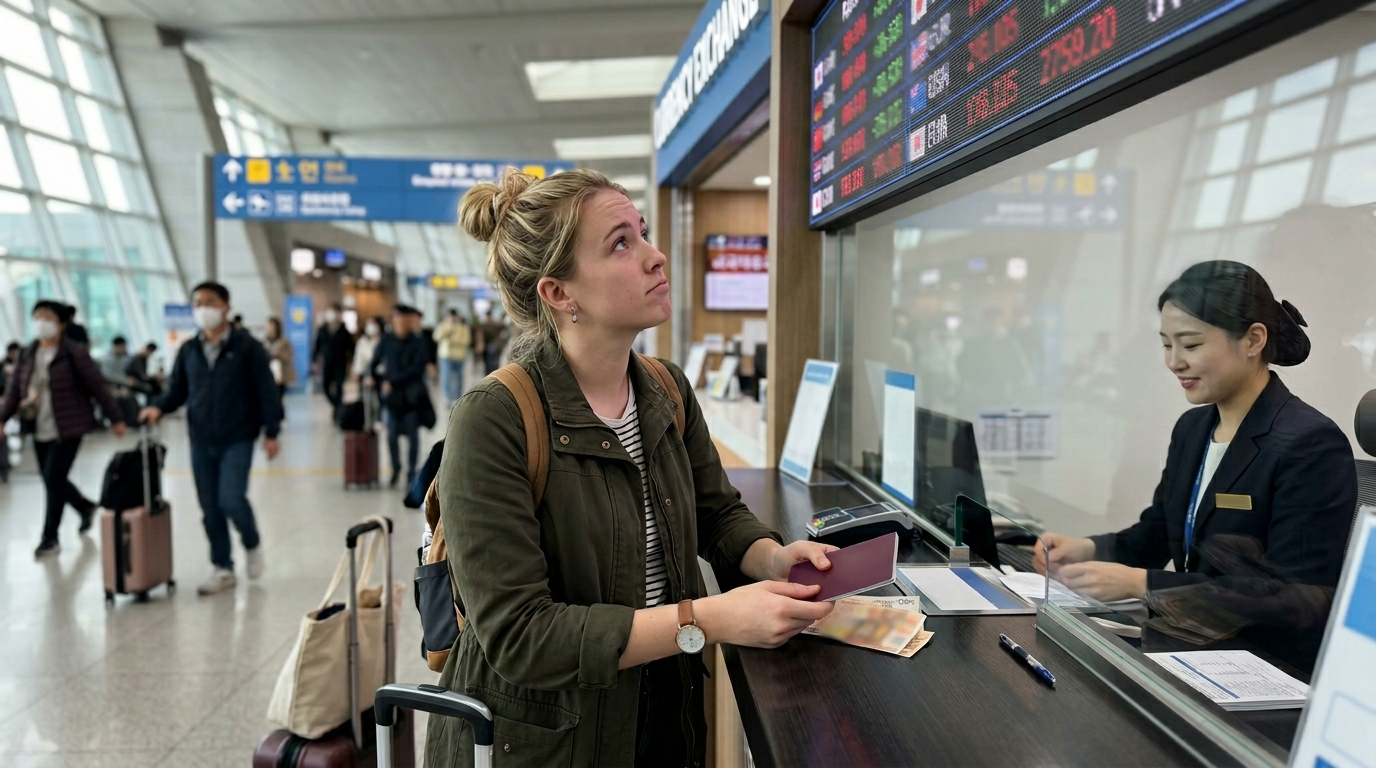
The method you choose for currency exchange korea foreigners deal with matters more than the amount you’re converting. A ₩500,000 exchange at the airport versus a city shop can differ by ₩15,000 to ₩30,000 — and most people make that choice based on convenience alone, without checking the spread.
Three main paths exist: airport counters, city exchange shops, and card-based options. Each one works. None of them is a scam. But the fee structures are completely different, and the gap widens the longer you stay and the more you convert.
This breakdown compares the actual costs across all three methods so you can pick the one that fits your situation — whether you’re landing for a two-week trip or settling in for a year.
Why There’s No Single Best Way to Convert Money in Korea
Korea’s currency exchange landscape splits into three distinct channels, and each one exists because it serves a different type of visitor. Airport counters target people who need won immediately. City exchange shops target people who can wait a few hours for a better rate. Card-based options target people comfortable with digital tools and planning ahead.
The problem is that most foreigners only learn about one of these channels — usually the airport booth — and assume the rate they’re getting is standard. It isn’t.
Exchange rates in Korea fluctuate based on where you convert, when you convert, and how much you convert. The Bank of Korea publishes a daily market reference rate, but no retail exchange service matches it exactly. Every option adds a margin. The question is how large that margin is — and whether you’re aware it’s there.
One thing that trips people up: Korea is still a heavily cash-dependent society in certain areas. Traditional markets, smaller restaurants, and some transportation services require Korean won in hand. So even if you plan to use cards for most purchases, the currency exchange korea foreigners need to think about isn’t optional — it’s a question of how much and through which channel.
Airport Exchange Counters — Convenience at a Hidden Cost
Incheon International Airport has multiple exchange counters on both the arrivals and departures floors. They’re open long hours, accept most major currencies, and require no reservation. You hand over cash, show your passport, and walk out with Korean won.
That simplicity comes with the widest spread of any option. Airport counters typically charge a 3% to 5% margin over the market rate — sometimes more for less common currencies. On a $500 USD exchange, that’s roughly ₩20,000 to ₩35,000 lost to the spread alone, before any posted commission.
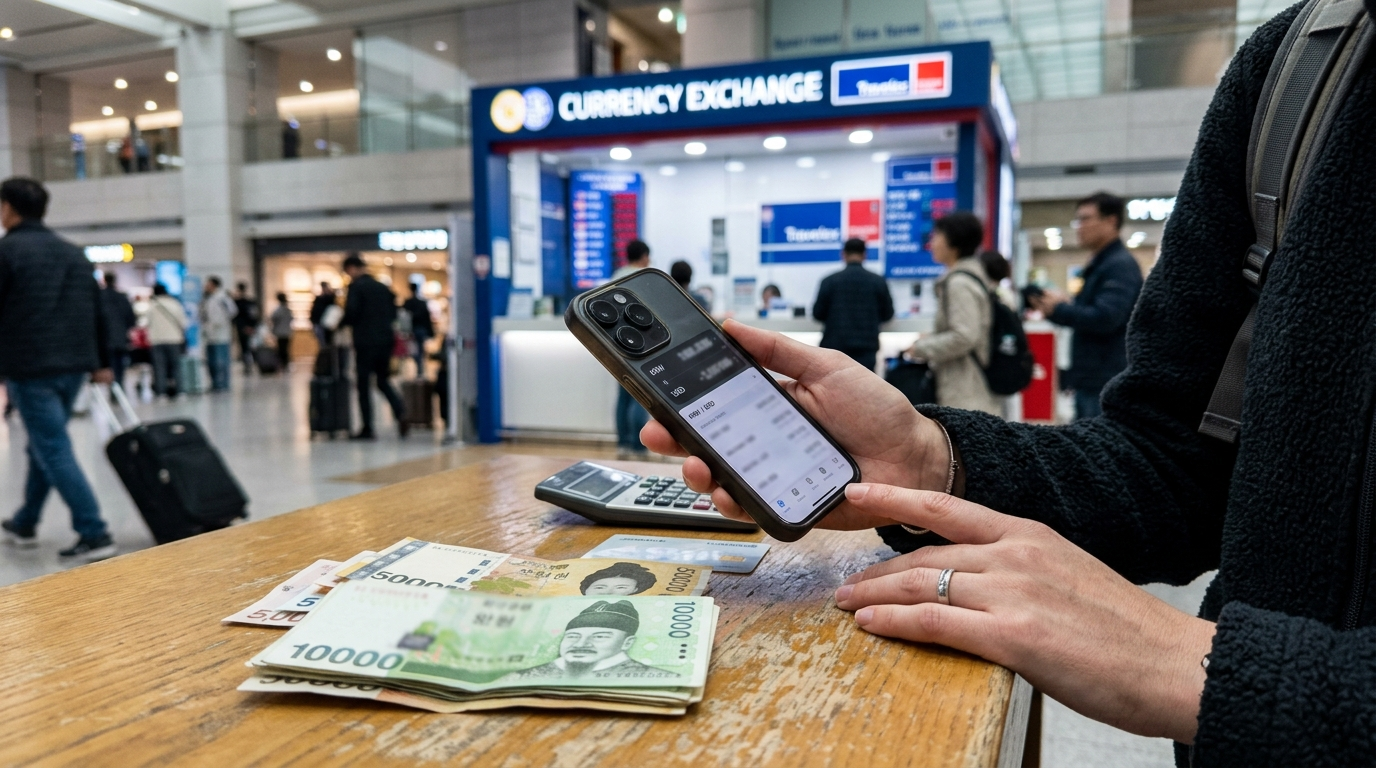
Some booths advertise “no commission” — but that doesn’t mean no fee. The fee is built into the rate itself. A counter showing “no commission” with an unfavorable rate can cost more than one that charges ₩3,000 commission but offers a tighter spread.
When the airport makes sense: if you need ₩50,000 to ₩100,000 immediately for airport transportation, a taxi, or a SIM card purchase, the convenience can justify the premium. The loss on a small amount is minor — maybe ₩2,000 to ₩5,000.
Converting your entire trip budget at the airport, though, is where the cost adds up. Anyone exchanging $1,000 or more should seriously consider the next two options.
City Exchange Shops — Where Rates Actually Compete
When it comes to currency exchange korea foreigners often discover too late, Seoul’s dedicated exchange shops in neighborhoods like Myeongdong, Itaewon, and Dongdaemun operate on much thinner margins than airport counters. The best city shops offer spreads of 1% to 2% — sometimes even tighter for USD, JPY, CNY, and EUR.
Myeongdong’s underground exchange shops are the most cited by long-term residents and travel forums alike. The competition among shops in that area keeps rates close to the market reference. You can often walk between three or four shops within a single block and compare posted rates directly.
A few things to know before heading to a city exchange shop:
Most require passport identification. Some have minimum exchange amounts (typically $100 equivalent). Operating hours are usually 9:00 AM to 7:00 PM, though popular tourist-area shops may stay open later. Not all shops accept every currency — if you’re exchanging Thai baht, Vietnamese dong, or other Southeast Asian currencies, check beforehand.
The practical trade-off is time and access. You need to physically go to the shop, which means you need to get there first — usually by subway or bus from wherever you’re staying. For someone arriving late at night or heading straight to a location outside Seoul, the city exchange shop isn’t an immediate option.
For anyone staying in Seoul for more than a few days, though, a trip to Myeongdong or a similar exchange hub during a normal afternoon can save a meaningful amount. On a $1,000 exchange, the difference between an airport counter and a competitive city shop can exceed ₩30,000.
Cards and Digital Wallets — The Option Most Visitors Skip
A growing number of foreigners arriving in Korea skip physical cash exchange entirely — or minimize it — by using multi-currency cards, travel cards, or direct ATM withdrawals with favorable-rate debit cards. This third path for currency exchange korea foreigners increasingly prefer works best with some preparation before departure.
Services like Wise (formerly TransferWise) let you load Korean won at near-market rates before you arrive. You receive a physical or virtual card, use it at Korean merchants, and avoid the exchange counter entirely. The fee is transparent: typically 0.4% to 1.0% depending on the currency pair and payment method.
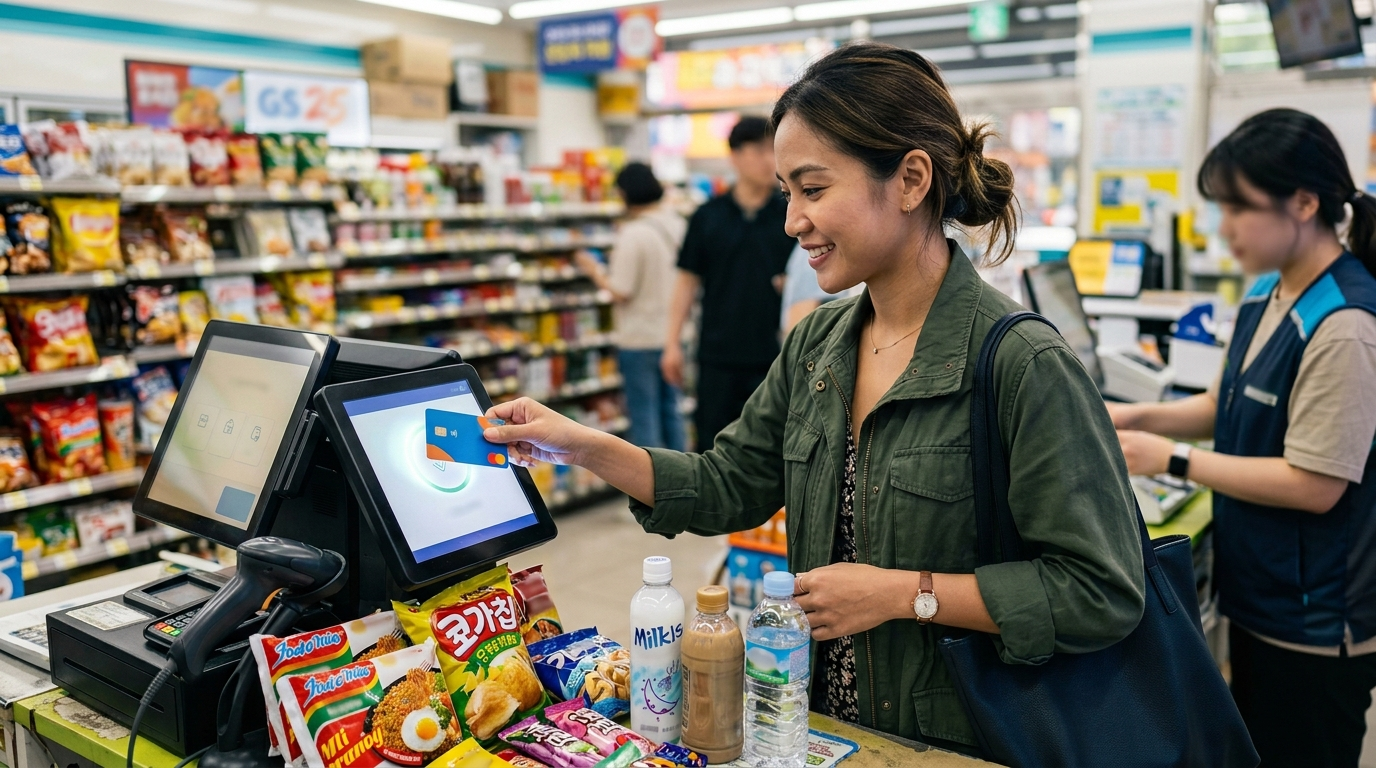
ATM withdrawal is another route. Korean ATMs at major banks and convenience stores accept international cards (Visa, Mastercard, sometimes Amex). The catch: your home bank may charge a foreign transaction fee (1%–3%), the Korean ATM operator may charge its own fee — ₩2,000–₩3,000 at bank branches, up to ₩6,000 at convenience store ATMs — and there’s usually a daily limit.
Watch for DCC (Dynamic Currency Conversion).
Some Korean ATMs ask whether you’d like to be charged in your home currency instead of Korean won. Always choose Korean won. Selecting your home currency triggers DCC — a hidden 3% to 5% markup on top of everything else. The ATM screen presents it as a convenience, but it’s an additional fee that benefits the ATM operator, not you.
If your home bank charges 3% foreign transaction fees, ATM withdrawal costs roughly the same as an airport exchange — defeating the purpose. But some banks and neobanks (Charles Schwab, Revolut, some credit unions) reimburse ATM fees and charge no foreign transaction fees. With those cards, ATM withdrawal becomes one of the cheapest methods available.
The digital path has one significant limitation in Korea: not every merchant accepts foreign cards. Smaller restaurants, traditional markets, street food vendors, and some taxis still require cash or Korean-issued cards. Relying entirely on a foreign card means running into payment walls, especially outside major commercial areas.
The practical approach most experienced visitors use: carry enough cash for situations where cards fail, and use a low-fee card for everything else.
What Currency Exchange Korea Foreigners Actually Need to Compare
Raw exchange rates don’t tell the full story. What matters is the total cost — rate spread plus fees plus any hidden charges. Here’s how the three methods compare on a $500 USD exchange (approximate, based on typical 2025–2026 conditions):
| Factor | Airport Counter | City Exchange Shop | Card / Digital |
|---|---|---|---|
| Rate Spread | 3%–5% | 1%–2% | 0.4%–3%* |
| Additional Fees | ₩0–₩5,000 | Usually ₩0 | ₩2,000–₩6,000 per ATM |
| Estimated Loss on $500 | ₩20,000–₩35,000 | ₩7,000–₩14,000 | ₩3,000–₩20,000* |
| Availability | 24/7 at Incheon | Business hours | Anytime (ATMs vary) |
| Best For | Small immediate needs | Bulk cash exchange | Ongoing daily spending |
*Card/digital range depends heavily on your specific bank’s foreign transaction fee policy. A 0% fee card sits at the low end; a 3% fee card sits at the high end.
The table makes one thing clear: currency exchange korea foreigners handle doesn’t have a universal winner. The cheapest option depends entirely on your bank, your timing, and how much cash you actually need.
3 Assumptions That Inflate Your Exchange Costs
Assumption 1: “No commission” means no fee. Airport counters and some city shops advertise zero commission. The fee is embedded in the exchange rate itself. A “no commission” booth offering 1,320 won per dollar when the market rate is 1,370 is charging a 3.6% spread. That’s the fee — it’s just not labeled as one.
The only way to check is to look up the current market rate on your phone (search “USD to KRW” on Google) and compare it to the posted rate. The difference is your real cost.
Assumption 2: Exchanging everything at once is smarter. Converting your entire budget on arrival means locking in one rate. If that rate happens to be an airport rate, you’ve committed your whole budget to the most expensive option. A more effective approach for many visitors: exchange a small amount at the airport for immediate needs, then convert the rest at a city shop or withdraw gradually from ATMs.
There’s also the safety angle. Carrying ₩1,000,000+ in cash through an unfamiliar city on your first day creates unnecessary risk.
Assumption 3: Your home country’s exchange is better. Some visitors exchange currency before flying, at their home bank or airport. In most cases, rates for Korean won outside Korea are significantly worse than rates inside Korea. Korean won isn’t a major global reserve currency, so international banks charge wider spreads. The smartest currency exchange korea foreigners can make starts after landing — not before.
Matching Your Exchange Method to Your Stay
Your stay length and spending pattern determine which currency exchange korea foreigners should prioritize.
Short trip (under 7 days), tourist areas only: Exchange a small amount at the airport. Visit a Myeongdong or Itaewon exchange shop on your first or second full day for the bulk amount. Use your foreign card for hotel and larger restaurant payments where paying by card works. Total cash needed is usually ₩200,000–₩500,000 depending on your style.
If you’re staying a few weeks, a multi-currency card loaded with won before arrival covers most daily spending. Supplement with one city exchange shop visit for cash-only situations. This combination keeps total exchange costs under 1%.
Long-term residents face a different calculation. Once you have a Korean bank account, international wire transfers through services with competitive rates become the most cost-effective method. The initial weeks before your account is set up, though, still require one of the three methods above.
One pattern that shows up repeatedly in expat forums: the currency exchange korea foreigners regret most is the large airport conversion on day one. People arriving for a year-long stay who exchange $2,000–$3,000 at the airport lose ₩80,000–₩150,000 in spread fees. That money could have been saved by exchanging just ₩100,000 at the airport and handling the rest through a city shop or card over the following days.
Questions That Come Up Most
Can I exchange money at Korean banks as a foreigner?
Yes. Major Korean banks (KB Kookmin, Shinhan, Hana, Woori) offer currency exchange services at most branches. You’ll need your passport. Bank rates are generally better than airport counters but slightly worse than the best city exchange shops. The main inconvenience is the wait — bank branches can be slow during peak hours, and the process involves paperwork that exchange shops skip.
Is there a limit on how much foreign currency I can bring into Korea?
You can bring in any amount, but if it exceeds $10,000 USD (or equivalent), you must declare it to Korea Customs upon arrival. Failing to declare can result in fines or confiscation. This applies to the combined total of all currencies you’re carrying, including traveler’s checks.
Do exchange rates change significantly day to day?
The KRW market rate fluctuates daily, sometimes by 1%–2% in a single week during volatile periods. For most visitors exchanging under $1,000, daily fluctuations matter less than choosing the right exchange method. The difference between an airport counter and a city shop on the same day is almost always larger than the difference between Tuesday’s rate and Wednesday’s rate at the same location.
Before You Convert: Quick Verification List
☐ Check today’s market rate on Google (“USD to KRW”) before approaching any counter
☐ Confirm your home bank’s foreign transaction fee percentage — this determines whether ATM withdrawal is cheap or expensive
☐ Decide how much cash you actually need versus what you can pay by card
☐ If exchanging at the airport, limit it to ₩50,000–₩100,000 for immediate transportation and essentials
☐ If using a travel card (Wise, Revolut, etc.), load Korean won before departure while connected to home Wi-Fi
☐ Carry your passport — all exchange locations in Korea require ID for foreign currency transactions
☐ If bringing more than $10,000 equivalent in cash, complete the customs declaration form on arrival
☐ At any ATM or card terminal, always select “Korean Won” if asked to choose a currency — never your home currency (DCC trap)
The Bottom Line
Currency exchange korea foreigners navigate in Korea comes down to a simple trade-off: time versus cost. Airport counters cost more but require zero planning. City exchange shops save real money but require a trip. Card-based options can be the cheapest of all — if your card has the right fee structure.
The biggest savings come not from finding the single cheapest option, but from avoiding the most expensive one for your largest exchange. Keep the airport conversion small. Handle the bulk through a city shop or a low-fee card. That one adjustment can save ₩30,000 or more per trip — enough to cover a solid meal or a day’s transportation in Seoul.