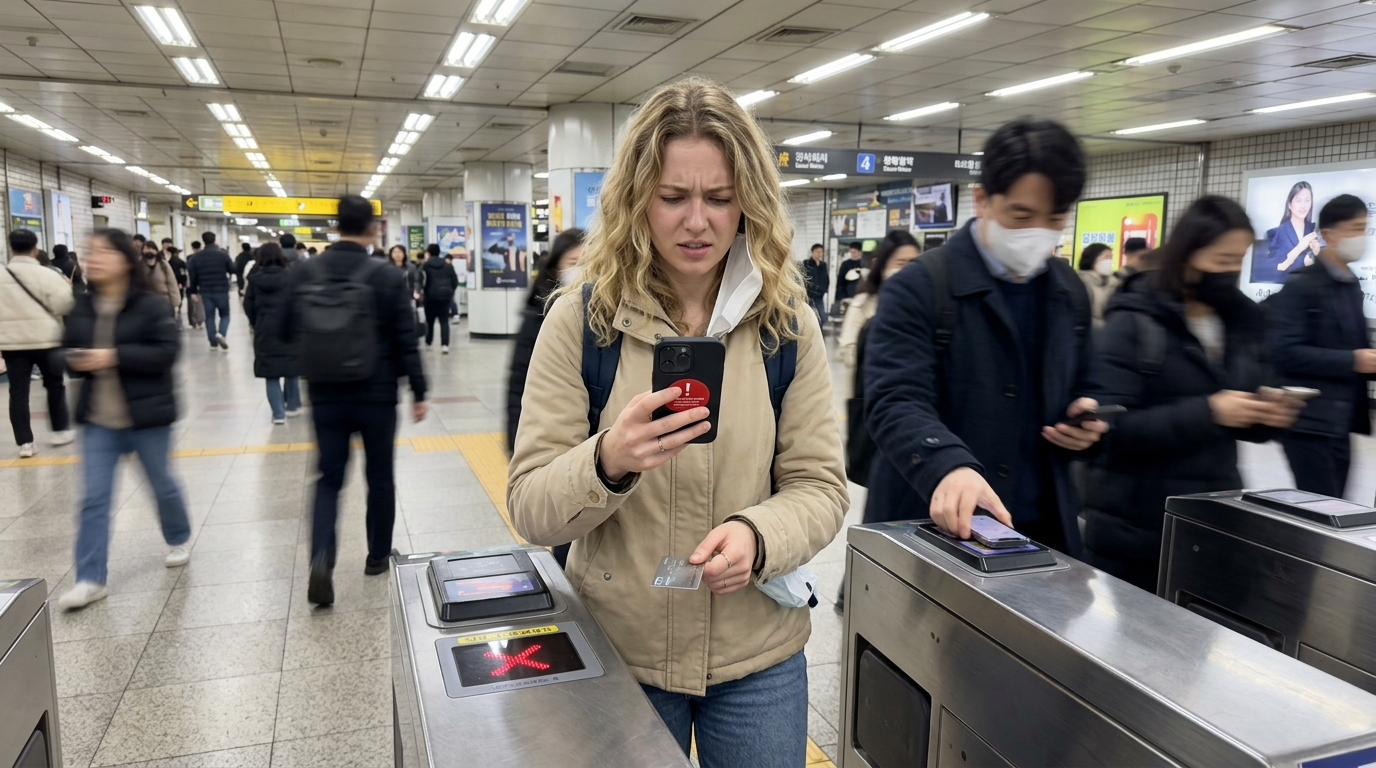
Korea runs one of the most advanced digital payment systems in the world. Tap-to-pay works at street food stalls. QR codes settle restaurant bills in seconds. Vending machines take your phone as a wallet. From the outside, it looks like the easiest place on Earth to spend money.
For foreigners, roughly half of that system is locked on arrival. Banking payments korea foreigners try to use don’t fail because of bad technology — they fail because each piece depends on the one before it. Phone verification gates your bank account. Your bank account gates app payments. App verification gates delivery, transit booking, and online shopping. Skip one link and the entire chain stalls, sometimes for weeks.
This guide maps out every scenario — from the day you land with nothing but a foreign card to the point where Korean payment apps actually work. Where you are in the chain determines what you can and can’t do with money right now.
Why There’s No Single Answer to Money in Korea
Most countries have one basic money story for visitors: bring your card, maybe grab some local cash, and you’re done. Korea doesn’t work that way.
The Korean financial ecosystem splits into two parallel tracks. One is the international track — Visa, Mastercard, foreign-issued cards accepted at large retailers and hotels. The other is the domestic track — Korean bank cards, Kakao Pay, Toss, Naver Pay, and app-based payments tied to a Korean phone number and national ID verification.
The domestic track handles about 80% of everyday transactions. Delivery apps, convenience store mobile payments, online shopping, transit passes linked to bank accounts, splitting bills at restaurants. If you can’t access the domestic track, you’re stuck in the international lane — which works, but with gaps that show up at inconvenient moments. That’s the core challenge of banking payments korea foreigners face in their first months.
The question isn’t “how do I pay in Korea.” It’s “which stage of the chain am I at, and what does that unlock?”
Banking payments korea foreigners navigate depend entirely on four things: whether you have a Korean phone number, whether your ARC (Alien Registration Card) has arrived, whether you’ve opened a Korean bank account, and whether you’ve completed app-level identity verification. Each one is a gate. Each gate depends on the one before it.
The 7-Step Chain That Locks Everything Together
This is the Korea Setup Dependency Chain — the sequence that controls every financial tool available to you. Banking payments korea foreigners rely on, from a basic bank account to a food delivery app, all sit somewhere on this chain. Skipping a step doesn’t just delay things. It creates rejection loops where the system keeps sending you back to the step you missed.
Korea Setup Dependency Chain — 7 Steps
Step 1: Entry Status — Your visa type determines what you can apply for. Tourist visas lock out most long-term financial services. Work or study visas open the path to ARC and banking.
Step 2: Phone / SIM — A Korean phone number is required for virtually every verification step that follows. Without it, bank applications, app signups, and identity checks all stall at the SMS stage. (Why phone verification fails for foreigners)
Step 3: A Verifiable Address — Your address is declared on the ARC application at immigration, so you need a lease, dorm confirmation, or accommodation letter before the appointment. The community center (주민센터) handles later changes of address. Some banks also ask for proof of address.
Step 4: ARC Card — The Alien Registration Card is your Korean ID. Banks require it. App verification requires the number on it. Without ARC, most domestic financial services treat you as unverifiable.
Step 5: Bank Account — Opening a Korean bank account requires ARC, a Korean phone number, and sometimes proof of employment or enrollment. The account gives you a domestic debit card and access to Korean payment rails. (What usually delays the bank account process)
Step 6: App Verification (본인인증) — Korean apps verify your identity through a system called 본인인증, which checks your name, phone number, date of birth, and carrier registration against a national database. This step unlocks Kakao Pay, Toss, Naver Pay, and most e-commerce checkouts. (Why online verification fails even after ARC)
Step 7: Daily Services — Once Steps 1–6 are complete, delivery apps, online shopping, mobile transit cards linked to your bank, and peer-to-peer transfers all become accessible.
The chain is strict. Step 5 won’t work without Step 4. Step 6 won’t clear without Steps 2 and 4 together. Anyone who tries to open a bank account before their ARC arrives, or attempts app verification before their phone number is carrier-registered under their real name, hits a wall that no amount of customer service calls can fix.
⚠️ Key point: Skipping steps doesn’t just cause a single failure — it creates rejection loops. A bank that rejects you for missing ARC won’t reconsider until you return with the card in hand. An app that fails 본인인증 won’t retry automatically. You have to go back, complete the missing step, and start the application over.
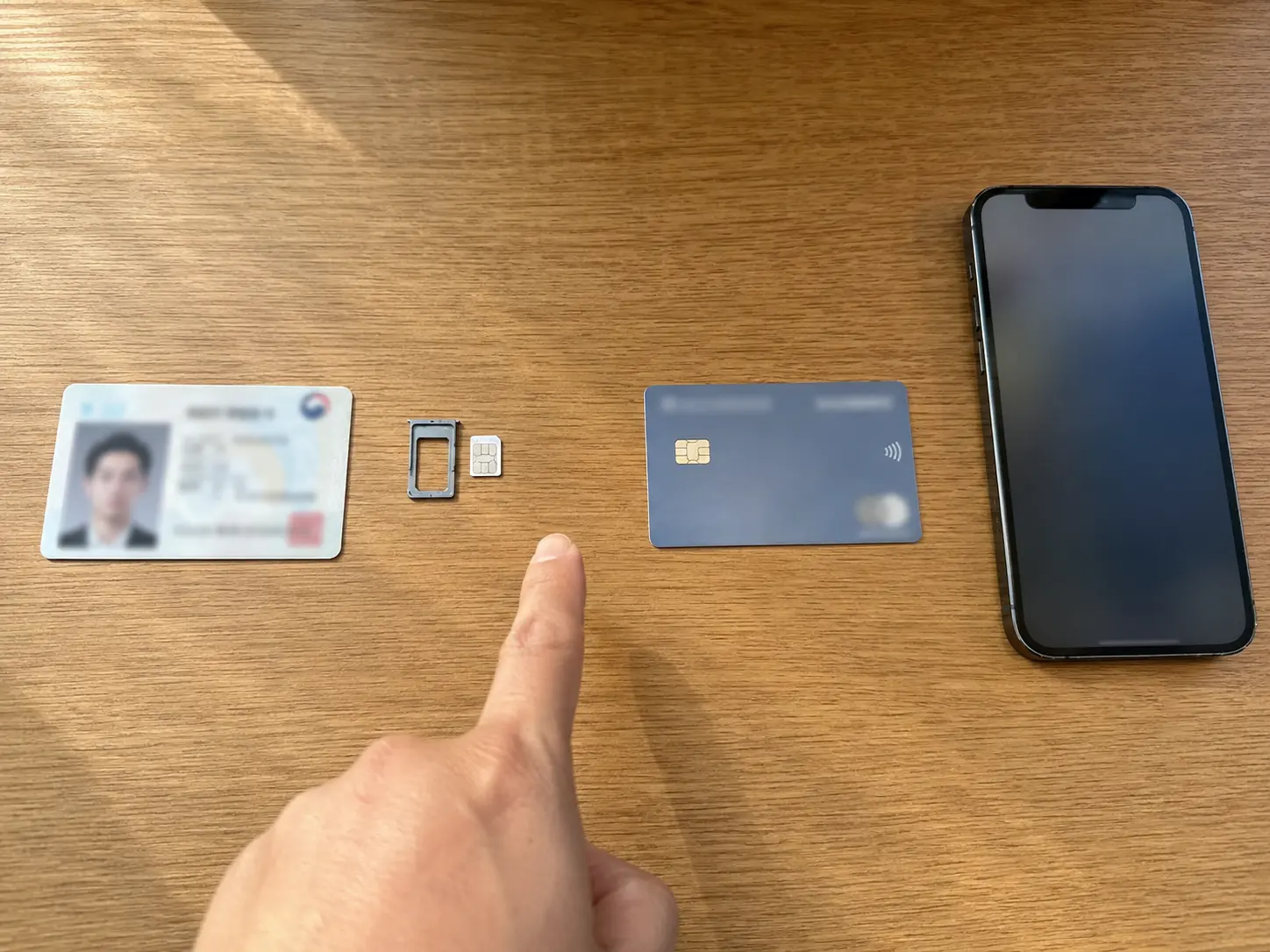
If You Just Landed — Foreign Cards and Survival Cash
Day one in Korea, your financial toolkit is limited to whatever you brought from home. That’s not nothing — but it’s narrower than it looks.
Foreign credit and debit cards work at most large retailers, chain restaurants, hotel front desks, and convenience stores. Visa and Mastercard have the widest acceptance. Amex is spottier. The airport convenience stores, the train ticket counter, and major brand shops will take your card without issues.
The gaps appear fast. Small restaurants — the ones locals actually eat at — sometimes only accept Korean cards or cash. Street food vendors are cash-only or Korean mobile pay only. Vending machines, coin lockers at train stations, and unmanned laundromats typically require Korean payment methods or exact change in won.
ATM cash withdrawal works, but not everywhere. International ATMs cluster at airports, major subway stations, and specific convenience store chains. A 7-Eleven or CU store might have one — or it might not. Withdrawal fees from your home bank plus the Korean ATM fee can stack to ₩5,000–₩8,000 per transaction. Pulling cash multiple times adds up quickly.
For short visits, this is manageable. For anyone staying longer than a week, the limitations start compounding. The banking payments korea foreigners need for daily life — delivery, transit booking, online shopping — remain completely out of reach. You can’t order delivery. You can’t book a KTX train ticket online without a Korean payment method. You can’t use Kakao T for taxis the way residents do. Every service that requires paying in Korea as a foreigner through the domestic system stays locked.
At this stage, your priority is getting a Korean phone number. That’s Step 2 in the chain, and everything else waits behind it.
If You Have a Korean Phone Number but No ARC
This is the most frustrating stage. You’ve got a Korean SIM, your phone works, you can receive calls and texts — and yet almost nothing financial opens up.
The reason is simple. Korean banks and verification systems don’t just need a phone number. They need a phone number registered under a verified identity, cross-referenced with your ARC number. Until Immigration issues your ARC, that cross-reference doesn’t exist in the system.
Some things do work at this point. You can use your phone to call banks and ask about account requirements. You can download apps like Kakao Talk and use basic messaging features. T-money cards — the physical transit cards — work independently of the banking chain. Load them with cash at a convenience store and ride buses and subways without any verification.
What doesn’t work yet: opening a bank account (most branches require ARC), completing 본인인증 for any app, setting up Kakao Pay or Toss, making online purchases through Korean e-commerce sites, or booking certain services that require identity-linked payment.
Banking payments korea foreigners attempt at this stage almost always end in a rejection screen. The error messages aren’t always clear — sometimes the app just says “verification failed” without explaining that the real issue is a missing ARC link in the carrier’s database.
If your ARC is still processing, expect a 2–4 week wait after your immigration appointment. During this gap, your best move is to understand where foreign cards work and where they don’t, keep enough won in cash for daily needs, and prepare the documents you’ll need once the ARC arrives.
A Few Things Worth Clarifying
Can I open a Korean bank account without an ARC card?
In very limited cases, yes. A few bank branches have reportedly opened accounts for foreigners with only a passport and proof of employment, but this is not standard practice and varies by branch. Most major banks — KB Kookmin, Shinhan, Woori, Hana — require a valid ARC. Attempting without one usually results in being turned away and told to return after ARC issuance.
Why does my foreign card work at some Korean stores but not others?
Korean payment terminals handle two types of card networks: international (Visa/Mastercard) and domestic (Korean bank-issued cards). Smaller merchants, local restaurants, and unmanned services often only connect to the domestic network. Your foreign card physically fits the reader, but the terminal’s software doesn’t route to an international processor. There’s no sign posted — it just declines.
Do Kakao Pay and Toss work with a foreign bank account?
No. Both Kakao Pay and Toss require a Korean bank account linked through 본인인증. The identity verification step checks your name, date of birth, phone number, and ARC number against a national database managed by Korean telecom carriers. A foreign bank account doesn’t register in this system. Until you have a Korean account with completed verification, these payment apps remain inaccessible.
How long does the full chain take from arrival to working payments?
The fastest realistic timeline is about 4–6 weeks. The full set of banking payments korea foreigners work through breaks down roughly as: SIM activation on Day 1, address documents ready within the first week, immigration appointment in Week 1–2, ARC arrival in Week 3–4, bank account opening in Week 4–5, and app verification shortly after. Delays at immigration — especially during busy periods — can push the total to 8 weeks or more.
If Your ARC Arrived — Banking Payments Korea Foreigners Can Finally Build
This is where things shift. The ARC card is the key that unlocks Step 5 and Step 6 of the chain, and once those clear, the payment landscape in Korea changes completely.
If you’re 14 or older and have a smartphone registered in your own name, you can also add a mobile ARC to the government’s Mobile ID app. In March 2025, six banks — Shinhan and Hana among them — began accepting it for account opening, but support still varies by bank and branch, so check before you leave the physical card at home.
Opening a bank account: Visit a bank branch with your ARC, passport, and Korean phone. Some branches also request proof of employment or enrollment. KB Kookmin and Shinhan have branches near universities and immigration offices that handle foreigner accounts more frequently — staff there tend to know the process. The appointment typically takes 30–60 minutes. You’ll walk out with a debit card and a bank app. (Full breakdown of the bank account process)
Once the account is active, the domestic payment world opens in layers.
Immediate access: Korean debit card payments at any store, ATM withdrawals without international fees, bank transfer to other Korean accounts (useful for rent, deposits, splitting costs).
One catch at this stage: most new accounts open as limited accounts (한도제한계좌), a fraud-prevention rule that applies to Korean customers too. Mobile and ATM transfers are capped at roughly ₩1,000,000 a day until you bring a document showing why you need the account, such as an employment certificate or enrollment letter. If a large housing deposit is due in your first week, plan for a counter visit.
After 본인인증 clears: Kakao Pay, Naver Pay, and Toss become functional. Online shopping through Coupang and other Korean e-commerce sites accepts your Korean card. KTX train tickets can be booked and paid through the Korail app. Delivery apps process orders without foreign card workarounds.
Banking payments korea foreigners build at this stage finally match what Korean residents use daily. But there’s a catch that trips up a lot of people: 본인인증 doesn’t always work on the first try. The verification system cross-checks your name spelling, date of birth format, and carrier registration. If any detail is slightly off between your ARC, your phone carrier’s records, and your bank’s records, the check fails silently. This guide explains why online verification fails even after ARC and how to fix the mismatches.

If You’re Visiting Under 90 Days
Short-term visitors operate in a different lane entirely. No ARC, no Korean bank account, no domestic payment apps. That’s the reality, and it’s not going to change during a tourist stay.
The practical toolkit for visitors:
Cash in won is still the most reliable backup. Exchange before arrival or at city exchange shops rather than airport counters — the rate difference on ₩500,000 can easily reach ₩15,000 or more. (Currency exchange fee comparison)
Foreign cards cover most tourist-facing expenses: hotels, department stores, chain restaurants, transportation cards at convenience stores, and major attractions. Visa and Mastercard have the broadest acceptance.
Prepaid travel cards like Wise or Revolut sometimes offer better exchange rates than your home bank’s foreign transaction fee. Load won before you arrive and use the card where international cards are accepted. Not all terminals work — test at a convenience store first.
T-money cards handle public transit and some convenience store purchases without any bank or identity link. Buy one at any convenience store near the airport for ₩2,500–₩4,000 and load cash onto it. This is the one piece of Korean payment infrastructure that works for everyone regardless of visa status.
What you won’t be able to do: order delivery through Baemin or Yogiyo, book KTX tickets through the Korean app, use Kakao T for taxi hailing (though you can try the international version with limitations), or shop on Coupang domestically. For those services, workarounds exist — but they’re clunky compared to what residents use.
For short stays, this setup is usually enough. The banking payments korea foreigners on tourist visas can access are limited by design — the Korean system simply wasn’t built for temporary users.
Setup Guides by Step
Each step in the chain has its own set of requirements, common failures, and workarounds. The banking payments korea foreigners set up involve far more moving parts than a single article can cover. These guides break down each stage in detail:
Step-by-Step Setup Guides
Step 2 — Phone & SIM: Phone Number Verification Korea · Why SMS verification blocks most services until carrier registration is complete.
Step 3 — Address Documents: Address Registration Korea · What fails at the counter and how to prepare the right documents.
Step 4 — ARC Card: ARC Card Korea Foreigners · What still fails even after approval, and how the card links to banking.
Step 5 — Bank Account: Opening a Bank Account Korea · What usually delays the process and which documents each bank requires.
Step 6 — App Verification: Online Verification Korea · Why 본인인증 fails even with a valid ARC and how to fix name mismatches.
Step 7 — Daily Services:
- Paying in Korea as a Foreigner — where cards fail and why
- Foreign Card Payment in Korea — 3 hidden blocks
- Coupang Checkout Foreigners — traps that stop your order
- KTX Booking for Foreigners — why foreign cards fail at payment
- Currency Exchange Korea — fee traps between airport, city, and card
- Sending Money from Korea — fee traps and the annual limit for foreign residents
- Korean Phrases for the Bank — what to say at the counter when something goes wrong
When You Don’t Know Which Stage You’re In
Sometimes the confusion isn’t about what to do — it’s about where you actually stand in the process. Maybe you activated a SIM at the airport but aren’t sure if it’s carrier-registered under your name. Maybe you applied for ARC two weeks ago and haven’t heard back. Maybe your bank app installed fine but nothing verifies.
Here’s how to figure out where you are.
Check your phone registration status. Dial 114 from your Korean phone — it connects to your own carrier’s customer center on SKT, KT, and LG U+ alike — and ask whether your phone number is registered under your passport or ARC number. If it’s passport-only, some verification steps may fail until Immigration processes your ARC and the carrier updates its records.
Check your ARC status. Visit Hi Korea (hikorea.go.kr) and log in with the credentials you created during your immigration application. Your ARC processing status should be visible there. If it shows “issued,” you can pick it up at the designated immigration office.
Check your bank account status. If you’ve opened an account, try a small test — transfer ₩1,000 to yourself through the bank app or attempt an online purchase. If the transfer works but online shopping fails, the gap is usually at the 본인인증 level, not the bank itself.
Banking payments korea foreigners troubleshoot often come down to one misaligned detail: a name spelled differently across the ARC, the phone carrier, and the bank. Korean systems perform exact-match checks. “JOHN A SMITH” on your ARC versus “JOHN SMITH” at your carrier is enough to cause rejection.
The safest path forward when you’re stuck is to work backward through the chain. Start at Step 6 (app verification). If it fails, check Step 5 (bank account). If the bank works but apps don’t, the gap is between your carrier registration and your ARC data. Contact your carrier first. Money is one chain among several in your first month — the checklist lays out the others in the same order.
What to Confirm Before Your Next Step
Each stage in the chain requires specific documents and conditions. The banking payments korea foreigners complete successfully almost always start with confirming these details before walking into any office or opening any app.
Pre-Step Verification Checklist
☐ Before getting a SIM: Confirm your visa type allows a postpaid plan, or choose prepaid. Bring your passport.
☐ Before your ARC appointment: Have your lease contract or confirmation of stay, passport, and the exact address in Korean format confirmed with your landlord.
☐ Before the bank: Bring ARC, passport, Korean phone (turned on — some branches call to verify), and proof of purpose (employment letter, school enrollment, or lease).
☐ Before app verification: Confirm your name matches exactly — character by character — across your ARC, your phone carrier’s registration, and your bank account. Any difference causes silent failure.
☐ Before relying on mobile pay: Test a small purchase (₩1,000) through Kakao Pay or the app you plan to use. If the test fails, the issue is usually at the 본인인증 step.
☐ Always keep backup cash: Even after full setup, carry ₩20,000–₩50,000 in won. Small vendors, traditional markets, and some taxi drivers still prefer or require cash.
The Bottom Line
Korea’s payment system is fast, convenient, and deeply integrated — once you’re inside it. The problem isn’t the technology. It’s the chain of dependencies that banking payments korea foreigners have to clear before any of it works.
Phone number first. Then a verifiable address and your ARC application. Then the card itself. Then bank. Then verification. Then apps. That sequence isn’t a suggestion — it’s the only order the system accepts. Every step in the banking payments korea foreigners go through feeds into the next one.
Where you currently sit on that chain determines what you can do with money today. If you know your stage, you can plan around the gaps instead of fighting them. And if something fails, the fix almost always lives one step back in the chain, not in the app that’s showing the error.
For detailed guidance on any individual step, the Setup Guides by Step section above links to the full breakdown for each stage. Start with wherever you’re stuck.
Last Updated: October 2026 · Information reflects current Korean banking and payment systems as of publication. Policies at individual banks and government agencies may change — verify requirements directly before visiting. For official immigration information, visit Hi Korea or the Financial Supervisory Service.