Address registration Korea foreigners deal with is rarely as simple as it first appears. Most people arrive at the community center assuming any rental contract will work — and that’s usually where the delay begins. The issue isn’t carelessness. It comes from not knowing that your housing type quietly shapes what the local office expects from you.
Korea’s address registration system connects to more than just your official records. It feeds into your ARC (Alien Registration Card) process, your bank account setup, your phone plan, and even healthcare registration. A delay in one step tends to ripple outward in ways that feel disproportionate to such a small administrative task. Understanding the process before you go — especially how different housing arrangements are treated — tends to save a significant amount of time and frustration.
This guide isn’t here to tell you exactly what to do. Procedures do vary by district and situation. What it does is walk through the patterns that tend to cause problems, and what’s generally worth checking before your visit.
Why Address Registration Matters More Than Expected
Korea’s administrative systems are more interconnected than they appear from the outside. Your registered address isn’t simply a record of where you live — it functions as an anchor point for several other processes that foreigners typically need to complete within their first few weeks of arrival.
When you apply for or update your ARC, the Immigration Service cross-references your registered address. If the address on your lease contract doesn’t precisely match what’s on file — or if you’re living somewhere that isn’t formally recognized as a residential address — the process can stall. Similarly, opening a bank account in Korea as a foreigner often requires an address that’s already been registered through the proper channel, not just a printed lease agreement.
The same applies to mobile phone services. If you’re in the process of switching from a tourist SIM to a full Korean mobile plan for foreigners, carriers typically require a verified registered address as part of the documentation. Delays in address registration can, in practice, delay all of these processes simultaneously.
None of this means the system is difficult — it’s actually fairly well-organized. But it does mean that assuming address registration is a formality can create compounding delays that weren’t expected.
How Housing Type Changes Required Documents
This is where many foreigners encounter their first real surprise. The 주민센터(community center) in Korea doesn’t treat all housing arrangements the same way, and what’s acceptable documentation in one scenario may not be sufficient in another.
Here’s a general overview of how different housing types tend to be treated, though outcomes can vary by district and individual circumstances:
| Housing Type | Typical Document Requirement | Common Issue |
|---|---|---|
| Standard one-room (원룸) | Lease contract (임대차계약서), passport, ARC | Name on contract doesn’t match passport exactly |
| Share house (쉐어하우스) | Master lease or sublease document, landlord consent letter | Sublease not officially recognized; primary tenant’s consent required |
| Goshiwon (고시원) | Facility registration form, occupancy confirmation | Facility type classification differs by registration; not all goshiwon qualify |
| Officetel (오피스텔) | Standard lease contract | Some officetels are zoned as commercial, not residential — affects registration |
| Airbnb-style or short-term rental | Generally not registerable | No formal lease document; registration typically not possible |
If you’re still deciding what kind of accommodation suits your needs, the comparison in guesthouse vs one-room monthly costs in Korea may be worth reviewing before you sign anything — housing type has downstream effects beyond rent.
Common Mistakes Foreigners Make Before Their Visit
Most of the problems people run into aren’t caused by complex bureaucratic rules. They’re caused by assumptions that seem reasonable but don’t quite match how the Korean system works.
Assuming the lease contract alone is enough. A printed or digital lease contract is a starting point, but it often needs to match your passport name character-for-character. Even minor romanization differences — a hyphen in the wrong place, “ae” versus “e” — have reportedly caused issues at some offices. This tends to be more of a concern when the contract was prepared by a real estate agent who filled in your name from memory.
Not knowing whether your unit number is officially listed. In some older buildings, individual unit numbers are not formally registered in the building database. The address on your contract might say “Room 302” but the official building registration may not list that specific unit. This is more common in converted buildings and older one-room complexes. Understanding the Korean address system in more detail can help you interpret what’s on your contract before you arrive at the counter.
Visiting before ARC is issued. In general, foreigners on a D or E visa need their ARC before completing address registration. Some people assume the process runs in parallel, but in many cases, ARC comes first. The exact order can depend on your visa type, so it’s worth confirming in advance.
Using temporary accommodation as the registered address. If you arrived in Korea and stayed in a guesthouse or serviced apartment while searching for housing, registering that temporary address is usually not possible. Some people try to use it as a placeholder, which rarely works. For guidance on what to expect from short-term housing options, the article on temporary housing in Korea for foreigners covers some of these limitations.
Not preparing for language barriers at the counter. Community centers vary in how much English is available. Some districts have dedicated foreigner windows with English-speaking staff. Others don’t. Having a few key phrases ready — or at least knowing what documents to hand over and in what order — tends to make the process smoother. If this is a concern, the guide on Korean phrases for government offices covers the most useful expressions for this kind of interaction.
Documents That Are Often Requested
The exact documents required can vary depending on your district, visa type, and housing situation. With that caveat clearly in mind, here’s what tends to come up most frequently in standard registration scenarios:
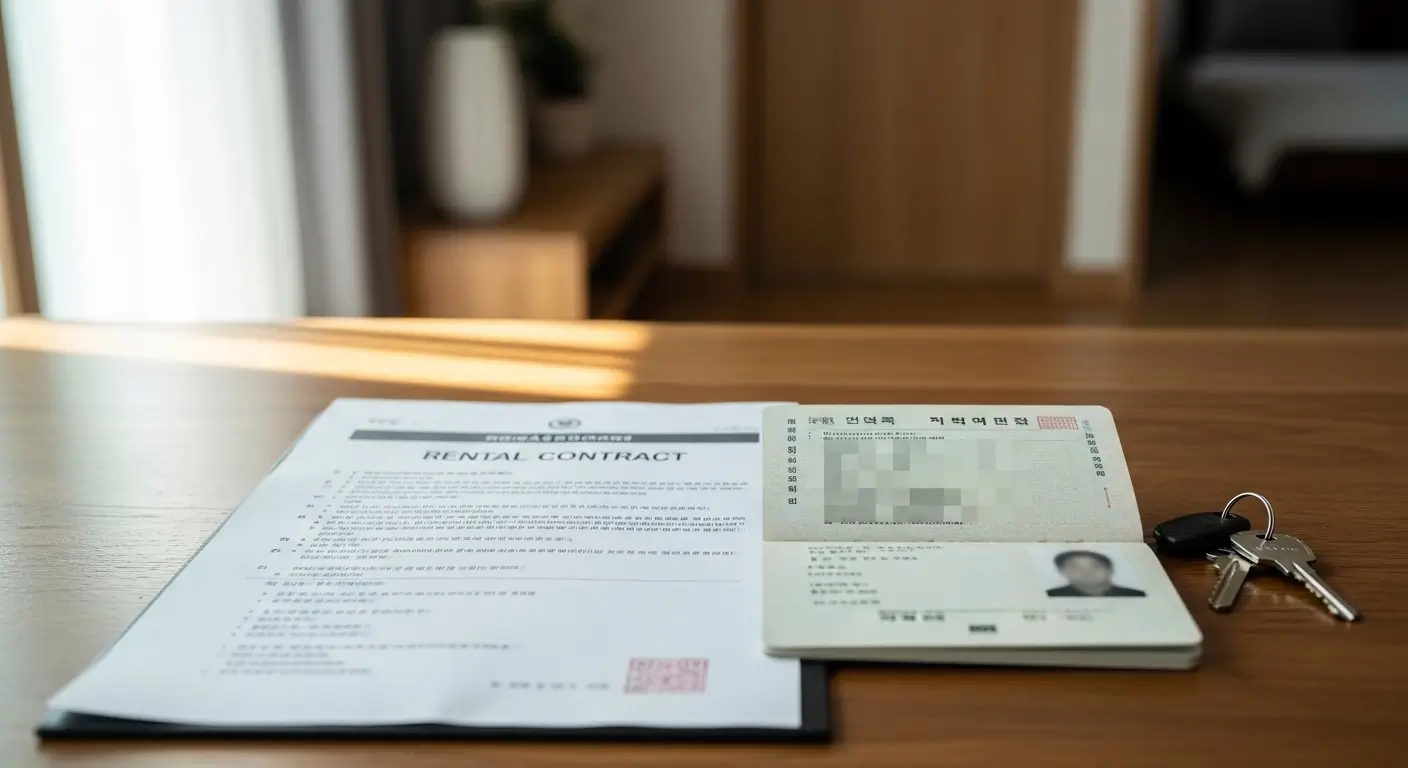
For a standard lease in a one-room or apartment: your passport, your ARC (or ARC application receipt if still processing), and the original lease contract (임대차계약서) with the landlord’s name, property address, and your name clearly stated. Some offices request a copy of the landlord’s ID, though this is more common in certain districts than others.
For share houses and subleases, the situation is less straightforward. If the primary lease is under someone else’s name, you may need a written consent letter from the primary tenant or a sublease agreement that’s been signed by the original landlord. This varies considerably, and it may be worth contacting your local 주민센터(community center) directly before visiting — the Hi Korea immigration portal also lists district-level contacts and foreigner support numbers.
For goshiwon residents, the facility typically issues its own residency confirmation document. The key question is whether the goshiwon itself is registered as a residential facility — not all are, and some operate in a gray area that can make official address registration difficult.
Address Registration Korea Foreigners: Decision Guide by Situation
Rather than one-size-fits-all advice, it’s more useful to think through your specific situation. Here are some common scenarios and what generally tends to apply:
If you have a standard lease contract in your name for a registered residential property, the process is generally the most straightforward. Bring your lease, passport, and ARC. Double-check that your name matches your passport exactly.
If you’re in a share house where the lease is under a Korean tenant’s name, ask your housemate or the management company whether they can provide a sublease document or consent letter. Without this, registration may not proceed. Some share house companies in Korea have experience helping foreign residents navigate this and may have standard documentation available.
If you’re in a goshiwon, ask the facility manager directly whether previous residents have successfully registered there. If the answer is yes, ask what document they typically provide. This saves a trip back to collect something you didn’t know you needed.
If you’re still in temporary accommodation while looking for permanent housing, registration in most cases isn’t possible yet. In the meantime, it’s worth reviewing what your short-term vs long-term stay in Korea means for your overall administrative timeline — some processes have deadlines that connect to your entry date, not your housing contract date.
If you’re in an officetel, check whether it’s zoned as residential or commercial. This information is in the building register (건축물대장), which your real estate agent or landlord can pull up. A commercially-zoned officetel may still be usable as a residential address in some districts, but it’s worth confirming before you assume it will work.
Practical Checklist Before Visiting the Community Center
Before heading to the 주민센터(community center), it helps to run through these verification points mentally:
- Is your name on the lease exactly as it appears in your passport? Including middle names if applicable. Even small differences can require a correction before the registration can proceed.
- Is your unit number clearly listed in the lease? Vague descriptions like “second floor room” rather than “Unit 201” have caused issues in some cases.
- Is the property officially classified as residential? Particularly relevant for officetels and any building that was recently converted.
- Do you have your ARC or at minimum your ARC application receipt? Most offices require one or the other before proceeding.
- If your housing is a sublease or share arrangement, do you have written consent from the primary leaseholder? This is often the missing document.
- Have you checked the operating hours and whether your district has a dedicated foreigner window? Hours vary, and some services are only available on certain days.
- Do you know the basic vocabulary for this interaction? Even a handful of relevant phrases tends to reduce confusion at the counter significantly.
The address registration itself typically takes 10 to 20 minutes once you’re at the window with the right documents. It’s the preparation stage — and occasionally a return trip — that ends up taking most of the time.
Frequently Asked Questions
Can foreigners register an Airbnb or short-term rental address in Korea?
In most cases, no. Short-term rentals and Airbnb-style accommodations do not come with a formal lease contract (임대차계약서), which is generally required for address registration at the community center. If you are still in temporary accommodation, registration typically needs to wait until you move into a place with an official lease. For more on what to expect from short-term stays, the guide on temporary housing in Korea for foreigners covers the limitations in more detail.
What documents are needed for address registration in Korea as a foreigner?
The documents most commonly requested include your passport, your ARC (or ARC application receipt if still processing), and the original lease contract with the landlord’s name, property address, and your name clearly stated. Depending on your housing type and district, additional documents such as a landlord ID copy or sublease consent letter may also be required. It helps to contact your local community center in advance to confirm exactly what applies to your situation, as requirements can vary.
Does address registration in Korea affect my ARC application?
Yes, the two processes are closely connected. In general, foreigners on D or E visas need to complete their ARC application before registering their address — not the other way around. However, the exact order can depend on your visa type and individual circumstances. Confirming the correct sequence with the Immigration Service or your local community center before visiting tends to prevent unnecessary return trips.
Final Thoughts
Address registration in Korea isn’t complicated in the way that people sometimes fear — but it isn’t as automatic as it might seem from the outside either. The part that catches most foreigners off guard isn’t the process itself, but the assumption that any rental arrangement and any set of documents will work in the same way.
Housing type quietly shapes the requirements, and small mismatches between your documents and what the office expects are the most common source of delays. Checking your lease contract in advance, understanding whether your building is registered as residential, and knowing what additional documents your specific arrangement might require — these tend to be the factors that separate a smooth visit from a frustrating one.
This usually gives you a clearer picture of what to expect. From there, the actual visit is generally quite manageable, and once your address is registered, the other administrative steps — phone plans, banking, healthcare — tend to fall into place more smoothly than they would without it.