
First 3 days Korea foreigners spend setting things up rarely go according to plan — not because the tasks are difficult, but because Korea’s administrative systems run on dependencies that no one explains up front. Miss one step, or do two steps out of order, and the next three services reject you before you understand why.
Most guides hand you a checklist: get a SIM, open a bank account, register your address. What they skip is that these steps aren’t independent. Each one unlocks — or blocks — the next. Arriving with a plan that ignores the sequence is how foreigners end up spending day three at the same immigration counter they visited on day one.
This article maps the dependency structure. Not a checklist — a sequence map.
The goal isn’t to finish everything in the first few days. It’s to start things in an order that doesn’t create problems you’ll spend weeks untangling. That distinction matters more than most arrival guides suggest.
Why Setup Order in Korea Matters More Than Expected
Korea’s administrative infrastructure is built around sequential verification. Unlike some countries where you can open a bank account with a passport and an address abroad, Korea’s systems assume you have already completed the previous step before you arrive at the next counter. This isn’t a flaw — it’s by design for resident verification. But it creates a bottleneck structure that catches most new arrivals off guard.
The core issue is this: many services in Korea require a Korean phone number for verification — but not all phone numbers qualify. A tourist SIM (여행자 유심) gives you a working number, but major apps reject it during the verification step because it isn’t tied to a resident identity record. That distinction doesn’t appear on the SIM card packaging.
The same logic runs through the entire chain. Your ARC (Alien Registration Card, 외국인등록증) status affects what banking options are available. The address you declare when you apply for that ARC affects which documentation banks accept. Your phone number type affects which apps will complete onboarding. These aren’t separate problems — they’re one connected system, and the first few days are when you discover whether your setup sequence was correct.
Sources verified October 2026: Residence status eligibility by visa type, address declaration on the first ARC application, and residence-change reporting (within 14 days of moving) — Hi Korea (hikorea.go.kr). Pre-arrival entry card — e-Arrival Card (e-arrivalcard.go.kr). Procedures and timelines may change — confirm directly before your visit.
Common Mistakes Foreigners Make in the First 3 Days
These aren’t rare edge cases. The same patterns come up in expat forums every spring and fall — the busiest arrival seasons. Different visa types, different home countries, same mistakes.
The problem is rarely missing documents.
It’s missing the step that makes the document acceptable.
Treating the airport SIM as a complete phone solution. A tourist SIM from Incheon Airport (인천공항) works for calls and data. What it won’t do is pass the real-name verification (본인인증) that Korean banking apps, delivery platforms, and government portals require. This creates a situation where your phone works fine but every app that matters still rejects you.
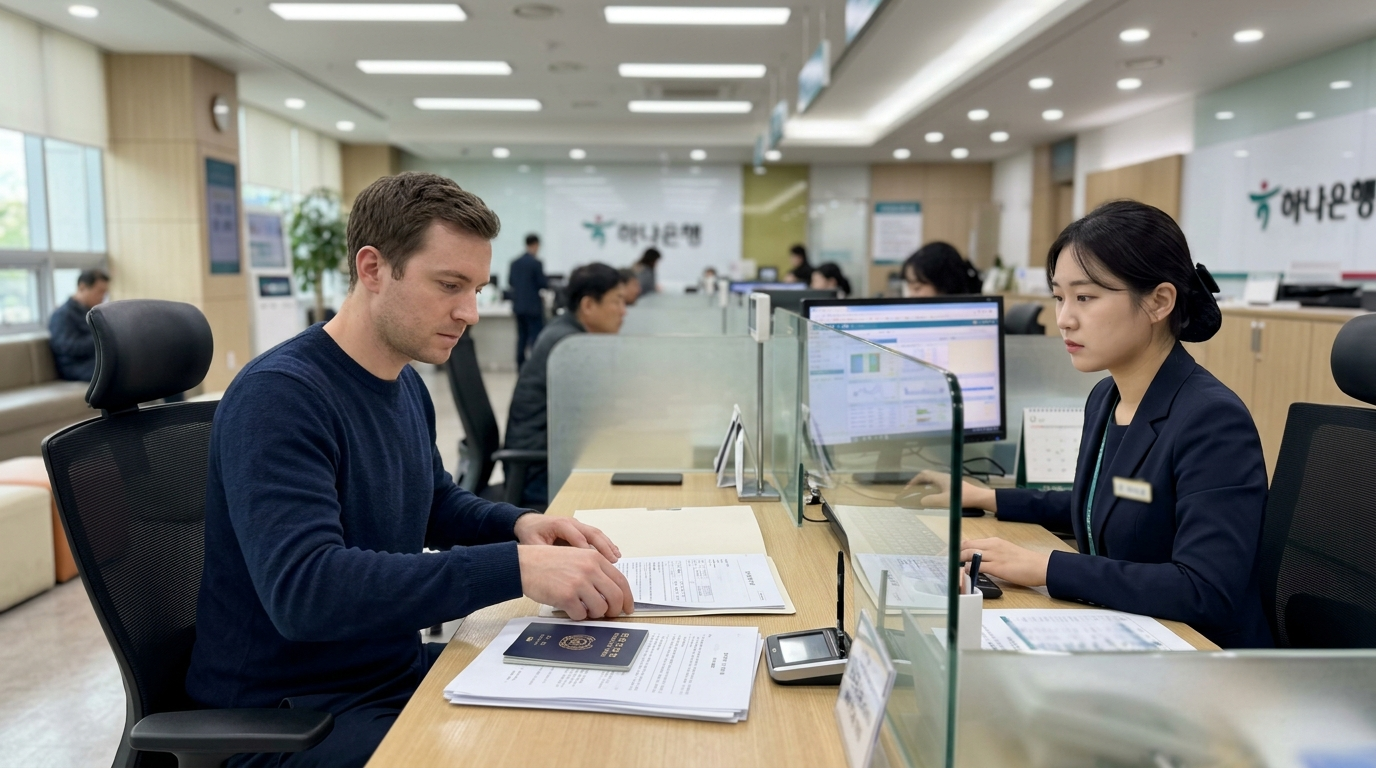
Going to the bank before your ARC application is filed. This is one of the most common first-week errors. Several major Korean banks require a domestic address on record before opening an account — or they’ll open a limited account that can’t receive international transfers. If your ARC application hasn’t been filed yet, the bank visit may produce a partial result — most banks want the ARC itself or the immigration receipt (외국인등록 접수증) showing the address you declared.
Assuming an ARC application is enough. Applying for an ARC (외국인등록증) at immigration (출입국관리사무소) is not the same as having one. The card takes weeks to arrive, and many services won’t accept “pending” status. If you’ve structured your setup plan around having ARC-level access immediately after applying, the next two weeks will be a series of blocked services. The ARC card guide covers which services can move forward with a pending receipt and which genuinely require the physical card in hand.
Attempting KakaoTalk or PASS verification before a qualifying phone number is active. Both KakaoTalk (카카오톡) and the PASS app (패스 앱) use SMS-based real-name verification tied to Korean telecom registrations. Attempting to verify with a tourist SIM or foreign number triggers an immediate rejection with no clear error message — just a loop that restarts the verification screen. Many people repeat this loop four or five times before realizing the block is at the SIM level, not the app. The SIM decision comes first — it shapes what every other service will or won’t accept.
Trying to pay online with a foreign card before confirming which platforms accept it. Most Korean e-commerce platforms and ticketing sites require a Korean payment method or a verified Korean identity layer. Foreign cards don’t always fail — but when they do, the error message rarely explains why. For day-one purchases, cash and T-money cover most situations while the longer setup catches up.
The Dependency Chain: What Blocks What
This is the core structure that most new arrivals discover only after something breaks. It isn’t complicated — but it’s almost never explained as a single connected picture.
Korea Setup Dependency Chain
Each step unlocks or blocks the one below it. Skipping ahead doesn’t speed things up — it creates a rejection loop.
Your entry status (visa type, length of authorized stay) determines whether you’re eligible to apply for an ARC at all, and under what timeline. That eligibility shapes every step after it. Long-term visa holders have a different setup path than travelers on a 90-day visa waiver — and the two paths don’t share the same sequence.
Your phone number type determines which verification systems accept you. A prepaid tourist SIM, a Korean postpaid contract SIM, and a foreigner-registered SIM on a domestic carrier produce three different results when apps check your identity. This isn’t obvious from the SIM itself — only from testing each platform. Which type to get is the first decision in the sequence, and it affects everything after it.
Your ARC application and the address declared on it affect both banking and administrative processes. Many first-timers expect a separate trip to the community center (주민센터) before this step, but for a first registration the address goes on the ARC form itself — so the lease or housing document you bring to immigration is what puts your address on record. Without that filing, some banks will only open a basic (제한 계좌) account. The community center becomes relevant later, when you move. The address system itself causes confusion because Korea uses a road name address (도로명주소) and a lot number address (지번주소) interchangeably — different forms ask for different formats. The address registration guide covers what the counter staff actually checks and which format each document requires.
Your ARC issuance status (not applied, applied pending, card in hand) creates the sharpest access gap. Many online platforms run ARC number verification as a hard requirement. Even with a valid visa, if the ARC number isn’t yet in the immigration database, the verification returns a failure — and there’s no message explaining why.
Before the physical card arrives, these services are typically unavailable regardless of visa status: online real-name verification (본인인증), Korean mobile banking apps, delivery app registration (Baemin, Coupang Eats), KakaoTalk account verification, PASS app, and full resident bank account access. Applying for the ARC doesn’t unlock them. The card arriving and the carrier record updating does.
Your bank account status (no account, limited account, full resident account) then determines payment platform access, payroll receipt, and rent transfer capability. This is where many foreigners first discover that the bank account they opened isn’t the account type they actually needed.

Decision Guide: Tourist, Student, and Worker Paths
The decision that shapes everything else is one most people haven’t consciously made before they land: are you on a short stay or a long stay? Korea’s systems treat these as separate tracks. The table below maps the three most common arrival types.
| Setup item | Tourist Visa waiver · under 90 days |
Student D-2 · D-4 |
Worker E-2 · E-7 · F-series |
|---|---|---|---|
| ARC required | ✗ Not eligible | ✓ Within 90 days | ✓ Within 90 days |
| Address registration | Not required | Declared on ARC application | Declared on ARC application |
| Korean bank account | Limited options only | After ARC issued | After ARC issued |
| SIM type | Tourist SIM only | Resident contract after ARC | Resident contract after ARC |
| App verification (본인인증) | Not available | After ARC + resident SIM | After ARC + resident SIM |
| First priority on arrival | T-money + cash | Housing → ARC application (address declared) | Housing → ARC application (address declared) |
Source: Hi Korea (hikorea.go.kr), verified October 2026. Visa sub-types vary — confirm eligibility for your specific status.
If you’re staying under 90 days on a visa waiver (무비자 입국), you’re not eligible for an ARC. Your setup path relies on a tourist SIM, T-money card (티머니 카드) for transit, and cash or foreign card for payments. The goal isn’t to build a full resident infrastructure — it’s to identify which specific services you actually need and find the tourist-path workaround for each. Transit, cash, and a tourist SIM cover most of it. The T-money card guide covers what to get first and where.
If you’re staying long-term on a work, study, or family visa, your sequence runs in this rough order: arrive → get airport SIM (temporary) → secure housing with a lease or housing document → apply for ARC at immigration (your address goes on the form) → upgrade phone plan → open bank account → set up resident-level apps. The exact timing varies by visa type, but the dependency order is consistent. Visiting the bank before your ARC application is filed is where this path most commonly breaks.
One thing worth knowing if you’re troubleshooting: Korea’s immigration and banking systems don’t communicate with each other in real time. A bank counter staff member cannot see your ARC application status — they only see what documentation you hand them. This means “I applied for ARC last week” doesn’t accelerate anything at the bank. What works is arriving with the immigration receipt (외국인등록 접수증) and understanding in advance which banks accept it as a substitute during the waiting period.
If your setup situation doesn’t match either of these cleanly — visa pending, irregular stay type, working holiday — the ARC eligibility check at hikorea.go.kr is the most reliable first step. The site lists requirements by visa category.
First 3 Days Korea Foreigners: A Practical Setup Sequence
This isn’t a guaranteed timeline — it’s a dependency-aware order that reduces the chance of one step blocking the next. Adjust for your visa type and housing situation.
One thing that comes up repeatedly: people try to complete the entire setup in three days. That’s not the point. Getting the first two or three steps right — in the right order — matters far more than speed.
One step now happens before you even board. Unless you hold a valid K-ETA, you’ll likely need to submit Korea’s e-Arrival Card online at e-arrivalcard.go.kr within 72 hours (3 days) before landing — paper arrival forms are no longer the standard route. This applies to first-time arrivals on student and work visas too, since you don’t hold a residence card yet. The official form is free, so avoid third-party sites that charge a fee to submit it for you.
| When | Action | Note |
|---|---|---|
| Before arrival |
Confirm visa type and ARC eligibility | Check at hikorea.go.kr by visa category |
| Confirm housing can provide address documentation | Temporary housing guide — what goshiwon and short-term stays can and can’t provide | |
| Day 1 | Airport transit to accommodation (AREX or limousine bus) | Don’t make permanent decisions on arrival day. Just get there. |
| Get T-money card + tourist SIM if needed | SIM card guide — which type to buy at the airport and what it can and can’t do | |
| Day 2 (long-term only) |
Collect housing documents (lease, goshiwon receipt, or host letter) | No community center visit yet — your first address is declared on the ARC application at immigration. Apply within 90 days of entry. |
| Create a Hi Korea account and book your ARC appointment | Walk-ins not always accepted, and busy offices fill up. Book through the immigration portal as early as you can. | |
| Day 3+ (long-term only) |
Attend ARC appointment at immigration (출입국관리사무소) | Bring passport, photo, fee, and your housing document — this is where your address is declared. Keep the receipt (외국인등록 접수증). |
| Bank visit with the ARC receipt | Bank account guide — which branches serve foreigners with your document set | |
| After ARC | Upgrade SIM → set up apps | App verification (KakaoTalk, banking apps, Kakao T) becomes available after a resident SIM is active and linked to your ARC record. |
Tourist path: skip the housing-document, ARC, and bank rows. T-money and cash cover most day-to-day needs for short stays.
There’s a pattern to building a life somewhere new, and it isn’t specific to Korea. Housing comes before address. Address comes before identity. Identity comes before money. Money comes before everything else.
What changes between countries is only how strictly each link is enforced. Korea enforces them completely.
Pre-Setup Checklist
Before starting any of these steps, confirm the following. Each unchecked item is a potential block further down the sequence.
- Visa type confirmed and ARC eligibility checked
- Housing address confirmed and documentation available (lease, goshiwon receipt, or host letter)
- Hi Korea account created, so you can book the ARC appointment now and report any later move online
- Bank branch confirmed as foreigner-accessible with your document set
- ARC appointment booked if long-term stay
- Phone plan type decision made: tourist SIM vs resident contract
- T-money card pickup planned for arrival day transit
- Emergency contact numbers saved before you need them — see the Korea emergency numbers guide
Ticking these off covers the first few days, but the month that follows has its own order of tasks waiting behind them.
FAQ
Can I open a Korean bank account without an ARC?
Some banks will open a limited account (제한 계좌) for foreigners with a passport and visa only — but the account type often has restrictions on international transfers, and some payment platforms won’t accept it. Whether this is worth doing depends on how soon your ARC is expected.
Do I need to register my address at the community center before applying for ARC?
No. For a first registration, your address is declared on the ARC application itself at the immigration office, so bring your lease or housing document to that appointment. The community center comes in later: once you hold an ARC and move, you report the new address there, at the immigration office, or online through HiKorea within 14 days of moving in. Missing that deadline can lead to an administrative fine.
My app keeps failing verification — what’s the most common cause in the first 3 days?
In the first 3 days, the most common cause is a mismatch between the phone number type and what the app’s verification system requires. Tourist SIMs from Incheon Airport are the most frequent culprit. Apps like KakaoTalk and PASS run a real-name check against Korean telecom records — a number not tied to a resident identity record will fail that check silently, looping back to the verification screen without a clear explanation.
What if I can’t finish everything in three days?
Most people don’t, and that’s normal. The three-day framing is about the order of the first steps, not a deadline. Securing housing documents and booking the ARC appointment are the two that genuinely benefit from being done early — the rest can follow at whatever pace your documents allow.
Conclusion
Korea’s first-days setup failures almost always come down to sequence, not effort. The systems are functional — but they assume a specific order, and that order is rarely written anywhere accessible to someone arriving for the first time.
The dependency chain runs in one direction: entry status → phone number type → ARC application (with your declared address) → ARC issuance → bank account → app access. Each block in that chain has its own failure mode.
If your setup is already partially done and something is blocked, the most useful first step is identifying which layer in the chain is incomplete — not trying to force the blocked service from the front. That’s usually where the time gets recovered.
Last reviewed: October 2026. Official procedure details sourced from hikorea.go.kr and e-arrivalcard.go.kr. Verify current requirements before your visit.