
You’re standing in the cereal aisle of a Homeplus in Bundang, and the box in your hand has a cartoon bear, a nutrition label, and what might be chocolate flavor — or might be coffee. The box next to it looks identical except for two Korean characters you can’t read. One costs ₩4,500. The other costs ₩7,200. Both weigh the same. Grocery mart Korea foreigners walk into for the first time tends to feel exactly like this: familiar enough to seem easy, different enough to quietly cost you money.
The layout looks like a supermarket back home. Carts, aisles, checkout lanes. But the details underneath — label formats, discount structures, bag policies, membership systems, and even which days the store is open — all follow rules that most guides skip over. The gap isn’t about finding the building. It’s about everything that happens once you’re inside.
This article breaks down where grocery mart Korea foreigners actually get stuck, why the system works the way it does, and what to sort out before your next trip.
Where Things Break Down Inside a Korean Mart
Korean grocery stores — E-Mart, Homeplus, Lotte Mart — look like Costco or Tesco at first glance. Wide aisles, shopping carts, fluorescent lights, a food court near the entrance. That visual familiarity creates a false sense of confidence. The grocery mart Korea foreigners step into for the first time seems navigable until the details start surfacing.
They can’t.
The friction starts at the labels. Nearly every product — from pasta sauce to laundry detergent — is labeled entirely in Korean. Expiration dates follow a YYYY.MM.DD format that looks backwards if you’re used to MM/DD/YYYY. The word 까지 (kkaji) next to a date means “until” — that’s your expiration. The word 제조 (jejo) means “manufactured on.” Mixing those two up is common, and it leads to either throwing away perfectly good food or eating something that expired weeks ago.
Then there’s the bag situation. Korea banned single-use plastic bags at supermarkets in 2019, and the rule expanded to convenience stores and bakeries in 2022. If you show up without a reusable bag, you’ll need to buy a designated waste bag (종량제 봉투, jongnyangje bongtu) at the register — which doubles as your trash bag at home. That bag costs anywhere from ₩300 to ₩700 depending on size and district. Not a huge expense, but the first time you’re asked at checkout and don’t understand, the line behind you feels very long.
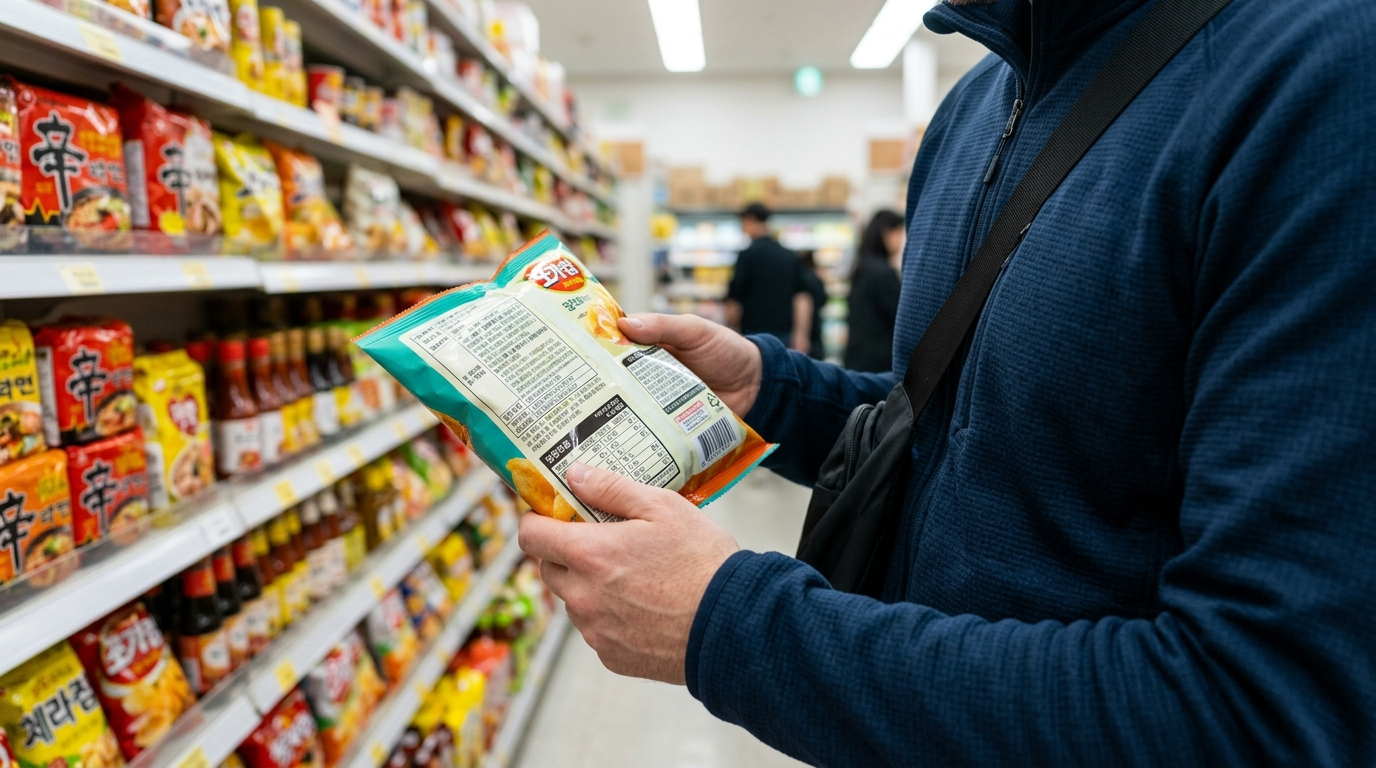
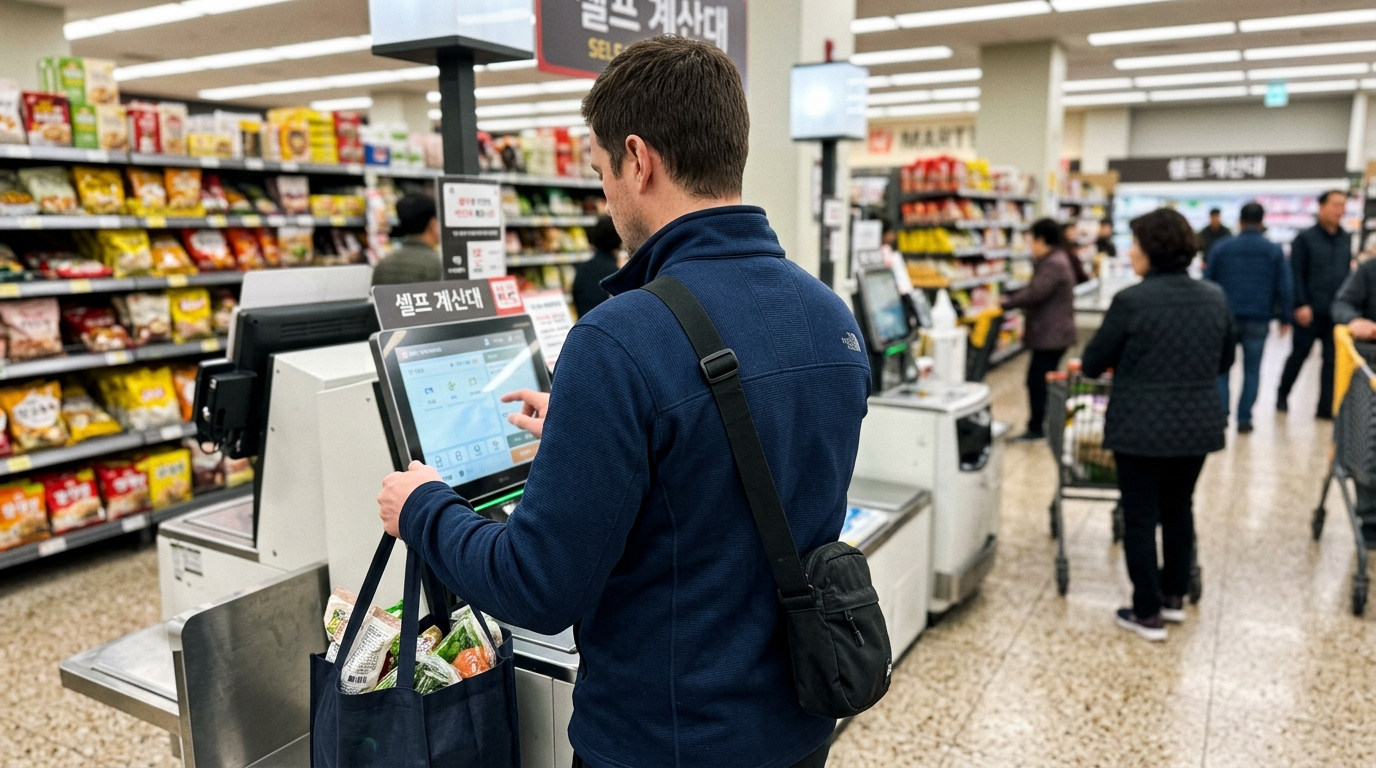
Payment is another quiet trap. Physical card terminals at E-Mart and Homeplus generally accept Visa and Mastercard, but self-checkout kiosks are a different story. Many self-checkout machines are configured for domestic Korean cards only. Your foreign Visa might work at the staffed register and fail completely at the self-checkout two meters away. The error message, of course, is in Korean. For a detailed breakdown of where foreign cards work and where they don’t, the guide to paying in Korea as a foreigner covers the structural reasons behind these failures.
And the store might not even be open when you go. Korean law has required major supermarkets to close twice a month since 2012 — traditionally the 2nd and 4th Sundays. Some districts have shifted mandatory closure days to weekdays, but the rule varies by location. Showing up on a Sunday afternoon to find the parking lot empty and the shutters down is a rite of passage for most foreigners in Korea.
Why Korean Grocery Stores Work Differently
Korea’s major supermarket chains were built for Korean consumers, and almost every system inside them reflects that. The mandatory closure days exist because of the Distribution Industry Development Act (유통산업발전법), passed in 2012 to protect traditional markets (시장, sijang) and small neighborhood stores from being crushed by large chains. The government reasoned that if E-Mart and Homeplus closed twice a month, foot traffic would redirect to smaller shops.
Whether that actually works is debatable. But the closure days remain law — and as of 2026, some districts are revisiting the policy to allow large marts to operate dawn delivery services even on closure days, reflecting the growing influence of Coupang’s 24-hour logistics network. The Ministry of Trade, Industry and Energy (MOTIE) oversees the distribution act, and any updates to mandatory closure rules flow through their announcements. For grocery mart Korea foreigners rely on regularly, the practical takeaway is simple: check the closure schedule before you leave the house. Each chain’s website or app lists the dates, but the pages are in Korean. Bookmarking the relevant page and using a translation app is the fastest workaround.
The membership and discount system is another layer that’s invisible to most foreigners until they’ve overpaid for weeks. E-Mart runs on Shinsegae (신세계) points, which accumulate through the SSG.COM app. Homeplus has its own My Homeplus app, which offers weekly coupons and point accumulation. Lotte Mart uses the L.POINT system across the entire Lotte ecosystem. All three apps are primarily in Korean, though E-Mart and Homeplus have partial English support in their interfaces.
Without these memberships, you’re paying full sticker price on items that are often 10–30% cheaper with a member coupon. Signing up usually requires a Korean phone number. If your phone setup is still in progress, the guide to phone number verification for foreigners in Korea explains what tends to block the process.
Questions That Come Up Most
Can I use a foreign credit card at Korean self-checkout machines?
Sometimes, but not reliably. Self-checkout kiosks at E-Mart and Homeplus are often configured for domestic cards only. The same Visa that works at the staffed register may be rejected at the self-checkout. If your card fails, move to a staffed lane — the cashier’s terminal usually processes international cards without issues. Carrying a backup payment method, whether cash or a WOWPASS card, avoids the awkward moment of holding up the line.
The Patterns That Cost Grocery Mart Korea Foreigners the Most
After watching friends and coworkers make the same trips to Homeplus and come back frustrated, the same patterns keep repeating. The grocery mart Korea foreigners visit weekly becomes a source of four specific habits that cost the most — not in dramatic ways, but in a steady drip of overspending and wasted food that adds up over months.
Ignoring the membership apps. The price gap between member and non-member pricing on staple items is real. Weekly app-only coupons at Homeplus can drop a ₩15,000 item to ₩9,900. E-Mart’s “e-money” accumulates across purchases and converts to discounts. Most foreigners skip the apps because they’re in Korean, and end up paying an invisible premium on every visit for months. Even partial use of the app — just scanning the barcode at checkout — captures most of the savings.
Buying imported products by default is the second pattern. Western cheese, pasta, cereal, and snacks are available at every major mart, but they sit in the “imported foods” (수입식품) section at 2–3x the price of comparable Korean-made alternatives. A block of imported cheddar might cost ₩12,000 while a domestic cheese of similar quality sits in the dairy section for ₩4,500. The imported aisle is easy to find because it has English labels. The Korean alternatives require reading — or at least photographing and translating — the Korean label.
Missing the bulk and multi-buy deals. Korean marts label multi-buy promotions with signs like 1+1 (buy one, get one free) and 2+1 (buy two, get one free). These aren’t always on food — they appear on household supplies, toiletries, and snacks. The signs are large but entirely in Korean. If you’re not scanning for 1+1 tags on the shelf, you’re missing the strongest deals in the store. The concept is identical to BOGO in Western stores, but the signage is easy to walk past if you’re not looking for it.
Overbuying fresh produce is the fourth and most wasteful pattern. Korean marts sell produce in large quantities — a bag of 10 apples, a box of 30 eggs, a full kilogram of garlic. For a single person or a couple, the portions designed for Korean families of 3–4 lead to spoilage. This is a common gap at every grocery mart Korea foreigners shop at alone. Smaller neighborhood stores (동네 마트) and traditional markets sell produce in smaller portions, often cheaper per unit. The big mart is convenient, but it’s designed for households bigger than most solo foreign residents.
Is it cheaper to shop at traditional markets instead of chain marts?
For fresh produce, often yes — especially if you’re buying smaller amounts. Traditional markets (시장) sell loose vegetables, fruit, and meat by weight without the packaging markup. For packaged goods, household items, and imported products, chain marts typically offer better prices due to scale. Mixing both — markets for fresh ingredients, marts for everything else — is a common pattern among long-term foreign residents who’ve figured out the system.
What does 1+1 mean on Korean mart shelves?
1+1 means buy one, get one free. It’s the Korean equivalent of BOGO. You’ll also see 2+1 (buy two, get a third free). These deals rotate weekly and cover everything from ramen to detergent. The cashier usually applies the discount automatically when you scan the items, but some promotions require scanning a coupon from the store’s app first. If you’re already using the membership app, the coupon is typically on the main page.
Are Korean mart operating hours the same as Western supermarkets?
Not quite. Most Korean chain marts open around 10:00 AM and close between 10:00 PM and midnight. That’s later than many Western supermarkets, but the mandatory closure days — typically twice a month — have no equivalent in most Western countries. The specific closure dates vary by chain and district, so checking before each visit is the safest approach. Any grocery mart Korea foreigners plan to visit on a Sunday should be verified first.
What Actually Helps When You Shop
The solutions for grocery mart Korea foreigners need aren’t complicated. They just require a few adjustments that nobody tells you about on day one.
Start with Papago or Google Translate’s camera feature before you even enter the store. Both apps let you point your phone at Korean text and see a live English overlay. It’s not perfect — product names get mangled — but it’s enough to distinguish between soy milk (두유, duyu) and regular milk (우유, uyu), or between pork (돼지고기, dwaejigogi) and beef (소고기, sogogi). For packaged food with allergy concerns, look for the word 함유 (hamyu) on the label, which means “contains.” The allergens listed next to it are your shortcut to identifying what’s in the package without reading the full ingredient list. The Ministry of Food and Drug Safety (식품의약품안전처) requires allergen labeling on all packaged food products in Korea, and the format is standardized across chains. You can verify current labeling standards through the MFDS official website.
For the membership apps, you don’t need to read every screen. Download the app, register with your Korean phone number, and scan the barcode at checkout. Even without navigating the full interface, the barcode scan captures your points and applies most automatic discounts. If registration stalls at the identity verification step — which happens — the issue is usually the same phone verification wall that affects most Korean apps. The KakaoTalk verification guide covers the underlying problem.
Check the mart’s closure schedule before you go. This takes 30 seconds but saves a wasted trip. The easiest method: search “[마트 이름] 휴무일” (mart name + closure day) in Naver. The result usually shows the next two closure dates at the top. Some locations have shifted from the traditional 2nd and 4th Sunday closures to weekday closures — Seoul’s Jongno, Seocho, and Dongdaemun districts have already made this change — so don’t rely on the old Sunday assumption.
For produce, consider splitting your shopping between the big mart and a smaller source. Korean marts sell bulk well, but online grocery delivery through apps like Coupang Fresh, Market Kurly (마켓컬리), and the Homeplus online store allows smaller portion orders with next-day delivery. The apps require Korean payment methods, but once your bank account and phone verification are set up, the delivery option often costs less than impulse-buying a 2kg bag of onions you won’t finish.
One thing worth knowing about timing: the grocery mart Korea foreigners visit during weekend afternoons is the same one that heavily discounts perishables — prepared foods, sushi, bakery items, deli meats — in the final hours before closing. Shopping after 8 PM on a weekday often means 30–50% stickers on items that were full price at lunch. This isn’t a secret to Korean shoppers, but it’s invisible to foreigners who default to weekend afternoon trips.
After the Receipt — What Still Catches People
Getting through checkout at any grocery mart Korea foreigners shop at doesn’t mean the surprises are over.
Korean mart receipts are long — sometimes a full meter of paper — because they include detailed breakdowns of discounts applied, points earned, and upcoming promotions. The receipt itself isn’t important to keep for most purchases, but if you bought electronics, home goods, or anything above ₩50,000, the receipt is your proof of purchase for returns. Korean marts typically allow returns within 7–14 days with the receipt, but the policy varies by chain and product category. Electronics bought at E-Mart, for instance, follow Shinsegae’s return policy, which can differ from the mart’s general policy.
Recycling is the other post-shopping gap. Everything you buy at a Korean mart generates packaging that needs to be sorted according to your district’s recycling rules — and those rules are strict. Cardboard, plastic, styrofoam, glass, and food waste all go in separate designated locations, usually in your apartment building’s waste area. Getting this wrong can result in rejected waste or complaints from building management. The recycling guide for foreigners in Korea walks through the sorting system district by district.
There’s also the matter of carrying everything home. Most foreigners without a car underestimate how heavy a full grocery run gets. Korean mart parking lots are designed for drivers. If you’re on foot or using public transit, ordering the heavy items online — rice, water, detergent — and buying fresh goods in person is a split that most long-term residents eventually adopt.
What to Confirm Before Your Next Trip
Before heading to any grocery mart Korea foreigners depend on, a quick check prevents the most common frustrations. Confirm the store’s closure schedule — search the mart name plus 휴무일 in Naver or check the store’s app. Bring a reusable bag or plan to buy a 종량제 봉투 (jongnyangje bongtu) at checkout, which doubles as your household trash bag. Have the Papago or Google Translate app ready with camera mode for label reading. Download the store’s membership app and register your barcode before your first trip if possible — even partial registration captures basic discounts. Carry a backup payment method for self-checkout, whether that’s cash, a Korean debit card, or a WOWPASS card. And if you’re shopping solo, consider splitting heavy staples to online delivery and keeping in-person trips focused on fresh items you want to select yourself.
Where to Go From Here
Any grocery mart Korea foreigners visit regularly isn’t harder than supermarkets anywhere else. It’s just different in the specific places where most people aren’t looking — labels, bags, closure days, memberships, and payment quirks. Once you’ve adjusted for those five things, the weekly shop stops being an exercise in guesswork and starts being what it should be: groceries.
If your payment setup is still blocking app registrations or self-checkout, the payment guide for foreigners and the convenience store guide cover the pieces that connect to what you’ll run into at the mart. The gaps overlap — solving one often unblocks the next.