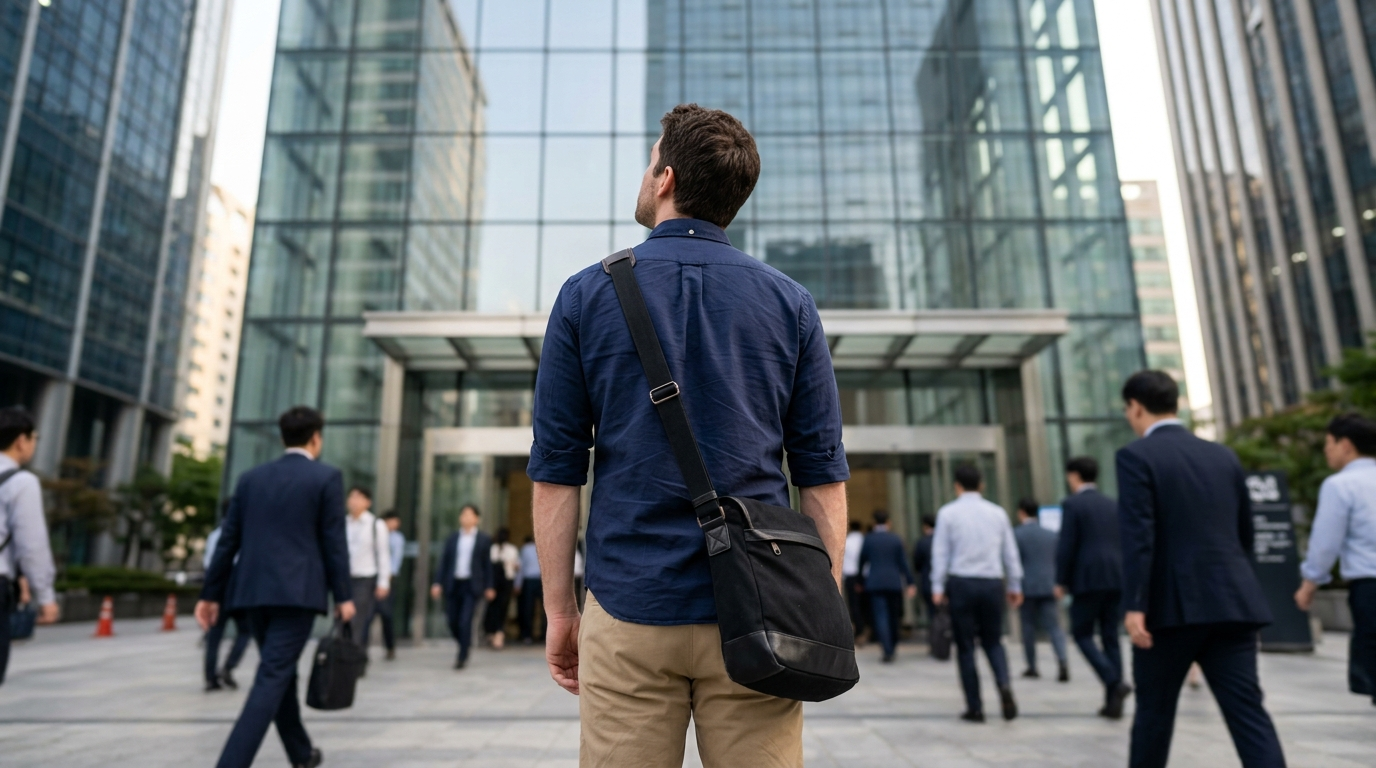
The part of korean work culture foreigners struggle with most has almost nothing to do with the actual work. It’s the invisible layer underneath — the hierarchy nobody explains, the meetings where decisions already happened before you walked in, the after-work dinners that feel optional but aren’t.
Most expats who’ve worked in Korean offices for a year or longer will tell you the same thing. The job itself was manageable. The korean work culture foreigners describe as “confusing” or “exhausting” is what blindsided them. And the frustrating part? These aren’t rare edge cases. They’re patterns — recurring friction points that show up in almost every Korean workplace, whether you’re teaching English in Busan or writing code at a startup in Gangnam.
This article breaks down five specific blind spots that catch foreign workers off guard. Not general “Korean culture is hierarchical” advice. Actual gaps between what foreigners expect and how Korean offices actually operate — and what helps once you see them.
The Hierarchy Isn’t Just Titles — It’s Built Into Every Interaction
This one sounds obvious until you live it. Korean offices run on a formal rank system called 직급 (jikgeup). Your rank determines how people address you, who speaks first in meetings, who pours whose drink at dinner, and how much weight your opinion carries in a group discussion.
Here’s where the korean work culture foreigners underestimate kicks in. In most Western workplaces, calling your manager by their first name is normal. In a Korean office, addressing someone without their proper title — say, skipping 대리님 (daeri-nim) or 과장님 (gwajang-nim) — reads as disrespectful. Not rude in a dramatic way. Just enough to quietly mark you as someone who doesn’t understand the room.
The practical rule is simple. When in doubt, use the person’s last name plus their title plus 님. Calling someone “김 대리님” instead of “Minjun” is always the safer bet, even if your pronunciation isn’t great. Most Korean colleagues will appreciate the effort. If you’re working with official documents or forms where titles appear in Korean, the government office phrases guide explains the same title conventions in a public-service context.
And it goes deeper than names. The hierarchy shapes who gets to disagree openly, who stays late, and who’s expected to volunteer for extra work. Junior employees — and that often means foreign workers who just arrived — are expected to show willingness before being asked. Offering to help before someone asks is noticed. Waiting until you’re told is also noticed, but differently.
One thing worth knowing: 직급 (rank) and 직책 (role) aren’t the same thing. Your business card shows both. A 부장 (bujang) in rank might hold the role of 팀장 (team leader). The distinction matters because people sometimes defer to rank even when the role hierarchy suggests otherwise.

Meetings Aren’t Where Decisions Get Made
This blind spot in korean work culture foreigners consistently miss. You prepare a well-reasoned case. You present it in the meeting. Everyone nods. Then nothing happens the way you expected.
The reason: in many Korean workplaces, meetings are for presentation and confirmation — not debate. The actual decision-making happens through a formal approval chain called 품의 (pumui), which involves senior managers reviewing and signing off before anything reaches the meeting room. By the time a proposal is discussed in a group setting, the direction is often already set.
This doesn’t mean your input is irrelevant. It means the timing and delivery matter more than you’d expect. If you want to influence a decision, the place to do it isn’t in the meeting — it’s in a one-on-one conversation with your manager beforehand. Or over coffee. Or through a well-written brief that circulates before the meeting happens.
Publicly disagreeing with a senior colleague in front of others? That creates tension. Not the kind anyone will mention to you directly. The kind that shows up later, in how tasks get assigned and whose ideas get picked up.
There’s a useful habit foreign workers pick up after a few months: asking twice. First, “Does this approach work?” Then, “Is there anything that might make it difficult?” The second question gives room for the kind of honest answer that Korean communication style often buries under politeness.
I learned this the hard way. Before running KLifeChoice, I spent years in pharmaceutical sales, then moved into IT, and eventually managed a team in the Philippines for an overseas operation. Every one of those environments had its own communication rules — but nothing prepared me for my first Korean corporate meeting. I’d laid out a solid proposal, backed it with numbers, and watched every head in the room nod. I walked out thinking it was approved. Two weeks later I found out the actual decision had been made over lunch between two directors the day before my presentation. The meeting was a formality. Once I understood that, I stopped trying to win the room and started having the conversation before the room.
회식 Has Changed — But It Still Matters More Than You Think
회식 (hoesik) — the company group dinner — is probably the single most discussed aspect of korean work culture foreigners read about before arriving. And what most people read is increasingly outdated.
The old version: mandatory team dinners with heavy drinking, multiple rounds of soju, and norebang (karaoke) until midnight. Skipping wasn’t really an option.
The 2026 version is different. COVID accelerated changes that younger Korean workers had been pushing for years. Shorter dinners are more common now. Lunch gatherings are replacing late-night sessions in some companies. Non-drinking options are increasingly accepted. The MZ generation (millennials and Gen Z) has successfully shifted expectations in many workplaces.
But here’s the blind spot. Even in its evolved form, 회식 still functions as an informal trust-building space. Your manager uses it to read the team’s energy. Colleagues build bonds that affect how smoothly work runs the next day. Consistently skipping sends a signal — not that you’re rude, but that you’re not invested in being part of the team.
The practical approach for foreigners: attend the ones that matter. Team-wide dinners organized by your manager? Show up. Department celebrations, welcome dinners for new hires? Those are worth your time. Random after-work drinks on a Tuesday when you have plans? It’s okay to pass — as long as you’re not passing every time.
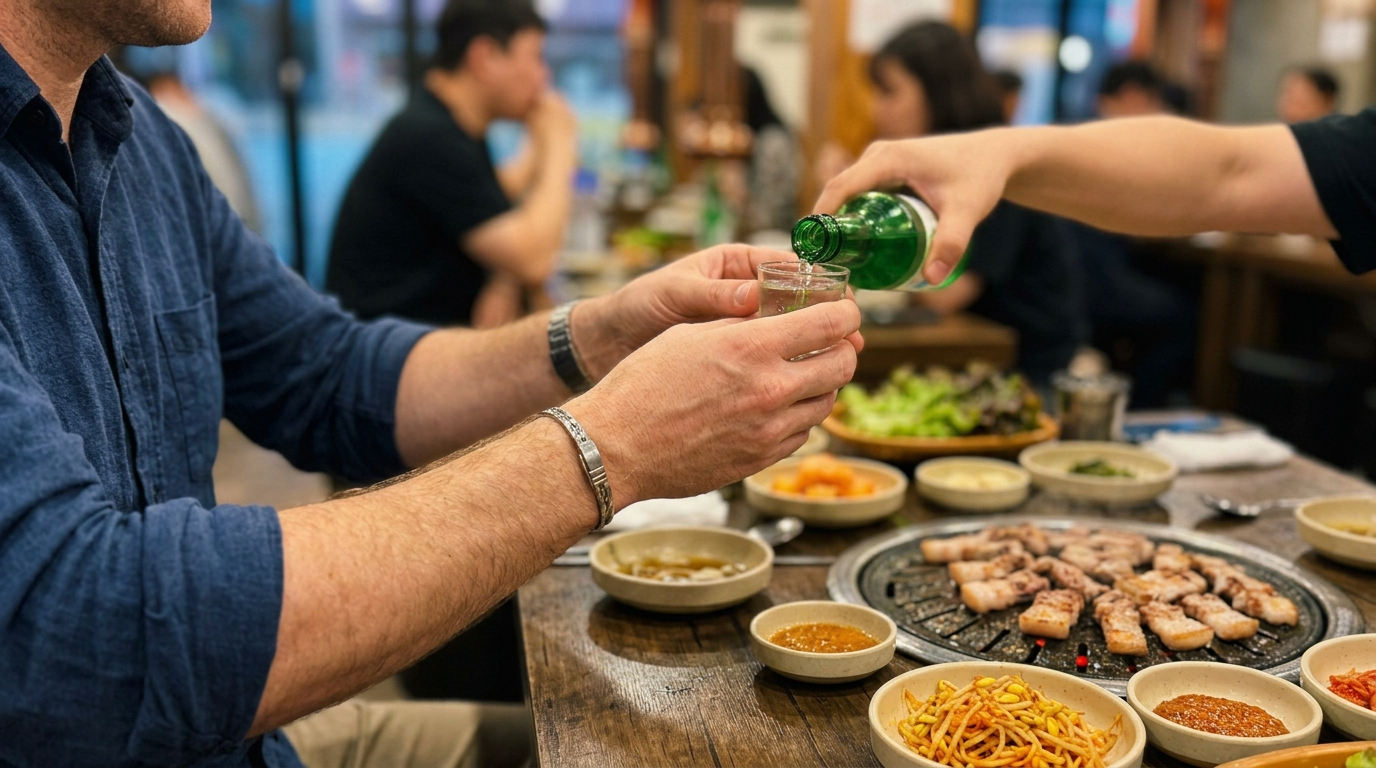
One more thing. If someone senior pours you a drink, receive the glass with both hands. It’s a small gesture that earns disproportionate respect. And you don’t need to drink alcohol — holding a glass of water or juice while participating in the conversation works fine in most modern Korean offices.
눈치 Is a Professional Skill, Not a Personality Trait
눈치 (nunchi) translates loosely as “eye-measure” — the ability to read the atmosphere of a room and respond appropriately. In Western workplaces, this skill exists but rarely gets named or formally valued. In Korean offices, it’s considered as important as any technical ability.
Having good 눈치 means noticing when your manager is stressed before they say anything. Sensing that a meeting is going sideways and adjusting your approach. Understanding what a colleague needs without them asking directly. It means reading the gap between what people say and what they actually mean.
This is one of the subtler dimensions of korean work culture foreigners need to understand. Foreign workers often get tagged as having poor 눈치 — not because they’re inconsiderate, but because the signals being given are culturally Korean and not immediately readable to someone from a different background.
The phrase 눈치껏 하다 (nunchi kkeot hada) — “handle it as the situation calls for” — is one of the highest compliments a Korean manager can give. It means: I trust you to read it right without me spelling it out.
So how do you develop it? Start with these:
Watch who speaks first in meetings, and who waits. The order isn’t random. Pay attention to seating arrangements — they often reflect hierarchy. When silence follows your comment, don’t fill it — it might mean people are processing, not ignoring you. And if your Korean colleague says “that might be difficult” instead of “no,” understand that it probably means no.
눈치 isn’t something you either have or don’t. It’s a skill that develops with attention. The fact that you’re even aware of it puts you ahead of most new arrivals.
Side by Side: What Changes When You Walk Into a Korean Office
The friction isn’t random. It follows a pattern. The korean work culture foreigners clash with most often comes down to specific moments where what you’d do at home directly conflicts with what Korean offices expect. This table maps the five most common gaps.
| Situation | Common Overseas Practice | Korean Office Norm | Why It Matters |
|---|---|---|---|
| Reporting to your manager | Update when milestones are hit or problems arise | 보고 (bogo) — frequent, proactive updates even on minor progress | Silence reads as disengagement, not independence |
| Disagreeing in meetings | Raise concerns openly during group discussion | Raise concerns privately with your manager before or after the meeting | Public disagreement with a senior creates lasting tension |
| Leaving at end of shift | Leave when your hours are done | Observe the team — leaving before your manager signals low commitment | Changing, but still strong at traditional firms |
| Team dinner (회식) | Optional social event — attend or skip freely | Semi-expected; consistent absence is noticed and interpreted | Trust and rapport are built outside work hours |
| Addressing colleagues | First names, even with managers | [Last name] + [Title] + 님 (e.g., 김 대리님) | Skipping the title reads as disrespect, however unintentional |
None of these norms are legally enforceable — they’re cultural defaults, not obligations. But in practice, the gap between “you don’t have to” and “you’ll be fine if you don’t” is narrower than it looks.
“Leaving on Time” Sends a Signal You Didn’t Intend
Korea’s legal workweek cap is 52 hours — 40 regular hours plus up to 12 hours of overtime, set by the Labor Standards Act. On paper, the typical schedule runs 9:00 AM to 6:00 PM, Monday through Friday. These rules apply equally to foreign workers under Korean labor law, regardless of visa type.
On paper.
In practice, many traditional Korean offices carry an unspoken expectation: you don’t leave before your manager does. Not because anyone will say something directly. Because leaving at 6:01 PM while your team is still at their desks reads as a statement about how invested you are.
This is changing. The 52-hour cap is more strictly enforced now than it was five years ago. President Lee Jae-myung’s administration has been pushing a 4.5-day workweek initiative since taking office in June 2025, with government subsidies of up to ₩600,000 per worker per quarter for small companies that adopt shorter hours. Major employers like SK Telecom and POSCO already offer biweekly Friday off programs.
But culture shifts slower than policy. This gap between law and practice is a defining feature of korean work culture foreigners navigate daily. At traditional Korean companies — especially mid-size firms and older industries — the expectation to stay visible after hours still exists. Startups and international companies tend to be more relaxed, but even there, showing up 10-15 minutes before your start time is generally expected.
The pragmatic move: observe what your team does in the first two weeks. Don’t be the first one out the door every day. Once you’ve built trust and your manager sees results, leaving on time becomes less loaded. But in the beginning, being visibly present matters more than you’d expect.
Saying It in Korean: 3 Situations That Come Up Every Week
Knowing the right phrase won’t fix the culture gap on its own. But in korean work culture foreigners navigate daily, three specific moments keep coming up — declining a dinner, leaving on time, checking in with your manager — and using Korean instead of English changes how the message lands.
1. Declining a 회식 with a reason (not an excuse)
Korean: “오늘은 선약이 있어서 참석이 어려울 것 같습니다. 다음에 꼭 함께하겠습니다.”
English: “I have a prior commitment today, so I won’t be able to join. I’ll definitely make the next one.”
When to use: When skipping a non-essential dinner. The key is 다음에 꼭 — it signals that you’re not opting out permanently.
2. Leaving on time without it feeling abrupt
Korean: “오늘 맡은 업무 마무리했습니다. 혹시 추가로 필요한 부분 있으신가요?”
English: “I’ve wrapped up today’s tasks. Is there anything else you need before I head out?”
When to use: Directed at your manager or team lead before leaving. Asking first — even when the answer is usually “no” — reframes your departure as responsible, not avoidant.
3. Proactive status update to your manager (보고)
Korean: “말씀하신 건 마무리했고, 다음 단계 진행하겠습니다. 확인 부탁드립니다.”
English: “I’ve finished the item you mentioned and I’m moving to the next step. Please let me know if anything needs adjusting.”
When to use: After completing a task — via KakaoTalk or in person. Short, specific, and signals progress. This is 보고 culture in its simplest form.
If you want a more complete set of office Korean — reporting, requesting, declining, and meeting phrases — the workplace Korean phrases guide covers the full range.
What’s Actually Shifting in Korean Work Culture (2026)
Korean work culture foreigners experience today isn’t static. In fact, it’s moving faster right now than at any point in the last two decades. A few things worth noting if you’re arriving this year:
Mental health support is becoming mainstream. Samsung, LG, Kakao, and other major employers now offer free counseling services, mental health days, and “recharge leave.” Open discussions about burnout are increasingly acceptable among younger workers — something that would have been unthinkable at traditional Korean companies even five years ago.
The 4.5-day workweek push is real. The government’s roadmap involves phased subsidies for small and mid-size companies, with a long-term target of bringing Korea’s annual working hours below the OECD average of approximately 1,742 hours by 2030. Korea’s workers logged around 1,859 hours in 2024 — still well above average. The subsidies started rolling out in late 2025, and early adoption is concentrated in tech companies and progressive employers. Traditional firms are moving slower.
Salary transparency is improving, though slowly. Tech startups and foreign-invested companies increasingly provide clear salary bands. At traditional Korean companies, pay discussions remain somewhat opaque.
The 보고 (bogo) culture — regular status updates to your manager — isn’t going anywhere, though. Korean managers expect frequent, proactive reporting. Even a short message like “I’ve completed X and am now moving on to Y” builds trust faster than waiting until a project is finished. If you’re unsure whether to update your manager, update them. That instinct serves you well in a Korean office.
A Few Things Worth Clarifying
Do Korean labor laws actually protect foreign workers the same as Korean nationals?
Yes. The Korea Labor Standards Act (근로기준법) Article 6 explicitly prohibits discrimination in working conditions based on nationality. Whether you’re on an E-2, E-7, E-9, or any other work visa, your core rights are identical to those of Korean workers — and these are set by law, not company policy:
- Overtime: 150% of ordinary wages for hours beyond 40/week (근로기준법 §56)
- Annual leave: 15 paid days after one year of 80%+ attendance (§60①)
- Severance: one month’s average wage per year of continuous employment (퇴직급여보장법 §8)
- Dismissal notice: 30 days advance notice or 30 days’ wages in lieu (§26)
Source: Ministry of Employment and Labor (moel.go.kr) and Korea Legal Information Center (easylaw.go.kr). Verified September 2026. Note: workplaces with fewer than 5 employees are partially exempt from some Labor Standards Act provisions.
If an employer says otherwise, they’re wrong — you can file a complaint with the Ministry of Employment and Labor (고용노동부) at the 1350 helpline. Your paycheck and health insurance enrollment are linked to your employment status, so any workplace dispute can ripple into coverage gaps. And your bank account is where severance and salary land — make sure both are set up correctly before a dispute forces the question.
How important is learning Korean for surviving in a Korean office?
It depends on the workplace — and this is one area where korean work culture foreigners experience varies widely. Tech companies and multinationals often operate primarily in English. But even basic Korean — greetings, honorific endings, and workplace phrases — significantly affects how you’re perceived. It signals cultural effort, which matters in relationship-driven environments. If you’re planning to stay longer than a year, investing in workplace Korean phrases pays off more than almost any other preparation. Even outside the office, having a Korean phone plan set up under your own name matters — many internal communication tools (KakaoTalk work groups, company portals) require Korean phone verification to function.
Is it okay to decline 회식 invitations?
Occasionally, yes — with a genuine reason and advance notice. Consistently declining creates a perception problem. The safest approach: attend the significant ones (team dinners, celebrations, welcome events), join lighter gatherings when your schedule allows, and communicate honestly when you can’t make it. Building rapport during work hours — offering lunch, grabbing coffee — also helps balance things if you miss an evening event.
Korean Work Culture Foreigners Should Know: 5 Things Before Your First Week
✔ Use [Last name] + [Title] + 님 until told otherwise — never default to first names
✔ Influence decisions before meetings, not during them — one-on-one conversations carry more weight
✔ Attend key 회식 events — you don’t need to drink, but showing up matters
✔ Update your manager proactively — 보고 culture rewards frequent, brief check-ins
✔ Arrive 10-15 minutes early — “on time” reads as late in most Korean offices
Where to Go From Here
Korean work culture foreigners walk into doesn’t come with a manual. The hierarchy, the communication gaps, the unwritten dinner expectations — none of this shows up in your onboarding packet.
The five blind spots that define korean work culture foreigners encounter aren’t things you solve once. They’re ongoing adjustments. You’ll misread a room. You’ll leave a meeting thinking agreement happened when it didn’t. You’ll accidentally skip the wrong dinner. That’s the process.
What helps is knowing the pattern exists before it catches you. Most foreign workers who’ve stayed in Korean companies for more than a year say the same thing: once you see the system, you stop fighting it and start working within it. The friction drops. The relationships deepen.
If you’re still in your first few days in Korea, the work culture details can wait — get your immediate setup sorted first. If you’re already settling into a job, the workplace Korean phrases guide covers the specific expressions that make daily office interactions smoother. And if you’re navigating visa extension timelines alongside work responsibilities, that process has its own set of deadlines worth tracking separately.
The system has logic. It’s just not the logic you brought with you.
Last reviewed: September 2026
Eric Youn lived abroad for over 15 years and writes practical Korea living guides based on firsthand experience.