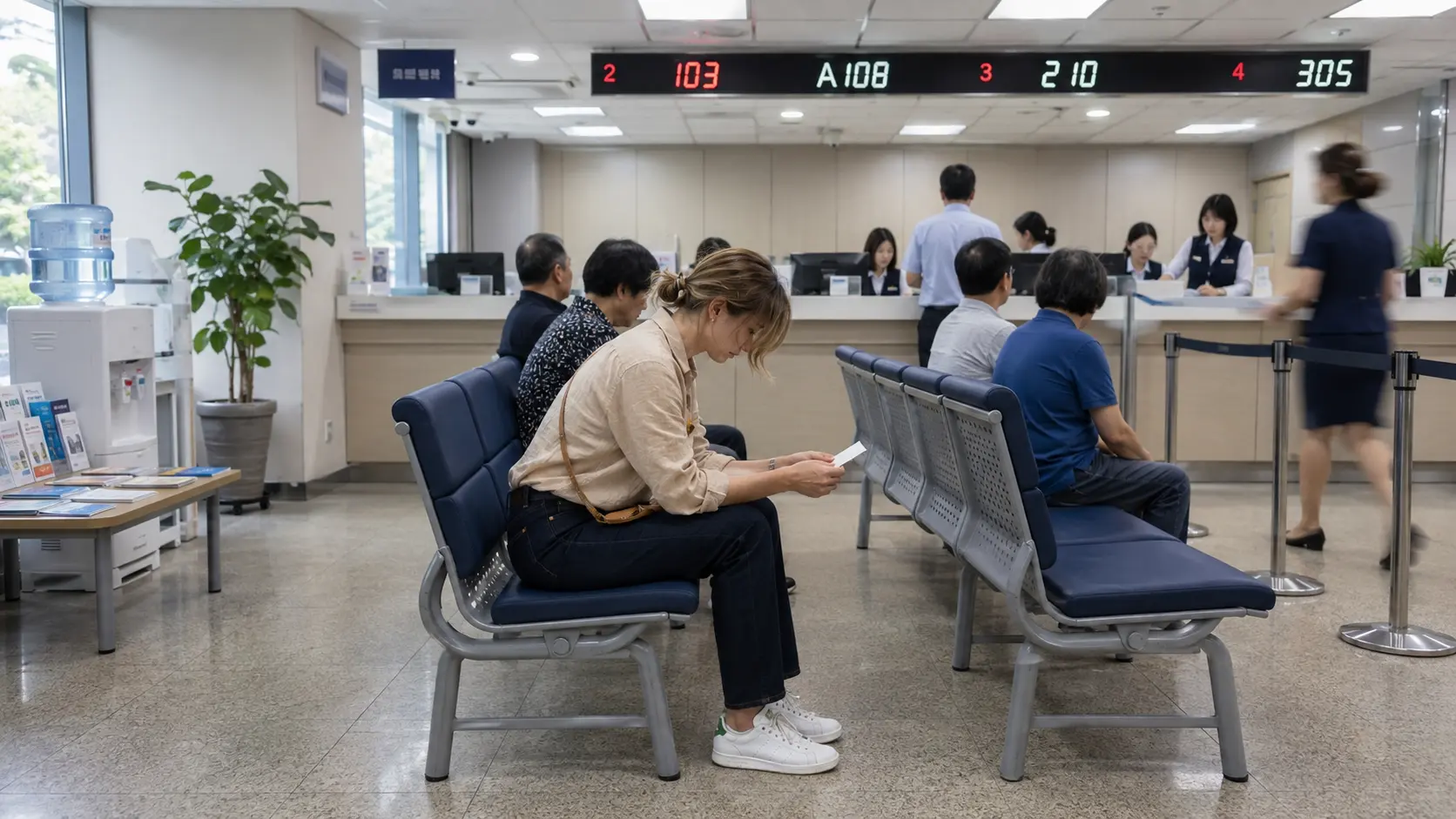
What do you say when the teller slides your card back across the counter and says one sentence you don’t catch? That single moment decides whether the next twenty minutes end with a finished transaction or a second trip. The Korean phrases bank staff use in that moment rarely match the polite dialogue printed in a textbook chapter called “At the Bank.”
Counter Korean is narrow. It is also fixed. A teller handles the same handful of transaction types all day, and each one comes with a short script that barely changes between branches or between banks.
That narrowness works in your favor. You don’t need conversational fluency to get through a branch visit — you need maybe forty words, split between the ones you say and the ones you have to recognize when they come back at you. This guide walks through a branch visit in the order it actually happens, from the ticket machine to the follow-up visit three weeks later that most people never see coming.
The Counter Runs on About Forty Words
Bank Korean is not a large vocabulary. It is a small one, repeated endlessly.
Most of the Korean phrases bank employees say to a customer come from a short, predictable set: hand over your ID, confirm your purpose, sign here, wait over there, come back with one more document. Learning to hear those five patterns does more for a branch visit than memorizing thirty nouns about savings products you will never open.
Timing shapes the whole experience too. Standard branch hours across the major banks run 9:00 to 16:00 on weekdays, and counters stay staffed through lunch on a rotation — though the queue at 12:30 tends to be the longest of the day. Around forty-odd branches nationwide operate as foreign-worker specialized branches (외국인근로자 특화점포), with evening or weekend hours, and the Korea Federation of Banks consumer portal lists them by region.
One thing worth knowing if you’re planning a first visit: arriving at 15:45 for anything involving document review is optimistic. Tasks that require a supervisor’s approval often stop being accepted well before the doors close.
Before You Take a Number: One Sentence Sets Your Queue
The ticket machine (번호표 발급기) near the entrance asks you to choose a category before it prints anything. Pick the wrong one and you wait twenty minutes to be told you’re in the wrong line.
The categories are usually four buttons: deposits and withdrawals (입출금), new accounts and deposits (예금/신규), foreign exchange (외환), and loans (대출). Anything involving opening an account, lifting a limit, or reissuing a card sits under new accounts rather than deposits — a distinction that catches a lot of first-timers.
If the screen has no English toggle, one sentence at the greeter’s desk solves it. Say what you came to do, and someone will press the button for you.
| What you want | Korean | Roughly sounds like |
|---|---|---|
| I’m here to open an account | 계좌 개설하러 왔어요 | gye-jwa gae-seol-ha-reo wass-eo-yo |
| I’d like to make a transfer | 이체하려고 하는데요 | i-che-ha-ryeo-go ha-neun-de-yo |
| I came about my card | 카드 때문에 왔어요 | ka-deu ttae-mun-e wass-eo-yo |
| Which number should I take? | 번호표 어떤 거 뽑아요? | beon-ho-pyo eo-tteon geo ppob-a-yo |
That last one is the safety net. It admits you don’t know and hands the problem to someone who does, which is faster than guessing.
The First Two Minutes: ID, Purpose, Signature
Sit down and the sequence starts immediately. Identification, then purpose, then paperwork — in that order, at nearly every branch.
Foreign customers are usually asked for a residence card (외국인등록증) and a passport together, because the name and spelling on both need to match the account record. Under tightened financial-crime rules, staff also have to record why the account exists, which is where the conversation often stalls for people who came expecting a two-minute errand.
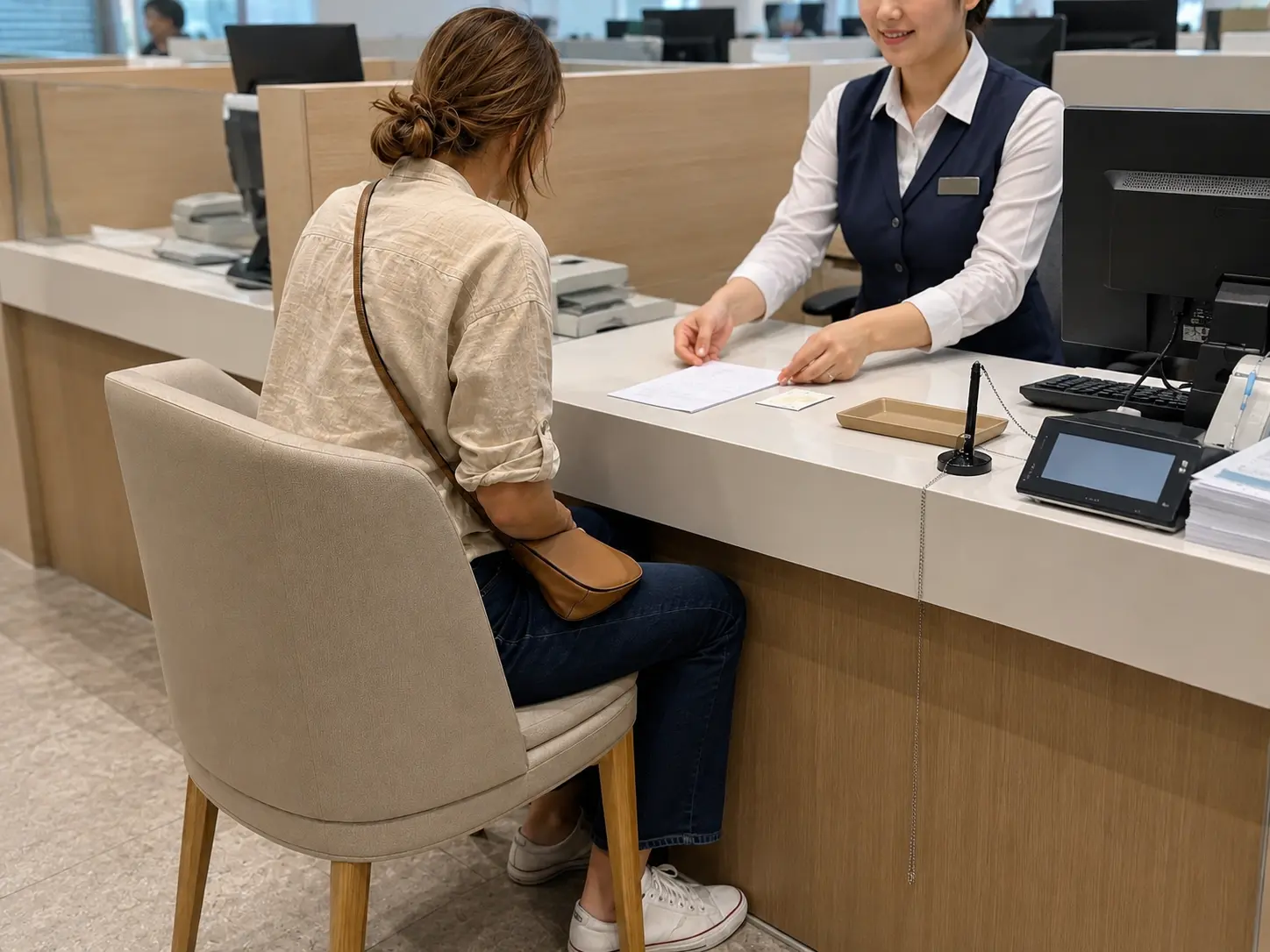
These are the lines that come at you, and what each one is really asking for.
| What the teller says | Korean | What it means for you |
|---|---|---|
| Your ID, please | 신분증 주세요 | Residence card first, passport ready behind it |
| What is this account for? | 거래 목적이 어떻게 되세요? | Answer in one word: salary, tuition, rent |
| Please sign here | 여기 서명해 주세요 | Signature style should stay identical every visit |
| Please wait over there | 저쪽에서 잠시만 기다려 주세요 | Processing continues; don’t leave the branch |
| Can I verify this by phone? | 본인 확인 전화 드려도 될까요? | Your Korean number has to be active and reachable |
Two replies carry most of the weight here. “천천히 말씀해 주시겠어요?” asks for the same sentence at half speed, and it works far better than nodding through something you didn’t follow. “영어 되는 분 계세요?” asks whether anyone available speaks English — at branches near universities or industrial complexes, the answer is often yes.
Neither phrase is embarrassing to use. Tellers hear both several times a week, and the Korean phrases bank employees offer in reply tend to be slower, shorter versions of the sentence you just missed.
If your account isn’t open yet, the paperwork side of this stage is covered in more detail in our guide to opening a bank account in Korea as a foreigner.
Minute Five: Korean Phrases Bank Staff Use When the Answer Is No
This is the part that turns one visit into three.
Most new accounts in Korea open as limited-transaction accounts (한도제한계좌), a fraud-prevention measure applied to essentially everyone, not just foreign customers. The daily ceilings were raised in May 2024 and now sit at roughly ₩1,000,000 through internet or mobile banking, ₩1,000,000 at an ATM, and ₩3,000,000 over the counter, according to the Financial Services Commission announcement on the change. Lifting those caps requires documents proving why you need to move more money.
So the refusal you hear is usually not a refusal at all. It’s a request for paper.
The Korean phrases bank staff use at this point tend to be softened almost to the point of vagueness, which is exactly why they get missed.
| What you hear | Korean | What it actually means |
|---|---|---|
| One more document is needed | 서류가 하나 더 필요해요 | Today’s task stops here; ask which document |
| It’ll open as a limited account | 한도제한계좌로 개설됩니다 | Account works, but transfer caps apply |
| This is a bit difficult | 이건 좀 어려우세요 | A polite no, not a maybe |
| You’ll need to come back | 다시 방문해 주셔야 해요 | Ask what to bring before you stand up |
Three questions turn a dead end into a plan, and they’re worth having ready before you sit down.
“어떤 서류가 필요해요?” asks which document is missing. “적어 주실 수 있어요?” asks the teller to write it down, which removes any chance of mishearing a document name you’ve never encountered. And “언제 다시 오면 될까요?” pins down when to return — useful, since some documents have to be issued within a recent window to be accepted.
Writing it down matters more than it sounds. Employment certificate (재직증명서), employment contract (근로계약서), certificate of enrollment (재학증명서), and lease agreement (임대차계약서) are easy to confuse when you hear them once, at speed, through a glass partition.
Three Weeks Later: The Visit Nobody Plans For
The follow-up visit is the one that decides whether your Korean banking life is comfortable or permanently awkward.
You come back with the document from last time. The vocabulary shifts — this visit is about lifting limits and adjusting settings rather than proving who you are, and the sentences you need are shorter than the ones from visit one.
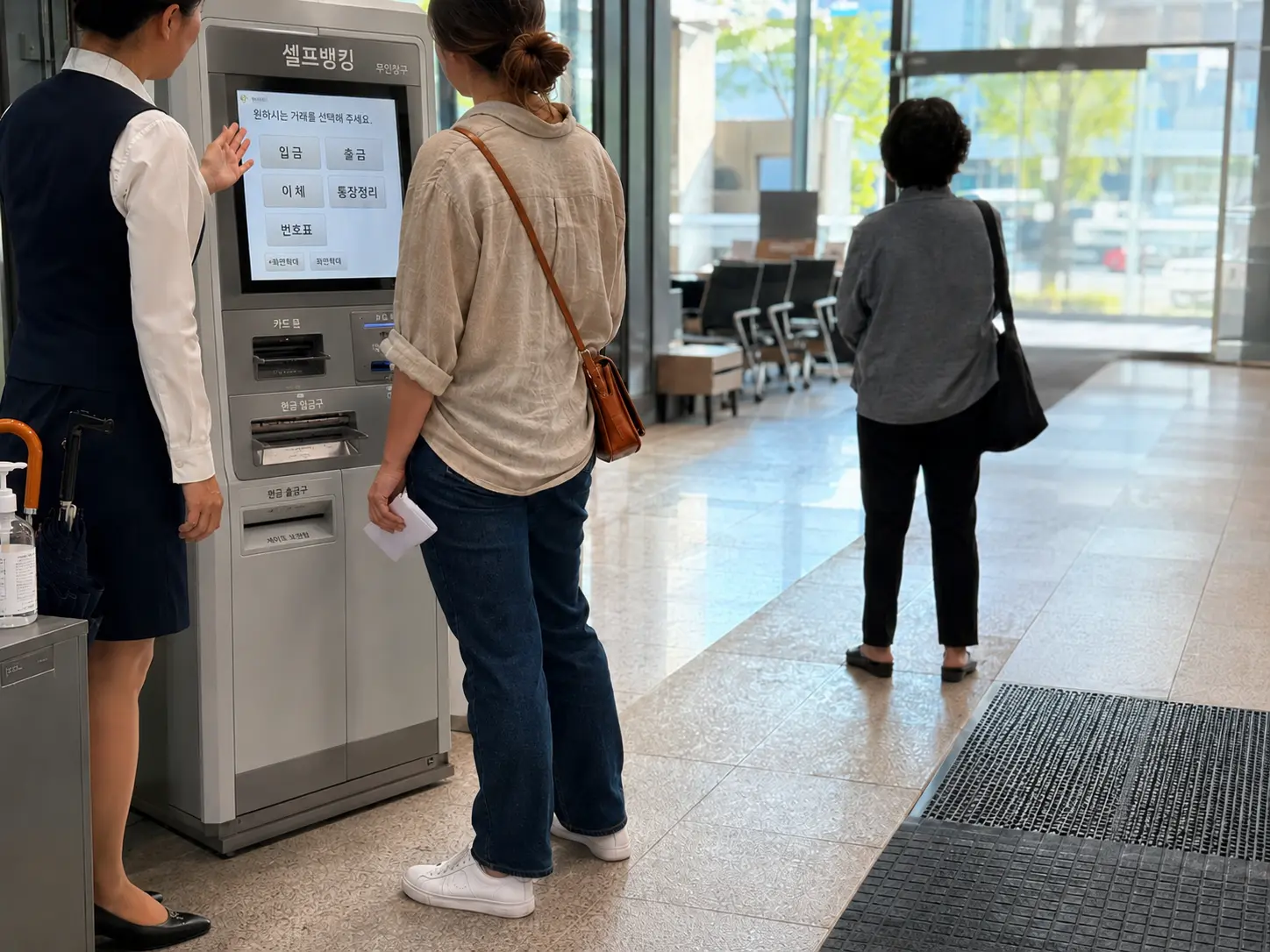
Four requests cover almost everything people return for.
- Lift the account limit — 한도제한 해제하러 왔어요 (bring the purpose-of-use document from last visit)
- Raise the transfer ceiling — 이체한도 올리고 싶어요 (a separate setting from the limited-account status)
- Reissue a card — 카드 재발급하고 싶어요 (usually collected in about a week, or mailed)
- Register mobile banking — 인터넷뱅킹 신청하고 싶어요 (bring the phone you’ll authenticate with)
One detail catches people out here. The Korean phrases bank staff use around the limited-account release refer to two different things that sound alike in English — the regulatory status itself, and your own per-transaction transfer ceiling. Clearing the first doesn’t automatically raise the second, so it’s worth asking about both while you’re already at the counter.
If your reason for raising limits is regular overseas transfers, the fee side of that decision is covered in our breakdown of sending money out of Korea.
What to Have Ready at Each Stage
A short version, in visit order.
| Stage | Bring | One phrase to have ready |
|---|---|---|
| Ticket machine | Nothing | 번호표 어떤 거 뽑아요? |
| First two minutes | Residence card, passport, Korean phone | 천천히 말씀해 주시겠어요? |
| When something is refused | Pen, or your phone’s notes app | 적어 주실 수 있어요? |
| Follow-up visit | Employment or enrollment document | 한도제한 해제하러 왔어요 |
Roughly a dozen expressions, and most branch visits stop producing surprises. The Korean phrases bank counters run on are that limited.
A Few Things Worth Clarifying
Do I need Korean at all if the branch has an English-speaking staff member?
Not for the transaction itself, though availability shifts by branch and by hour. The gap tends to appear during the handoff — a queue number is called in Korean, a document name is said once, or a follow-up call comes from an unfamiliar number. Recognizing a handful of Korean phrases bank employees repeat daily covers those seams without needing full conversations. The same pattern shows up at government counters, which is why our guide to Korean phrases for government offices focuses on the same narrow set of exchanges.
Is it rude to ask a teller to repeat something?
It isn’t. Asking again is treated as ordinary customer service, and it protects the branch as much as it protects you, since financial paperwork signed by someone who misunderstood it creates a problem for both sides. Requirements and accepted documents can vary by bank and by branch, so confirming details directly with your own branch before a visit is worth the phone call.
What This Comes Down To
Bank counters in Korea are not a language test. They’re a form-processing queue with a fixed script attached, and the script barely changes.
Learn the four sentences that state your purpose. Learn the five you’ll hear back. Learn the three that turn a refusal into a return date. That set covers the ticket machine, the first counter conversation, the moment something gets declined, and the follow-up visit — the four points where visits usually go sideways.
Everything else can wait for the app. The wider setup — accounts, verification, cards, and how they depend on each other — is mapped out in our banking and payments hub for foreigners in Korea.
Eric Youn lived abroad for over 15 years and writes practical Korea living guides based on firsthand experience.