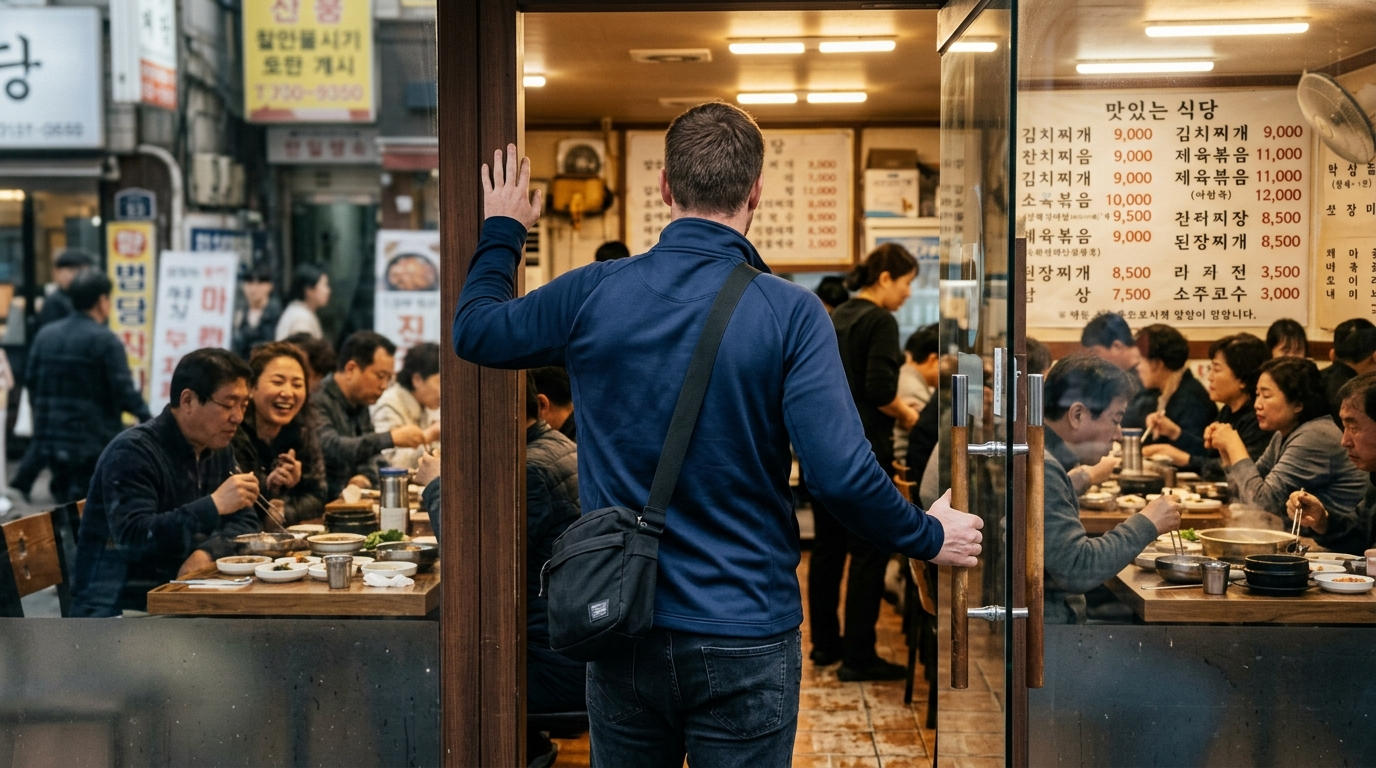
Korean phrases restaurant cafe situations demand number somewhere around 25 to 30 — and fewer than half of those show up in any standard phrasebook. The National Institute of Korean Language (국립국어원) documents standard forms, but what staff actually say to you at a busy 식당 in Mapo-gu at 12:30 PM on a Tuesday sounds nothing like a textbook. Shortened verbs, mumbled endings, rapid-fire questions about side dishes you didn’t know you needed to choose — that’s the real test.
Most phrase guides give you “주세요” and call it a day. That one word does carry you through about 40% of restaurant interactions. But the other 60% — customizing your order, flagging a wrong dish, asking to split the bill, handling a cafe barista who just asked you three things in one breath — those moments need a different set of expressions entirely. And nobody teaches them in order.
This article follows the actual sequence of a Korean restaurant and cafe visit, from the moment you walk through the door to the moment you leave. Each step has the specific phrases that situation requires — not a random vocabulary list, but words matched to the exact moment you’ll need them.
Why the Right Phrases at the Right Moment Change Everything
Korean restaurant interactions follow a predictable rhythm. You enter, get seated, order, eat, maybe request something mid-meal, then pay. Each of those steps has its own small vocabulary — and using the wrong phrase at the wrong step doesn’t just cause confusion. It stalls the entire flow.
Here’s what makes this tricky for foreigners. Korean service language compresses heavily. A waiter won’t say the full polite textbook sentence. They’ll drop particles, shorten verbs, and assume you already know the context. If you memorized phrases from a language app but never heard them spoken at actual Korean restaurant speed, you’ll miss them in real time.
The order also matters because Korean dining has built-in assumptions. Staff expect you to know that banchan (반찬) comes automatically, that water is self-serve in most places, and that you pay at the counter — not at the table. If you don’t know these things, even perfect pronunciation won’t save the interaction.
Step 1 — Walking In and Getting Seated
The first thing you’ll hear when you walk into most Korean restaurants is “몇 분이세요?” (myeot bun-iseyo) — “How many people?” Sometimes it comes out faster: “몇 분?” That’s the same question, just shorter. Don’t panic. They’re not asking your name or if you have a reservation. They just want a number.
Your response is simple. Hold up fingers and say the number plus “명이요” (myeong-iyo).
한 명이요 (han myeong-iyo) — one person. 두 명이요 (du myeong-iyo) — two people. 세 명이요, 네 명이요 — three, four. That covers most situations. For larger groups, holding up fingers and saying the number works fine.
If the restaurant is crowded and you need to ask whether there are seats available, say “자리 있어요?” (jari isseoyo). Staff will either point you to a table or tell you to wait. If they say “잠깐만요” (jamkkanmanyo), that means “just a moment” — they’re finding you a spot.
One thing worth knowing if you’re eating alone: solo dining (혼밥, honbap) is completely normal in Korea. But some Korean BBQ restaurants require a minimum of two servings. If you sit down alone and the staff says “2인분부터 주문 가능해요” (i-inbun-buteo jumun ganeunghaeyo), they’re telling you there’s a two-serving minimum — not refusing to serve you.
For restaurants that take reservations — mostly higher-end places or popular spots — “예약했어요” (yeyak-haesseoyo) means “I have a reservation.” Follow it with your name. But honestly, most everyday Korean restaurants don’t take reservations at all. You walk in, sit down, and that’s it. The korean phrases restaurant cafe regulars pick up naturally start right here — before anyone even looks at a menu.
Step 2 — Reading the Menu and Placing Your Order
Once you’re seated, the next step depends on the restaurant type. Some have paper menus on the table. Some have wall menus (벽 메뉴). Some use tablet ordering systems. And increasingly, many use kiosks at the entrance — which is a whole different challenge covered in the ordering food Korea foreigners guide.
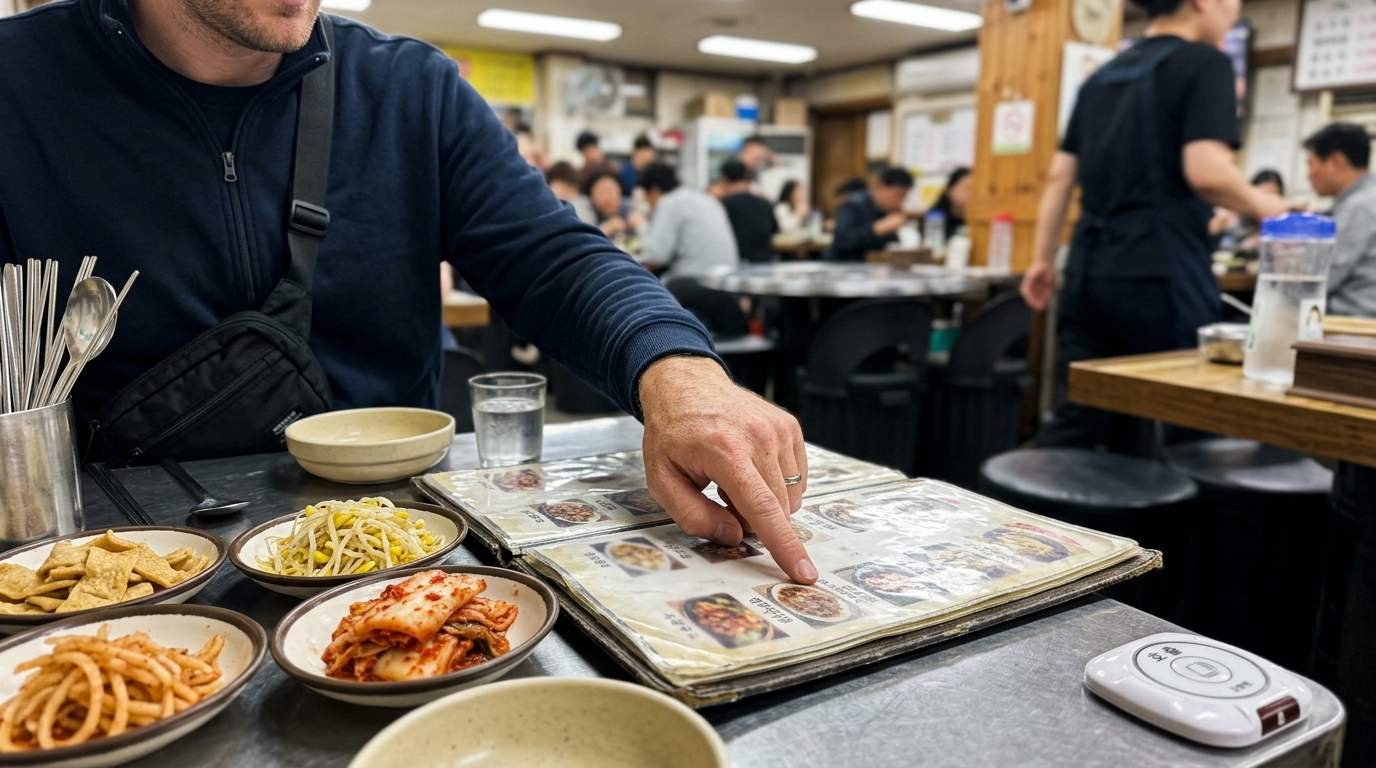
If you need a menu brought to you, say “메뉴판 좀 주세요” (menyupan jom juseyo). The word “좀” (jom) is subtle but important — it softens the request and makes you sound natural rather than robotic. Koreans use it constantly, and skipping it makes your Korean sound stiff even if the grammar is correct.
When you’re ready to order, you have two options for getting the server’s attention. Press the call button (호출 벨) on your table — most Korean restaurants have one. If there’s no button, say “저기요” (jeogiyo) clearly and at a normal volume. This isn’t rude. It’s exactly how Koreans call servers. Sitting quietly and waiting for eye contact will get you nowhere.
Then: “주문할게요” (jumun-halgeyo) — “I’d like to order.” Point at the menu item and say “이거 주세요” (igeo juseyo) — “this one, please.” If you want multiples, add the number: “이거 두 개 주세요” (igeo du gae juseyo) — “two of these, please.”
A few more ordering phrases that come up constantly:
• “이거 매워요?” (igeo maewoyo) — “Is this spicy?” Probably the single most useful question for any foreigner in a Korean restaurant.
• “이거 뭐예요?” (igeo mwoyeyo) — “What is this?” Point at the menu item when you ask.
• “추천해 주세요” (chucheonhae juseyo) — “Please recommend something.” Works well at places with overwhelming menus.
• “하나 더 주세요” (hana deo juseyo) — “One more, please.” Use this for extra banchan, drinks, or another serving.
One detail that catches people: banchan (side dishes) arrive automatically and are free. You don’t order them. If you want more of a specific side dish, point at the empty plate and say “이거 더 주세요” (igeo deo juseyo). Refills are free at most restaurants. Water is usually self-serve from a dispenser or water cooler near the wall — don’t wait for a server to bring it.
Common Questions About Ordering in Korean
Do I need to speak Korean to eat at restaurants in Korea?
Not strictly, no. Pointing at menu items and using basic gestures can get you through a meal. But even five or six key phrases — 주문할게요, 이거 주세요, 계산이요, 이거 매워요, 저기요 — transform the experience. You go from being someone the staff needs to work around to someone who’s part of the normal flow. In tourist areas like Myeongdong or Itaewon, many restaurants have English menus. Outside those zones, Korean-only menus are the standard.
What’s the difference between 식당 and 레스토랑?
식당 (sikdang) is the general Korean word for a restaurant — it covers everything from a neighborhood 김치찌개 spot to a bibimbap chain. 레스토랑 (reseutorang) is the Konglish version of “restaurant” and typically refers to Western-style or upscale dining. In everyday conversation, most Koreans say 식당 or just name the type of food: “고기집” (meat restaurant), “분식집” (snack restaurant), “횟집” (raw fish restaurant). Knowing these words helps you understand what kind of place you’re walking into.
Is it rude to call out “저기요” to get a server’s attention?
Not at all. In Korean restaurant culture, calling “저기요” is standard. Servers expect it. The alternative — pressing the call button on your table — is even more common. What would be unusual is sitting silently and expecting a server to notice you need something, which is standard practice in some Western countries but not in Korea. Just don’t shout across a crowded room. Normal speaking volume, directed at a nearby server, is the right approach. For a deeper look at how Korean service language differs from what foreigners expect, the Korea Tourism Organization’s dining guide offers additional context.
Can I ask for an English menu?
You can try: “영어 메뉴 있어요?” (yeongeo menyu isseoyo) — “Do you have an English menu?” In tourist areas, many places do. Outside those areas, the answer is almost always no. A practical workaround is using your phone camera with a translation app to scan the Korean menu. It’s not perfect, but it gives you enough context to order confidently. The phrases in this article are specifically chosen so you can navigate even when there’s no English menu at all.
Step 3 — Customizing, Requesting, and Handling Mix-Ups
This is where most phrasebooks stop and real restaurant life begins. Ordering is the easy part. What happens after — needing less spice, flagging a wrong dish, asking for something extra — requires a different register.
“덜 맵게 해 주세요” (deol maepge hae juseyo) — “Make it less spicy, please.” This is essential. Korean spice levels can be genuinely intense, and many dishes have a default heat that foreigners underestimate. Say this when ordering, not after the food arrives. Some places can’t adjust spice after cooking.
If you need to remove an ingredient entirely: “이거 빼 주세요” (igeo ppae juseyo) — “Please leave this out.” Point at the ingredient on the menu or name it if you can. Common removals: 고추 (gochu, chili pepper), 양파 (yangpa, onion), 고수 (gosu, cilantro).
When something goes wrong — and it will, eventually — you need these:
• “주문한 거 안 왔어요” (jumunhan geo an wasseoyo) — “My order hasn’t come yet.” Useful when you’ve been waiting 30+ minutes and other tables that arrived after you already have food.
• “이거 안 시켰어요” (igeo an sikyeosseoyo) — “I didn’t order this.” Say it calmly. Mistakes happen, especially in busy restaurants.
• “리필 돼요?” (ripil dwaeyo) — “Can I get a refill?” This applies mostly to banchan and water. Some restaurants also offer free rice refills. Drinks — not so much.
If you want to take leftover food with you: “포장해 주세요” (pojanghae juseyo) — “Can I get this packed to go?” Not every restaurant does this, but many will. You might also hear the staff say “포장 가능해요” (pojang ganeunghaeyo, “to-go is possible”) or “포장 안 돼요” (pojang an dwaeyo, “we don’t do to-go”). The Korean phrases delivery takeout article covers more expressions for pickup and delivery scenarios.
Step 4 — Paying the Bill and Walking Out
In Korea, you almost always pay at the counter near the entrance — not at the table. When you’re done eating, just stand up, walk to the register, and say “계산이요” (gyesan-iyo) or “계산할게요” (gyesan-halgeyo). Both mean “I’d like to pay.” The first is shorter and more common in casual spots.
Some useful payment phrases:
• “카드 돼요?” (kadeu dwaeyo) — “Can I pay by card?” Korea is overwhelmingly card-friendly. Most places accept cards for any amount. But very small, old-school 식당s occasionally are cash-only.
• “현금만 돼요?” (hyeongeum-man dwaeyo) — “Cash only?” Ask this if you see no card terminal.
• “따로 계산할 수 있어요?” (ttaro gyesan-hal su isseoyo) — “Can we pay separately?” Splitting bills is common but not universal. Some places insist on one payment.
• “영수증 주세요” (yeongsujeung juseyo) — “Receipt, please.” You usually get one automatically, but ask if you don’t.
Tipping doesn’t exist in Korea. Don’t leave money on the table — staff may actually chase you down thinking you forgot your change. This catches a lot of first-time visitors off guard, especially Americans. The price on the menu is the price you pay. No tip, no tax added at checkout. For more on how payments work for foreigners in Korea, see the paying in Korea as a foreigner guide.
Korean Phrases Restaurant Cafe Baristas Throw at You
Korean cafes operate differently from restaurants. You order at the counter, pay immediately, then wait for your drink. No table service. And the barista will ask you several things in rapid succession that you need to be ready for.
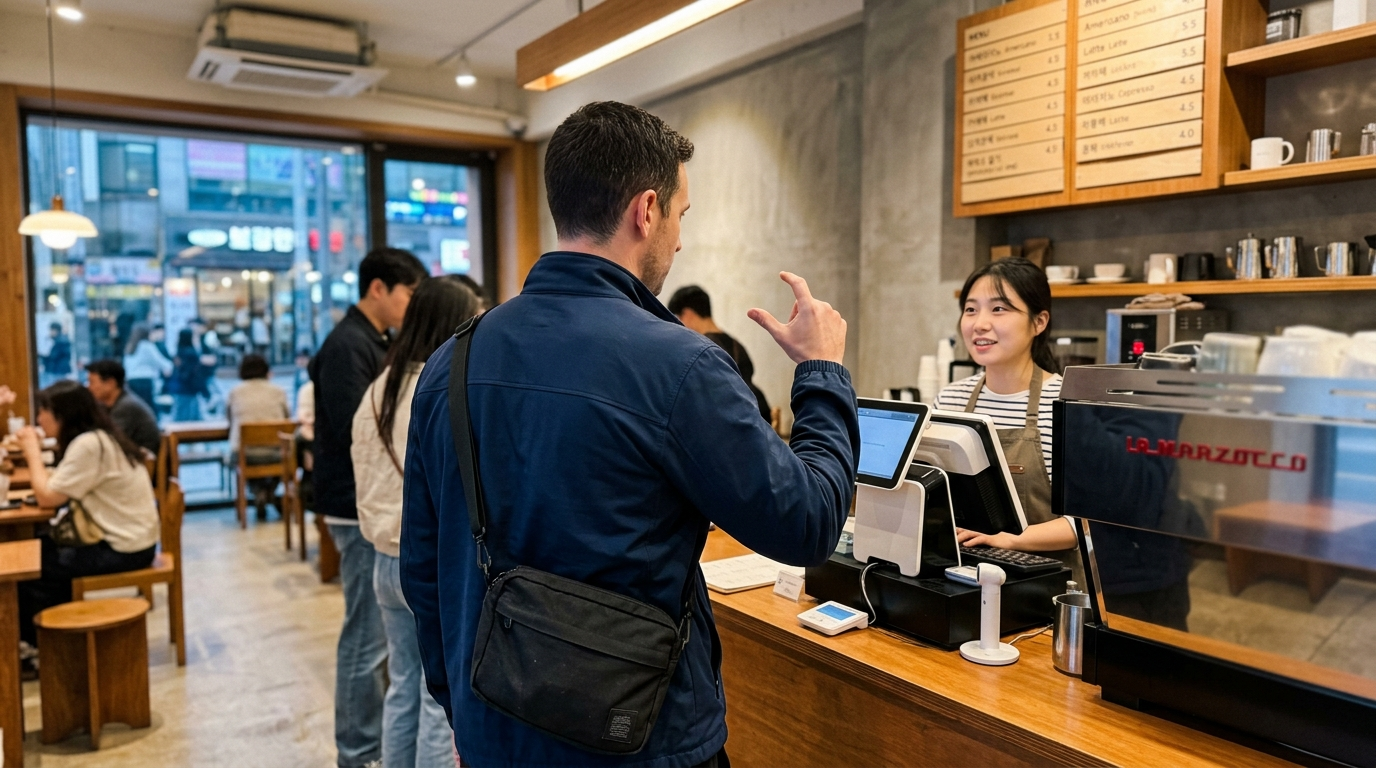
The first question: “드시고 가세요, 가져가세요?” (deusigo gaseyo, gajyeogaseyo) — “For here or to go?” Your answer: “여기서 마실게요” (yeogiseo masilgeyo, “I’ll drink it here”) or “가져갈게요” (gajyeogalgeyo, “I’ll take it to go”). Some baristas shorten this to just “먹고 가요? 테이크아웃?” — mixing Korean and Konglish.
Next question — size. They’ll ask “사이즈 뭐로 하실래요?” (saijeu mworo hasilleayo) — “What size?” Most Korean cafes use the Starbucks-style system: 톨 (tall), 그란데 (grande), 벤티 (venti). Or just say “작은 거요” (jageun geoyo, “small one”) and “큰 거요” (keun geoyo, “large one”). Nobody will judge you.
Temperature comes next. “따뜻한 거요” (ttatteutan geoyo) for hot. “차가운 거요” (chagaun geoyo) for iced. In Korean cafe culture, the iced Americano (아이스 아메리카노, or just “아아” in slang) is practically a national drink. If you say “아아 하나요” (a-a hanayo), every barista in Korea will know exactly what you mean.
Common cafe customizations:
• “샷 추가해 주세요” (syat chugahae juseyo) — “Extra shot, please.”
• “시럽 빼 주세요” (sireop ppae juseyo) — “No syrup, please.”
• “우유 바꿔 주세요” (uyu bakkwo juseyo) — “Can I change the milk?” — then specify: 두유 (soy milk), 오트밀크 (oat milk).
• “디카페인 돼요?” (dikape-in dwaeyo) — “Do you have decaf?”
When your drink is ready, staff will call out your number. Listen for “번” (beon, meaning “number”) after a number. “35번 나왔습니다” means order number 35 is ready. If you missed it, just show your receipt with the order number.
What Catches People Off Guard
The biggest mistake isn’t mispronouncing a word. It’s not knowing the unspoken rules that every Korean takes for granted.
Mistake one: waiting for a server to bring water. In most Korean restaurants, water is self-serve. Look for the water dispenser (정수기, jeongsigi) along the wall. Cups are usually stacked next to it or pulled from a drawer built into your table. Sitting and waiting for someone to bring you water is one of the clearest signals that you’re new to Korean dining.
Mistake two: trying to order banchan. Side dishes come automatically with your meal. You didn’t choose them. You don’t pay for them. If you want more, you ask — “이거 더 주세요” — but you never order banchan from the menu. The exception is a few upscale restaurants that charge for premium banchan, but those are rare.
Mistake three: leaving a tip. This bears repeating because the impulse is strong. Don’t. If you leave cash on the table, the staff will think you forgot it. Some will literally follow you out the door to return it. Korean restaurant pricing already includes service — there’s no tipping culture here at all.
Mistake four: using overly formal Korean. Textbooks teach the highest politeness level (-습니다 endings). But in a casual 식당, using ultra-formal Korean sounds strange — like walking into a diner and saying “I would be most obliged if you could furnish me with the bill.” The korean phrases restaurant cafe interactions actually run on use the -요 ending (주세요, 돼요, 있어요), which is the right register for 95% of situations. Save the formal level for business dinners and government offices, which the Korean phrases government offices article covers.
Matching Your Phrases to Your Situation
Not every phrase in this article applies to every meal. The korean phrases restaurant cafe encounters require shift depending on where you’re eating and how comfortable you are with Korean. Here’s a practical breakdown.
If you’re a complete beginner and just arrived in Korea, focus on five phrases: 이거 주세요 (this one please), 계산이요 (bill please), 저기요 (excuse me), 이거 매워요? (is this spicy), and 두 명이요 (two people). Those five will get you through 80% of casual dining situations. Everything else can wait.
If you’ve been in Korea a few weeks and eat out regularly, add the customization phrases: 덜 맵게 해 주세요, 이거 빼 주세요, 따로 계산할 수 있어요. These move you from “surviving” to “actually communicating.”
If you’re living here long-term and frequent cafes and restaurants daily, the cafe-specific vocabulary and problem-handling phrases — 주문한 거 안 왔어요, 이거 안 시켰어요, 리필 돼요 — are what separate a functional orderer from someone who can handle anything that comes up.
For Korean BBQ specifically, the dynamic is different because you’re cooking at the table. Staff may come over to help with grilling, ask if you want to reorder, or suggest when to flip the meat. The phrases above still apply, but add “고기 더 주문할게요” (gogi deo jumun-halgeyo) — “I’d like to order more meat” — and “불 좀 줄여 주세요” (bul jom juryeo juseyo) — “Can you turn down the heat?” if you have a gas grill.
Quick Check Before You Go
☐ Can you respond to “몇 분이세요?” with your group number?
☐ Do you know “저기요” or the call button to get attention?
☐ Can you say “이거 주세요” while pointing at a menu item?
☐ Do you know “이거 매워요?” to check spice level before ordering?
☐ Can you say “계산이요” and walk to the counter to pay?
☐ Do you know the cafe sequence: for here/to go → size → hot/cold?
☐ Are you aware that water is self-serve and banchan is free?
☐ Do you know not to tip?
Where to Go From Here
Korean phrases restaurant cafe visits need form a specific toolkit — not a random vocabulary list, but expressions organized by the exact moment you’ll use them. Walking in, ordering, customizing, handling problems, paying. Each step has its own small set of words, and knowing them in order makes the whole experience feel manageable instead of overwhelming.
Start with the five essential phrases from the decision guide above. Use them at your next meal. Once those feel automatic, add the customization and problem-handling expressions. The cafe phrases can come later, or immediately if you’re a daily coffee person — which, in Korea, you probably will be.
The other phrase guides in this series cover different daily-life situations: hospital and pharmacy phrases, delivery and takeout phrases, and government office phrases. Together, they build a practical Korean vocabulary set designed specifically for foreigners who need to function — not just study — in Korea.
Note: Korean spoken in restaurants varies by region, formality level, and individual speaker habits. The phrases in this guide reflect standard Seoul Korean as documented by the National Institute of Korean Language (국립국어원) and adjusted for practical use. For formal or specialized dining situations, phrasing may differ. When in doubt, the -요 politeness level used throughout this article is appropriate for the vast majority of everyday restaurant and cafe interactions in Korea.