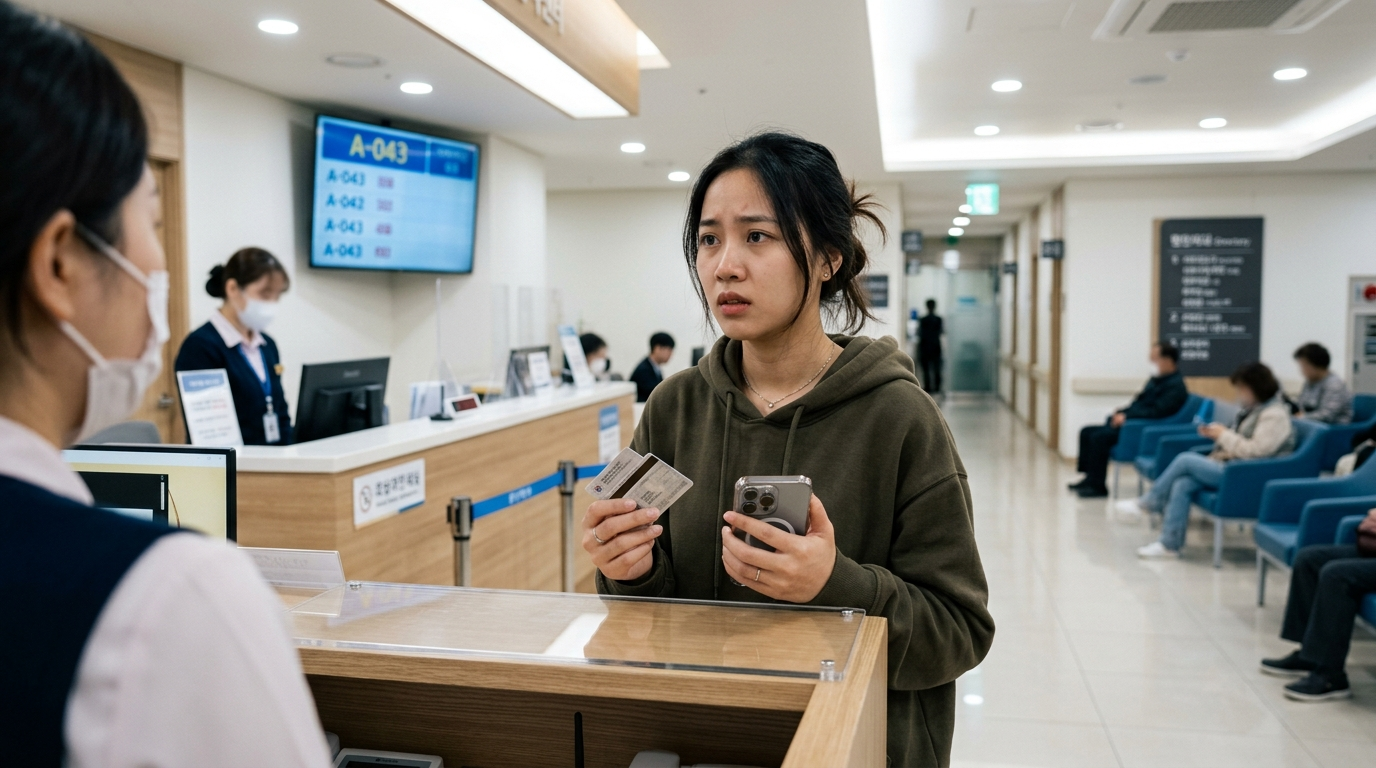
What do you actually say when you’re standing at a Korean hospital reception desk and the person behind the counter doesn’t speak English? Most foreigners freeze. The form is in Korean, the screen is flashing a number, and you’re not even sure you’re in the right line. Korean phrases hospital pharmacy situations demand aren’t the kind you’ll find in a textbook or a tourist phrasebook.
Here’s the thing most people miss: a hospital visit in Korea follows a strict sequence. Reception, consultation, payment, pharmacy — each stage has its own vocabulary, and the phrases that work at the front desk won’t help you at the pharmacy counter. You need different words at each stop.
This article walks through that sequence. Every phrase here comes from real situations — the kind that show up when you’re sick, stressed, and trying to communicate with limited Korean. If you’ve already read about how a hospital visit works in Korea, this is the language layer that goes on top of that process.
Why the Sequence of These Korean Phrases Hospital Pharmacy Visits Require Matters
Korean hospitals and pharmacies operate on a fixed flow. You don’t walk in, see a doctor, and leave with medicine in hand. There are four separate stops, each with different staff, different expectations, and different vocabulary.
The order is always the same: reception (접수, jeopsu), consultation (진료, jillyo), payment (수납, sunap), then pharmacy (약국, yakguk). Skip ahead or confuse the steps and the staff will send you back. It’s not unfriendliness — the system literally won’t proceed out of order.
That’s why memorizing random medical Korean words doesn’t help much. What helps is knowing which phrases belong to which stage. The korean phrases hospital pharmacy counters need are different from what works in the consultation room. Context matters more than vocabulary size here.
One thing worth knowing: Korean hospitals separate the prescribing and dispensing functions by law. The doctor writes the prescription, but you pick up the medicine at an external pharmacy — usually right next to the hospital. This means two separate conversations with two different people. Most foreigners don’t realize they’ll need pharmacy-specific phrases until they’re standing at that second counter, prescription in hand, with no idea what to say. That’s the gap this korean phrases hospital pharmacy guide is built to close.
Step 1 — What to Say at the Reception Desk (접수)
Among all the korean phrases hospital pharmacy visits require, reception desk phrases are the ones you’ll use first — and the ones most phrasebooks skip entirely. You need to register, show your ID or insurance card, and explain why you’re there — all in Korean, usually with people waiting behind you.
Here’s what actually works at this stage:
“처음 방문입니다.” (Cheoeum bangmun-imnida.) — “This is my first visit.” Say this immediately. It tells the desk you don’t have a patient number yet, and they’ll start a new registration instead of searching for an existing record.
“예약했습니다.” (Yeyak-haesseumnida.) — “I have a reservation.” If you booked through the hospital app or phone, this is the first sentence you need. They’ll pull up your reservation by name or phone number.
“건강보험증 있어요.” (Geongang-boheomjeung isseoyo.) — “I have my health insurance card.” Hand it over with your ARC or passport. If you’re covered under Korea’s National Health Insurance (국민건강보험), this sentence speeds things up. Without it, you may pay the full uninsured rate.
One more that saves confusion: “몇 번째에요?” (Myeot beonjjae-eyo?) — “What number am I?” Korean hospitals use a numbering system, not a name-call system. You’ll see a screen displaying numbers. This question tells you where you are in the queue.
If the receptionist asks which department you need, you’ll hear “어디가 불편하세요?” (Eodiga bulpyeon-haseyo?) — “What’s bothering you?” or literally “Where is uncomfortable?” Don’t panic. Just point to the body part or say one of the symptom phrases from Step 2. They’ll direct you to the right department.
Step 2 — Describing Symptoms to the Doctor (진료실)
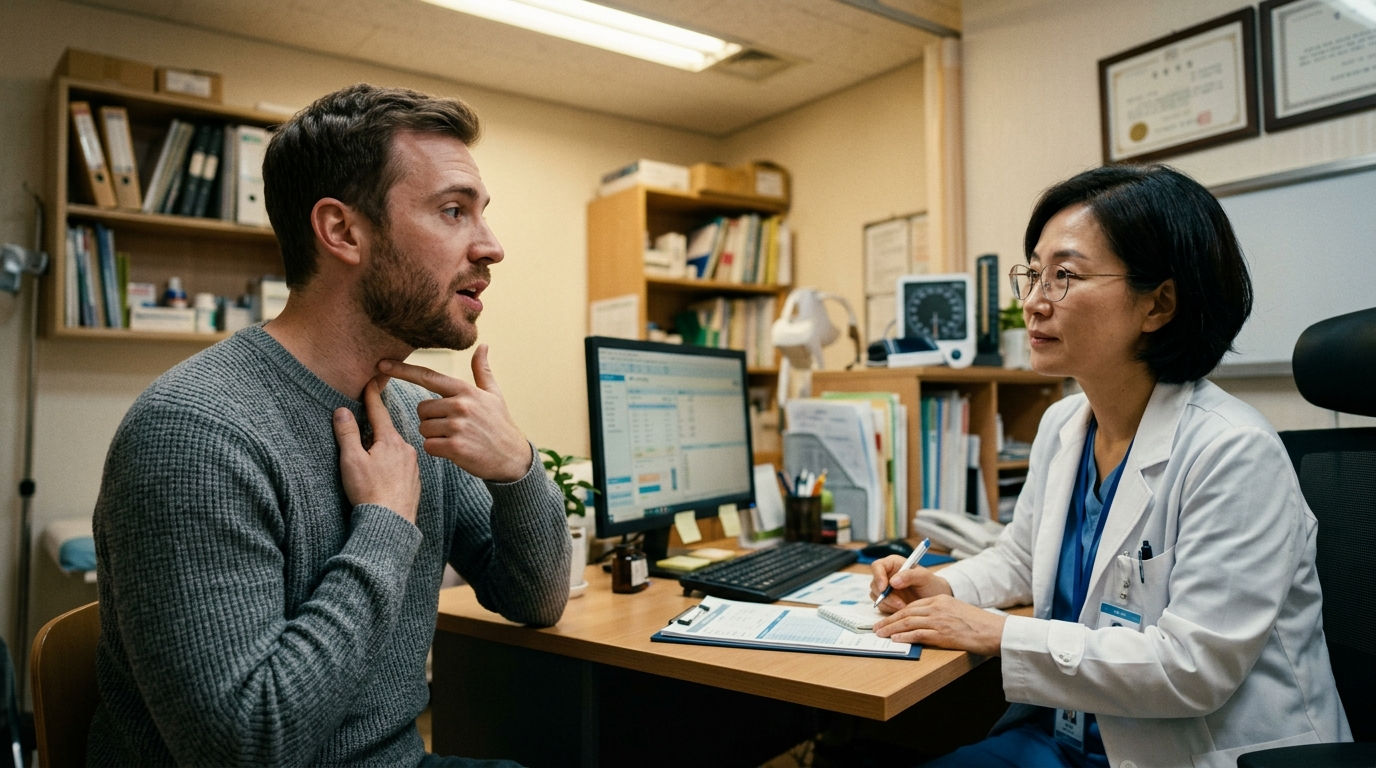
This is the part that terrifies most people. You’re in the consultation room, the doctor is looking at you expectantly, and you need to explain what’s wrong — in Korean. Of all the korean phrases hospital pharmacy and clinic situations demand, these symptom descriptions carry the most weight.
Good news: Korean doctors don’t expect full sentences. Short, clear fragments work. Here are the core patterns:
“여기가 아파요.” (Yeogi-ga apayo.) — “It hurts here.” Point while you say it. This is the single most useful phrase in any Korean hospital visit. Works for any body part, any symptom.
“[숫자]일 전부터요.” ([Number]-il jeonbuteoyo.) — “Since [number] days ago.” Doctors always ask when it started. “삼일 전부터요” (samil jeonbuteoyo) = since 3 days ago. “일주일 전부터요” (iljuil jeonbuteoyo) = since a week ago.
For specific symptoms, these short phrases cover the most common situations:
| Symptom | Korean | Romanization |
|---|---|---|
| I have a fever | 열이 나요 | Yeori nayo |
| I have a headache | 머리가 아파요 | Meoriga apayo |
| My stomach hurts | 배가 아파요 | Baega apayo |
| I feel nauseous | 속이 메스꺼워요 | Sogi meskkeowoyo |
| I have a cough | 기침이 나요 | Gichimi nayo |
| My throat hurts | 목이 아파요 | Mogi apayo |
| I feel dizzy | 어지러워요 | Eojireowoyo |
| I have diarrhea | 설사해요 | Seolsa-haeyo |
| I have a runny nose | 콧물이 나요 | Konmuri nayo |
Two more that come up constantly:
“알레르기 있어요.” (Allereugi isseoyo.) — “I have allergies.” If you’re allergic to any medication, say this immediately. Follow with the medicine name if you know it — even the English name usually works since many drug names are similar.
“약 먹고 있어요.” (Yak meokgo isseoyo.) — “I’m currently taking medication.” Doctors need to know this to avoid interactions. Bring the actual pill bottle or a photo of it. This shows up in expat forums as one of the most overlooked phrases — people forget to mention existing medications until they’re already being prescribed something new.
Questions That Come Up About Korean Phrases Hospital Pharmacy Visits
Can I use English at Korean hospitals?
At large university hospitals in Seoul — Severance, Samsung Medical Center, Asan — some doctors speak English, and international clinics have interpreters. But at neighborhood clinics (동네 병원, dongne byeongwon), which is where most people end up for common illnesses, English support is rare. The reception staff almost never speaks English, even at bigger hospitals. Having even basic Korean phrases ready makes the process significantly smoother. For phrase patterns used at other government-related counters, this guide to Korean phrases for government offices covers similar ground.
Do I need to bring my ARC card to the hospital?
Yes. Your ARC (외국인등록증, oegugin-deungnokjeung) is how they verify your identity and insurance status. Without it, the hospital may register you as uninsured, which means full-price payment. If you don’t have an ARC yet, bring your passport and your health insurance card separately. The receptionist will ask “신분증 있으세요?” (Sinbunjeung isseuseyo?) — “Do you have an ID?”
What if I can’t understand what the doctor says?
Say “천천히 말씀해 주세요” (Cheoncheonhi malsseum-hae juseyo) — “Please speak slowly.” If that still doesn’t work, “적어 주세요” (Jeogeo juseyo) — “Please write it down” gives you something to photograph and translate later. Most doctors will also pull up images on their screen to explain a diagnosis if the language gap is too large. Don’t nod and pretend you understood — Korean doctors interpret nodding as confirmation.
Can I buy medicine at the pharmacy without a prescription?
Some over-the-counter (OTC) items are available — basic pain relievers, cold medicine, digestive aids. But many medications that are OTC in other countries may require a prescription (처방전, cheobang-jeon) in Korea. Antibiotics, stronger pain medicines, and certain allergy medications can fall into this category, though rules may differ by specific item. The pharmacist might ask “처방전 있으세요?” (Cheobang-jeon isseuseyo?) — “Do you have a prescription?” If you don’t and the medication requires one, they legally cannot sell it to you. According to the Health Insurance Review & Assessment Service (HIRA), the prescription-dispensing separation is strictly enforced across all pharmacies in Korea.
Step 3 — Understanding What the Doctor Says Back
You’ve described your symptoms. Now the doctor responds — in Korean, fast, using medical terms. This is where the korean phrases hospital pharmacy guides usually fall short, because they focus on what you say but not on what you hear back.
You don’t need to understand every word. Focus on catching these key phrases, which tell you what happens next:
“약 처방해 드릴게요.” (Yak cheobang-hae deurilgeyo.) — “I’ll prescribe some medicine.” This means you’ll get a prescription slip after paying, and you take it to the pharmacy. This is the most common outcome for non-emergency visits.
“검사가 필요합니다.” (Geomsa-ga piryohamnida.) — “You need a test.” Could be blood work, X-ray, or other diagnostics. They’ll point you to the testing area. Don’t leave the hospital — you usually come back to the same doctor after the results, sometimes within 30 minutes.
“다시 오세요.” (Dasi oseyo.) — “Come back again.” This means a follow-up visit. The doctor might add a timeframe: “일주일 후에 다시 오세요” (iljuil hue dasi oseyo) = come back in one week.
“수납하고 나가세요.” (Sunap-hago nagaseyo.) — “Pay at the counter and you can leave.” This is how most consultations end. You go to the payment window (수납, sunap), pay, receive your prescription printout, and then head to the pharmacy.
If you need more time to process what was said, try: “다시 한번 말씀해 주세요.” (Dasi hanbeon malsseum-hae juseyo.) — “Could you say that one more time?” Korean doctors are generally patient with foreigners. They deal with communication gaps regularly.
Step 4 — Korean Phrases at the Pharmacy Counter (약국)
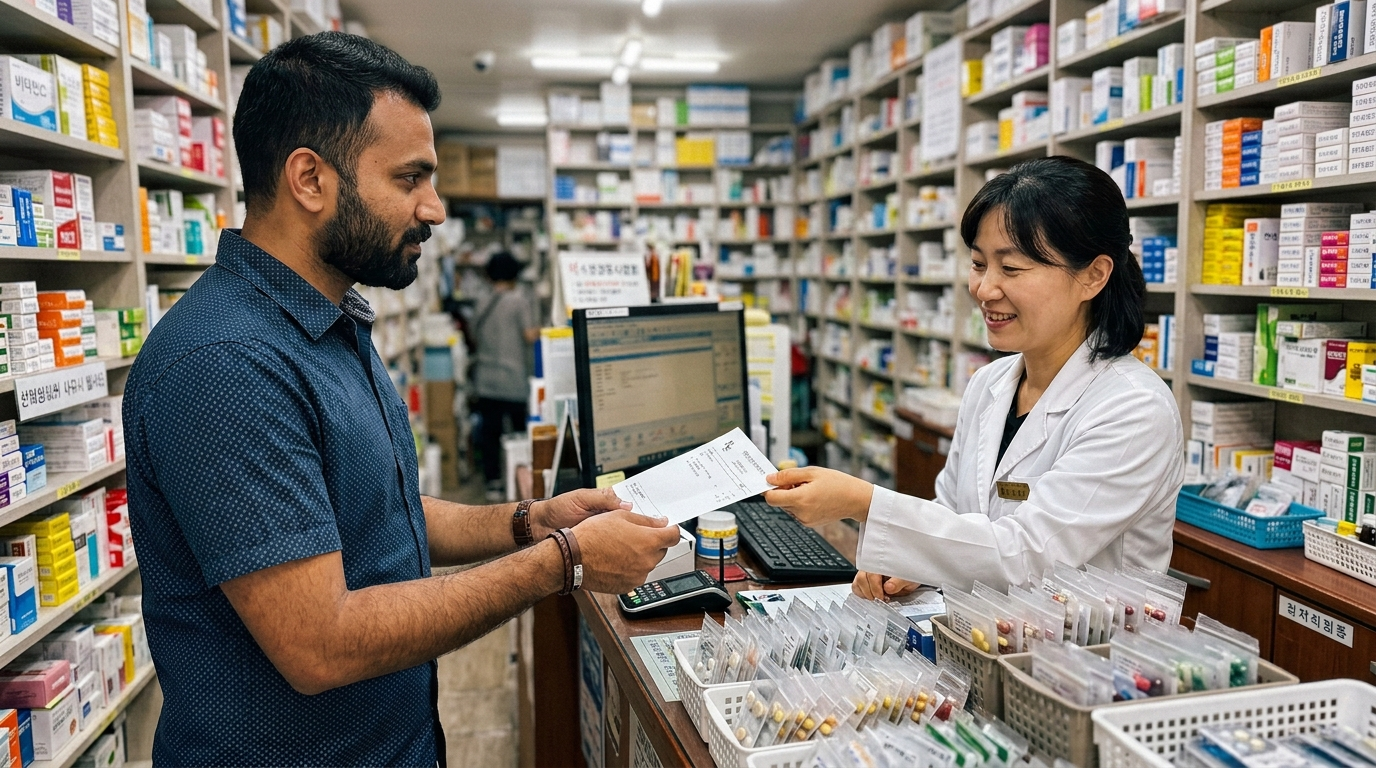
You’ve paid at the hospital. Now you’re standing in front of a pharmacy, holding a prescription printout. This is the final stage of the korean phrases hospital pharmacy sequence, and it has its own distinct vocabulary.
Walk in and say: “처방전이요.” (Cheobang-jeon-iyo.) — “Here’s my prescription.” Hand it over. The pharmacist will prepare the medication, which usually takes 5–15 minutes. In many pharmacies, they’ll call your number or name when it’s ready.
When you receive the medicine, the pharmacist will explain how to take it. Listen for these phrases:
“하루에 [숫자]번 드세요.” (Harue [number]-beon deuseyo.) — “Take it [number] times a day.” 세 번 = three times, 두 번 = twice. This tells you the frequency.
“식후에 드세요.” (Sikhue deuseyo.) — “Take it after meals.” The alternative is “식전에 드세요” (sikjeone deuseyo) — before meals. This detail matters. Some medications lose effectiveness or cause stomach issues if taken at the wrong time.
If you need to ask questions:
“이 약은 어떻게 먹나요?” (I yageun eotteoke meongna-yo?) — “How do I take this medicine?” Useful when the instructions aren’t clear or you missed part of the explanation.
“부작용 있어요?” (Bujagyong isseoyo?) — “Are there side effects?” Pharmacists in Korea are trained to answer this and usually will, even briefly. If they mention “졸음” (joreum, drowsiness), that’s important if you’re driving or working.
One last phrase that saves confusion at the pharmacy: “며칠분이에요?” (Myeochilbun-ieyo?) — “How many days’ worth is this?” Korean prescriptions are issued for specific durations — typically 3, 5, or 7 days. Knowing this tells you whether you’ll need a refill visit. According to the National Health Insurance Service (NHIS), insured patients typically pay around 30% of the pharmacy cost for prescribed medications — though the exact rate varies by medication type and hospital tier — so the total is often surprisingly low.
What Catches People Off Guard
The phrases above cover most situations. But certain gaps keep tripping people up — not because of vocabulary, but because of how the system works.
Paying before the pharmacy. In many countries, you pay once and leave with your medicine. In Korea, you pay at the hospital first (for the consultation), then pay separately at the pharmacy (for the medicine). Foreigners who skip the hospital payment window and walk straight to the pharmacy get turned away. The prescription won’t process until the hospital marks your visit as paid.
Going to the wrong department. Korean hospitals don’t have a single “general doctor.” You choose a department when you check in: 내과 (naegwa, internal medicine), 이비인후과 (ibiinhugwa, ENT), 정형외과 (jeonghyeong-oegwa, orthopedics), 피부과 (pibugwa, dermatology). If you don’t know which one to pick, say “어디로 가야 해요?” (Eodiro gaya haeyo?) — “Where should I go?” The reception staff will route you.
Not bringing your prescription printout. Some people assume the pharmacy already knows what the doctor prescribed. They don’t. Unless the hospital uses a digital prescription system linked to that specific pharmacy (some do, most neighborhood clinics don’t), you need the physical printout. Lose it, and you’ll have to go back to the hospital for a reprint.
Assuming all pharmacies stock everything. Smaller pharmacies near residential areas might not carry specialized medications. If the pharmacist says “이 약은 없어요” (i yageun eopseoyo) — “We don’t have this medicine” — ask “어디서 살 수 있어요?” (eodiseo sal su isseoyo?) — “Where can I buy it?” They’ll usually point you to a larger pharmacy nearby.
What to Confirm Before Your Visit
Knowing the right phrases is only half the preparation. The other half is having the right documents and tools ready before you walk in.
☐ ARC card or passport — have it in hand, not in your bag
☐ Health insurance card (건강보험증) — separate from your ARC
☐ Photo of any current medication bottles or pill packages
☐ Know the Korean word for your main symptom (from the table above)
☐ Know which department you need, or be ready to ask
☐ Phone charged — for translation apps as backup
☐ Cash or Korean bank card — some smaller clinics don’t accept foreign cards
☐ Name and address of a nearby pharmacy (the hospital reception often recommends one)
Where to Go From Here
A hospital visit in Korea isn’t complicated once you know the sequence. Reception, doctor, payment, pharmacy — four stops, four sets of phrases. The korean phrases hospital pharmacy visits demand don’t require fluency. They require matching the right words to the right counter.
The phrases in this article cover about 90% of what happens in a standard clinic visit. For the hospital process itself — what to expect at each stage, how insurance applies, what happens if you don’t have an ARC yet — the hospital visit guide walks through the full sequence. And if you haven’t sorted out your insurance situation yet, this breakdown of health insurance for foreigners explains what’s covered and when it kicks in.
Save the symptom table on your phone. Screenshot the pharmacy phrases. The next time you’re standing at a Korean clinic, sick and stressed, having these korean phrases hospital pharmacy ready makes the difference between a 30-minute visit and a two-hour ordeal.