
The amount of your apartment deposit korea foreigners pay matters far less than when you verify the details around it. Most deposit disputes in Korea don’t come from dishonest landlords. They come from a contract clause the tenant never questioned — signed weeks before the problem actually surfaced.
Korean rental deposits work on a timeline. Each stage — searching, signing, moving in, and eventually moving out — has its own set of traps. Miss the window at any stage, and your leverage disappears. That’s the part most foreigners don’t hear about until it’s too late.
This article follows that timeline from start to finish. Not theory. Not legal textbook language. Just the gaps that tend to cost real money when apartment deposit korea foreigners situations go sideways — and when to catch them.
Why the Deposit Timeline Matters More Than the Amount
Most foreigners focus on how much the deposit costs. That’s understandable. Korean deposit amounts can feel enormous — anywhere from ₩5,000,000 for a small monthly-rent studio to ₩50,000,000 or more for a jeonse (전세) lease. The numbers alone are enough to cause stress.
But the amount isn’t where most problems start.
The Korean rental system runs on two main structures: jeonse (전세), a large lump-sum deposit with no monthly rent, and wolse (월세), a smaller deposit plus monthly payments. Each has its own contract terms, refund rules, and risk profile. What catches apartment deposit korea foreigners off guard is that the refund process depends almost entirely on what was written — or not written — in the contract, not on verbal promises made during the apartment tour.
A licensed real estate agent, called a gonginjonggaesa (공인중개사), handles most rental transactions. Their involvement is legally required for registered properties. But “legally involved” doesn’t mean they explain every clause to a foreigner in English. One thing worth knowing if you’re troubleshooting a deposit issue later: the contract language is what counts. The tour conversation is not.
The timeline below follows the four stages where deposit problems actually start — and the specific window at each stage where you still have room to act.
Before Signing — The Window Most Foreigners Waste
This is the only stage where you have full leverage. Once you sign and transfer a deposit, the dynamic shifts. Everything before that point is negotiable. Everything after it requires effort, paperwork, and sometimes legal help to undo.

Before visiting any apartment, check the actual transaction prices (실거래가) for the building or neighborhood. This is where apartment deposit korea foreigners can save serious money before any commitment is made. The Korean government publishes this data through the Ministry of Land, Infrastructure and Transport’s transaction database. It shows what tenants actually paid in recent months — not what landlords are asking. The gap between listed price and real price can be ₩2,000,000 or more, especially in older buildings.
If you’re coming from a country where temporary housing in Korea was your first experience, the deposit system may feel completely foreign. In a wolse setup, typical deposits range from ₩3,000,000 to ₩10,000,000, with monthly rent on top. In jeonse, the deposit replaces rent entirely — but you’re handing over tens of millions of won to someone you may have met once.
Here’s what most foreigners skip during this window:
Confirm the landlord actually owns the property. Ask the gonginjonggaesa for the building registry, called a deunggibu deungbon (등기부등본). This document shows who legally owns the unit, whether there are existing loans against it, and if any legal claims are attached. If the landlord has a large mortgage on the property, your deposit refund may be at risk if they default.
Also check whether the building has any outstanding tax liens. This shows up in the same registry. A foreigner who doesn’t read Korean can request help from the agent — but in many cases, agents move fast and don’t pause to explain what each section means.
Contract Day — 3 Traps Hidden in the Paperwork
Apartment deposit korea foreigners sign contracts for tends to follow a standard template. That’s both good and bad. Good because the format is predictable. Bad because the details that matter most are buried in sections most tenants skim past.
Trap 1: The “special conditions” section (특약사항). This is the most overlooked part of a Korean lease. The standard clauses above it are mostly boilerplate. But the special conditions section is where landlords — or agents — insert custom terms. These can include penalties for early termination, responsibility for specific repairs, and conditions for deposit deductions at move-out. If this section is blank or vague, that’s a problem too. Anything not written here defaults to the landlord’s interpretation later.
Trap 2 tends to surprise people. The contract may list a move-out notice period of 1 to 3 months. If you don’t notify the landlord within that window, the contract may auto-renew — and your deposit stays locked. Foreigners who plan to leave Korea on a specific date sometimes miss this deadline by a week. That one week can delay a refund by months.
Trap 3: Deposit return timing isn’t always guaranteed. Korean law generally requires the landlord to return the deposit on the day the tenant moves out. In practice, landlords in many cases delay the refund until a new tenant moves in and pays their deposit. The contract may include language that permits this. For apartment deposit korea foreigners who plan to leave the country on a specific date, this delay can mean flying home without the money.
If you’re comparing housing options and still weighing a guesthouse versus a one-room in Korea, the contract stage is the main reason one-rooms carry more risk. Guesthouses rarely involve deposits this large or contracts this binding.
After Move-In — When the Deposit Becomes Leverage
Once you’ve moved in, the deposit shifts from being your money to being the landlord’s security. That’s how the system is designed. But the way apartment deposit korea foreigners handle the first few weeks after move-in often determines whether the refund process goes smoothly or turns into a dispute.
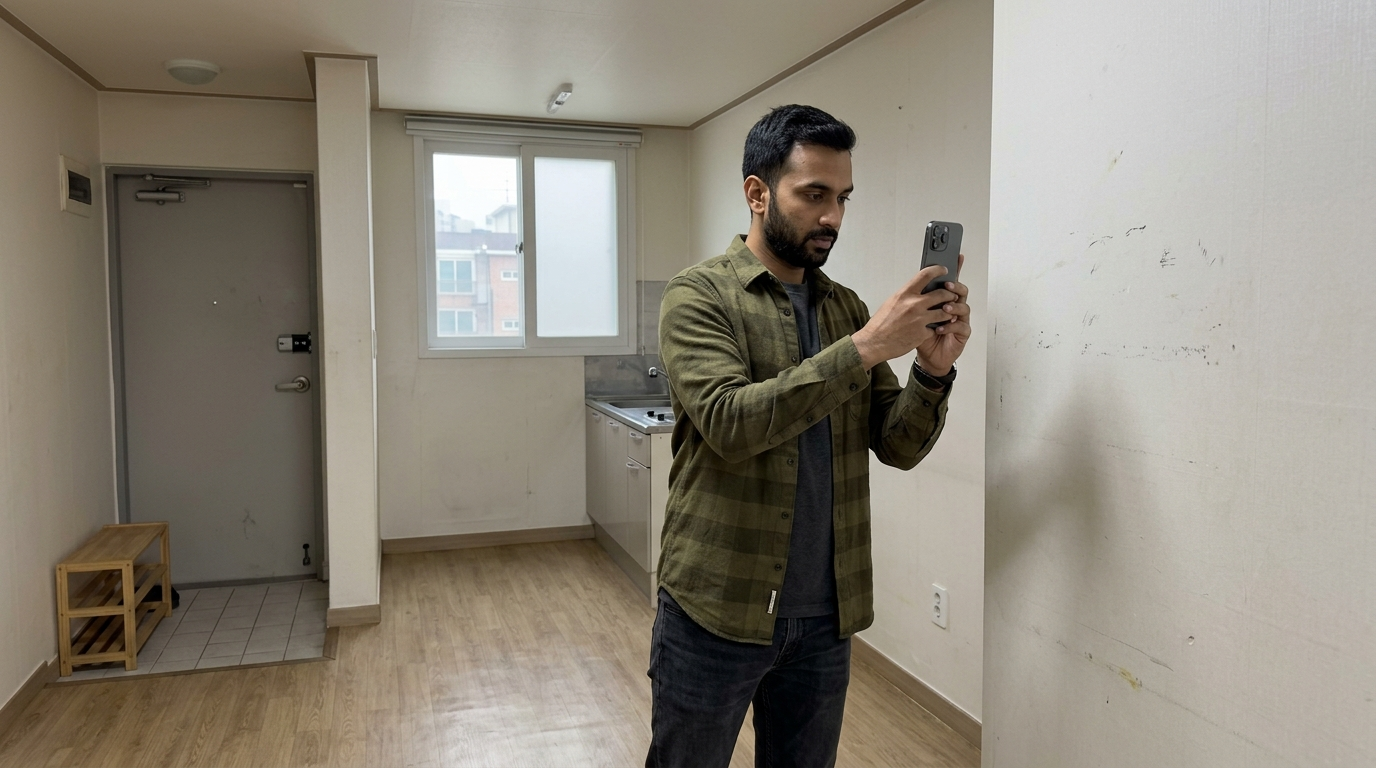
Take timestamped photos of every wall, floor, fixture, and appliance on the day you move in. Not the next week. Not when you “get settled.” Day one. Send those photos to the landlord or agent through KakaoTalk so the timestamp is on record. This is the single most effective thing you can do to protect a deposit refund later.
Complete your address registration (전입신고) at the local community center within 14 days. This step does more than update your official address — it activates tenant protections under Korean housing law. Without it, your deposit may not be legally prioritized if the landlord faces financial trouble. This is one of those steps that seems like paperwork but functions as insurance.
While you’re settling in, make sure utilities in your Korea apartment are properly transferred to your name. This is a detail apartment deposit korea foreigners frequently overlook. If the landlord’s name stays on the utility accounts, any unpaid balance at move-out can be deducted from your deposit — even if you paid everything on time through a different method.
Apartment Deposit Korea Foreigners: Why Move-Out Refunds Stall
This is where apartment deposit korea foreigners problems become real money problems. Everything before this point was preparation. Now it’s execution — and the margin for error is small.
The most common refund delay happens when the landlord hasn’t found a new tenant. In a jeonse situation, the landlord may genuinely not have the cash to return your deposit until the next tenant’s deposit comes in. This is legal in some contract setups and extremely common in practice. It doesn’t mean the landlord is acting in bad faith. But it does mean your money may be tied up for 1 to 3 months after you’ve already left the apartment.
If the landlord claims damage and deducts from your deposit, the photos you took on day one become your primary evidence. Without them, the landlord’s word carries more weight — especially in a mediation or legal setting. Deductions for “cleaning fees” or “wall damage” are the most frequent disputes foreigners report in online communities. The amounts aren’t always large individually, but they add up. ₩200,000 here, ₩500,000 there.
For disputes that can’t be resolved directly, the Korea Legal Aid Corporation (대한법률구조공단) offers free legal consultations for foreigners, including deposit recovery cases. They have English-language support in some offices. Filing a formal complaint through the local district court is also an option, though it typically takes several months to resolve.
Look — leaving Korea with a deposit dispute unresolved is one of the worst financial situations a foreigner can face. Once you’re outside the country, enforcing a refund becomes significantly harder. If your departure date is fixed, start the move-out process at least 2 to 3 months before that date.
Questions That Come Up Most
Can a landlord keep part of my deposit for normal wear and tear?
Generally, no. Korean tenancy law distinguishes between normal use and actual damage. Faded wallpaper from sunlight or minor scuff marks on vinyl flooring typically fall under normal wear. However, “normal” isn’t always defined the same way by every landlord. Having move-in photos and a clear special conditions clause in your contract makes this much easier to dispute if it comes up.
Do I need to pay the full deposit before moving in?
In most cases, the deposit is split into two payments: a smaller initial deposit called gyeyakgeum (계약금), usually 5–10% of the total, paid at signing, and the remaining balance paid on or before move-in day. The exact split and timing should be written in your contract. Paying the full amount upfront without a signed contract is a risk — and legitimate agents won’t ask you to do that.
What if I need to leave Korea before my lease ends?
Early termination rules depend entirely on what’s written in your contract’s special conditions section. Some contracts allow early termination with 1 to 2 months’ notice. Others impose a penalty — often equivalent to 1 to 3 months of rent. In some cases, the landlord may agree to release you early if a replacement tenant is found. None of this is guaranteed, so apartment deposit korea foreigners should check the termination clause before signing, not after the flight is booked.
What to Confirm Before Signing
Property verification: Request the building registry (등기부등본) and confirm the listed owner matches the person on the contract. Check for outstanding loans or liens.
Deposit structure: Confirm the exact deposit amount, payment schedule (계약금 + balance), and the bank account the deposit will be transferred to. Verify the account matches the owner’s name.
Special conditions (특약사항): Read every line. Confirm move-out notice period, early termination terms, deposit deduction conditions, and refund timing. If this section is blank, ask the agent to add specific protections.
Move-out notice deadline: Write down the exact date by which you need to notify the landlord to avoid auto-renewal. Set a calendar reminder at least 2 weeks before that date.
Condition documentation plan: Agree with the landlord or agent that you’ll send timestamped photos of the apartment’s condition on move-in day via KakaoTalk.
Address registration (전입신고): Plan to complete this within 14 days of moving in at your local community center (주민센터). Bring your passport, ARC card, and lease contract.
Where to Go From Here
Apartment deposit korea foreigners deal with in Korea isn’t just a financial transaction — it’s a timeline of decisions, each with its own window. The research stage is where you hold the most power. Contract day is where the terms get locked. Move-in is where you build your evidence. And move-out is where everything you did or didn’t do earlier shows up in your bank account.
None of this requires fluent Korean or a law degree. It requires paying attention at the right moments and knowing which details actually matter. The deposit system in Korea isn’t designed to trap foreigners — but it isn’t designed to protect them by default, either. The protection comes from what you verify before you sign.