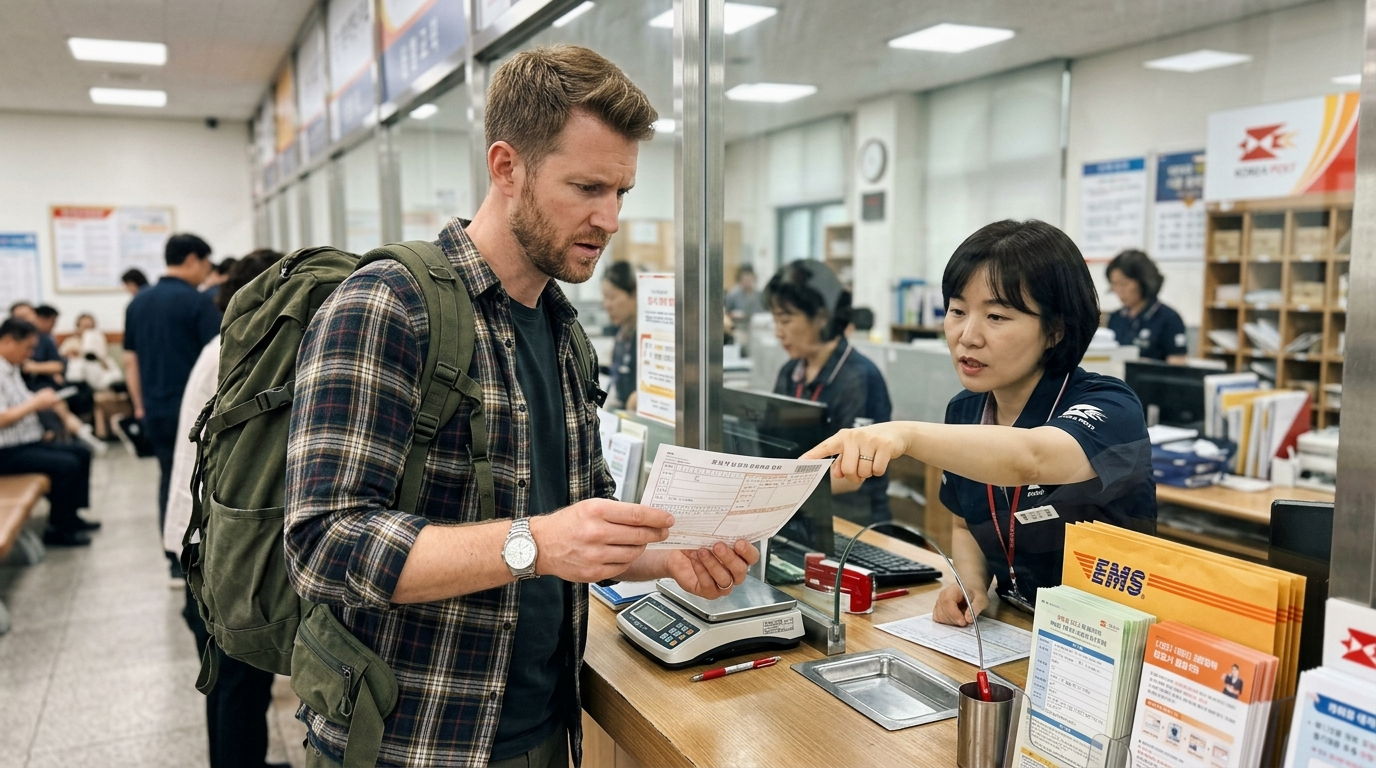
Korean post offices handle international shipments efficiently — when the paperwork is filled out correctly. For foreign residents, that’s a bigger condition than it sounds. The first post office korea foreigners walk into tends to send forms back for reasons that look trivial: a reversed name, a missing district code, or a customs description the clerk considers too vague. None of these show up as errors on any screen. They get caught at the counter, out loud, in Korean.
The frustrating part is that the forms themselves aren’t complicated. Most have English fields. The issue is that the rules behind those fields — name order matching your ID, address format matching the Korean postal system (우편번호), customs value thresholds — aren’t explained anywhere in the building. You fill it out, wait in line, and find out what went wrong when the clerk hands it back.
Three specific things cause most rejections. This article breaks down where the system flags foreign residents, why it happens, and what to prepare before you stand in line.
Where Form Rejections Actually Happen
It’s not one specific form. Foreigners run into rejections across three common tasks at Korean post offices: sending an international parcel through EMS (국제특급우편), mailing registered letters to another country, and filling out customs declaration slips for anything valued above a certain threshold. Each one has its own form, and each form has a different sticking point.
EMS is the most popular option for sending packages home. The form asks for sender and receiver addresses, item description, declared value, and weight. Straightforward on paper. But the sender address needs to follow the Korean postal format — and most foreigners write it the way they’d address a letter back home. That alone is enough to get the form handed back.
Registered mail (등기우편) is simpler, but the name field still trips people up. Foreigners at Korean post offices often find that if the name on the form doesn’t match the name on your ARC or passport, the clerk may refuse to process it. This comes up more than you’d think — people use nicknames, shortened versions, or write their family name last when the system expects it first.
One thing worth knowing if you’re troubleshooting: the clerk isn’t being difficult. They follow a checklist. If something doesn’t match, they physically can’t move forward in the system. Understanding this makes the experience less personal and more predictable.
Why Korean Post Offices Flag Foreign Names and Addresses
The Korean postal system (우체국) uses a standardized digital backend. When a clerk enters your form into the system, the address auto-checks against the national address database. Korean addresses follow a strict hierarchy: province or city (시/도), district (구/군), neighborhood (동/읍/면), street name (도로명), building number, then detail unit. If your handwritten address skips a level or uses the old lot-number format (지번주소) instead of the current road-name format (도로명주소), the system flags it. More detail on how this works is covered in the Korean address system guide.
Names create a different problem. Korean post offices verify foreign names manually against your official ID. For Korean nationals, this is automatic — their name is in the national registry. For foreigners, the clerk manually cross-references your passport or ARC card (외국인등록증). If your form says “Mike Johnson” but your passport reads “Michael Robert Johnson,” that gap is enough for a rejection. The clerk has no discretion here. This is the same kind of name-matching issue that blocks address registration for foreigners at the district office.
Then there’s customs. Korea’s customs declaration rules require specific item descriptions — not categories. Writing “clothes” gets flagged. Writing “2 cotton t-shirts, 1 wool sweater” doesn’t. The Korea Customs Service sets these requirements, and post office clerks enforce them at the counter. Vague descriptions can delay or even hold your package at the destination country’s customs office.
3 Patterns That Get Your Form Sent Back
These aren’t random. They repeat every week at Korean post offices in Seoul, Busan, and everywhere in between. Expat forums bring these up constantly.
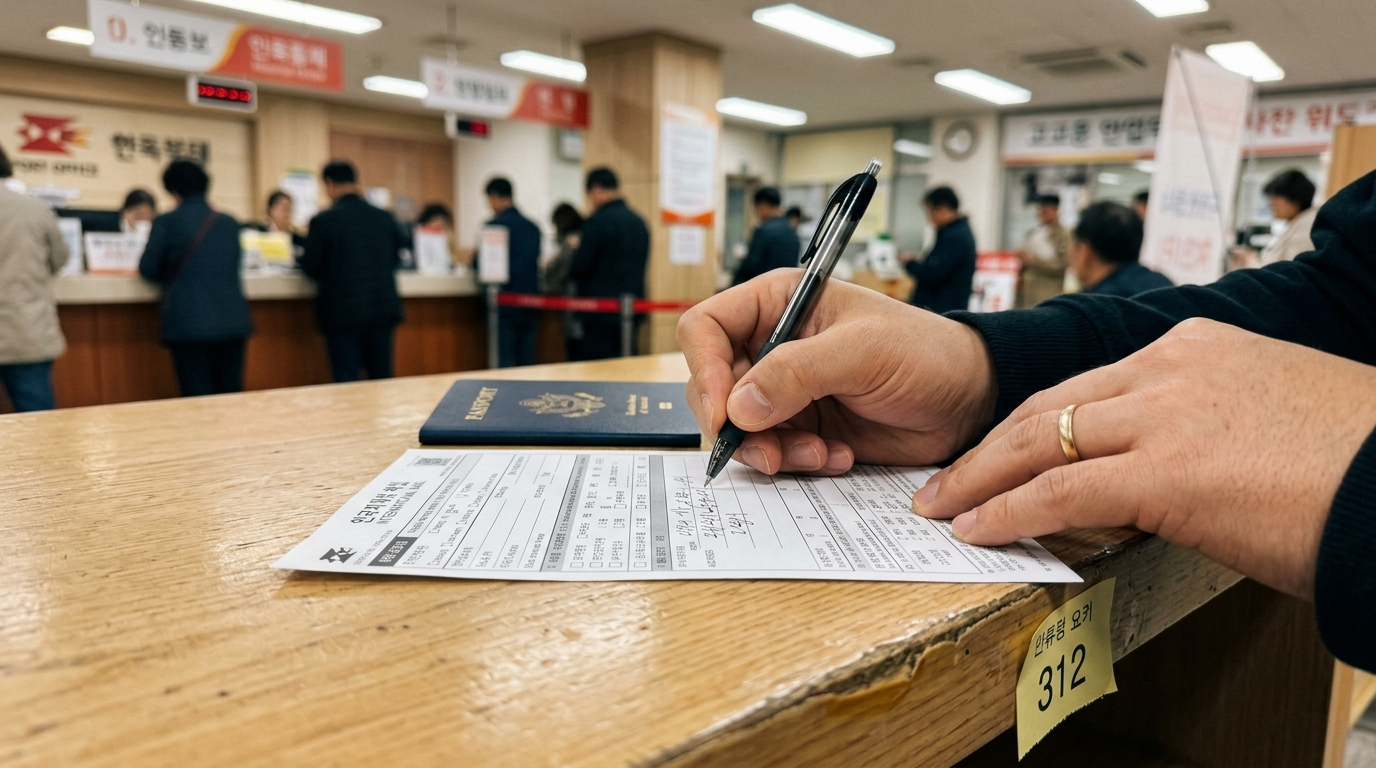
Pattern 1: Writing your Korean sender address in English. The sender field on EMS and registered mail forms needs to be in Korean — or at minimum, in the Korean postal format with the five-digit postal code (우편번호). Many foreigners write their Korean address the way they’d write it for a friend abroad: apartment number first, then street, then city. The Korean system reads it the opposite way. Province first. Street last. If you’re unsure of your exact registered format, check the address on your ARC card or your resident registration confirmation (전입신고확인서).
Pattern 2: Name doesn’t match official ID exactly. This is where people lose time. You write “Chris Park” on the form because that’s what you go by. But your passport says “Christopher David Park.” The clerk checks, it doesn’t match, and the form comes back. No partial matches. No nicknames. Use the full legal name, character for character. The same principle applies to any official Korean document — a pattern explained further in the guide to Korean terms in official documents.
Pattern 3: Customs description is too vague or the declared value looks suspicious. Writing “personal items” on the customs declaration is a guaranteed flag. Writing “gift” with a declared value of ₩5,000 for a box that clearly weighs 4kg also raises questions. Korean customs expects itemized descriptions with approximate values per item. If the numbers don’t make sense relative to the weight and size, the clerk will ask you to redo it — or worse, the package gets held at the destination.
Most people hit pattern 1 or 2 on their first visit. Pattern 3 tends to catch people who’ve sent a few packages successfully and start cutting corners on the description.
What Actually Gets Your Package Through
Bring your ARC card or passport. Not a photo of it. The physical card. Korean postal clerks need to see the original document to verify your name. Some locations accept a passport copy for simple letters, but for EMS parcels and anything requiring customs declaration, the original is expected.
Write your sender address in Korean. If you can’t write Korean, type it on your phone and show it to the clerk — most will help foreign residents fill in the form. Use the road-name address (도로명주소) from your ARC card, not the old lot-based format. Include the five-digit postal code. If you don’t know yours, the Korea Post website has a postal code lookup tool that works with both Korean and partial English input.
For customs declarations, list each item separately. Include the material if relevant — “leather belt” instead of “belt,” “cotton dress” instead of “clothing.” Assign realistic values. If you’re sending used items, you can declare them at lower values, but they still need to be individually listed. Nobody expects you to appraise a used hoodie to the won. A reasonable estimate is fine.
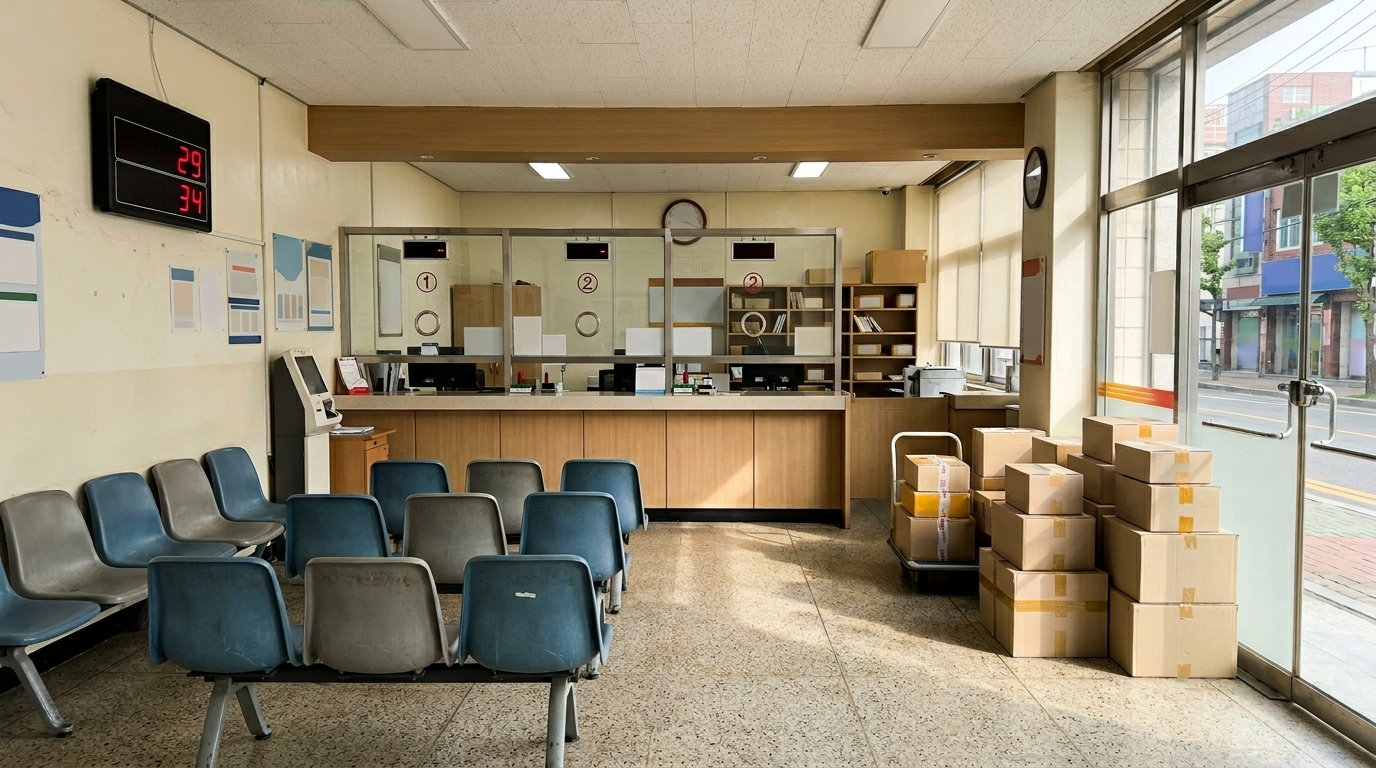
One more thing: timing matters. Post offices in Korea (우체국) are open weekdays 9:00 AM to 6:00 PM. Some branches close for lunch. The last pickup for international EMS is usually around 4:00–4:30 PM, so arriving at 5:30 with a complicated parcel is asking for trouble. Go before noon on a weekday if you can. Saturdays are limited hours and significantly more crowded.
After Sending — What Post Office Korea Foreigners Still Miss
Your form went through. The clerk accepted the package. You got a tracking number. That doesn’t mean it’s done.
EMS tracking works well within Korea, but once the package crosses the border, tracking updates depend on the destination country’s postal system. Some countries update in real-time. Others go silent for days. This is normal. Korea Post’s tracking page shows the domestic journey clearly — it’s the international handoff where visibility drops.
Customs holds at the destination are another common surprise for foreigners sending packages from Korea. Even if your local post office accepted your customs form, the receiving country’s customs office can still hold the package for additional inspection. This happens more often when the declared value is suspiciously low, when the description is vague, or when the destination country has import restrictions on certain items. Food, cosmetics, and electronics are frequent triggers.
Keep your receipt. The tracking number on it is the only way to file an inquiry if something goes wrong. Korea Post’s claim window for lost or damaged EMS items is typically 6 months from the date of mailing, but you need the original receipt and tracking number to start the process.
Questions That Come Up Most
Can I send a package from a Korean post office without an ARC card?
Yes — a passport works for identification at most branches. Foreigners without ARC cards can still send EMS and registered mail from any Korean post office. However, some clerks may ask additional questions about your Korean address if you don’t have an ARC to verify it. Having your accommodation address written in Korean on your phone helps speed this up. Tourists send packages regularly without issue as long as the ID and address are clear.
Is there an English option at Korean post offices?
Not consistently. Smaller neighborhood branches rarely have English-speaking staff. Larger post offices near Myeongdong, Itaewon, or Gangnam sometimes do, but it’s not guaranteed. The EMS form itself has English fields, but all signage, queue numbers, and verbal instructions are in Korean. Preparing your forms in advance and having your address details typed on your phone makes the process manageable even without Korean language skills.
Where to Go From Here
Every post office korea foreigners encounter across the country runs on the same system. Name matching, address format, and customs detail — these three things account for almost every rejection at the counter. Get them right before you walk in, and the whole process takes fifteen minutes.
If you’re still settling into Korea and dealing with addresses, registration, or official documents, the underlying patterns are the same everywhere. Korean systems expect exact matches and specific formats. The earlier you learn that rhythm, the fewer surprises you get — at the post office and everywhere else.