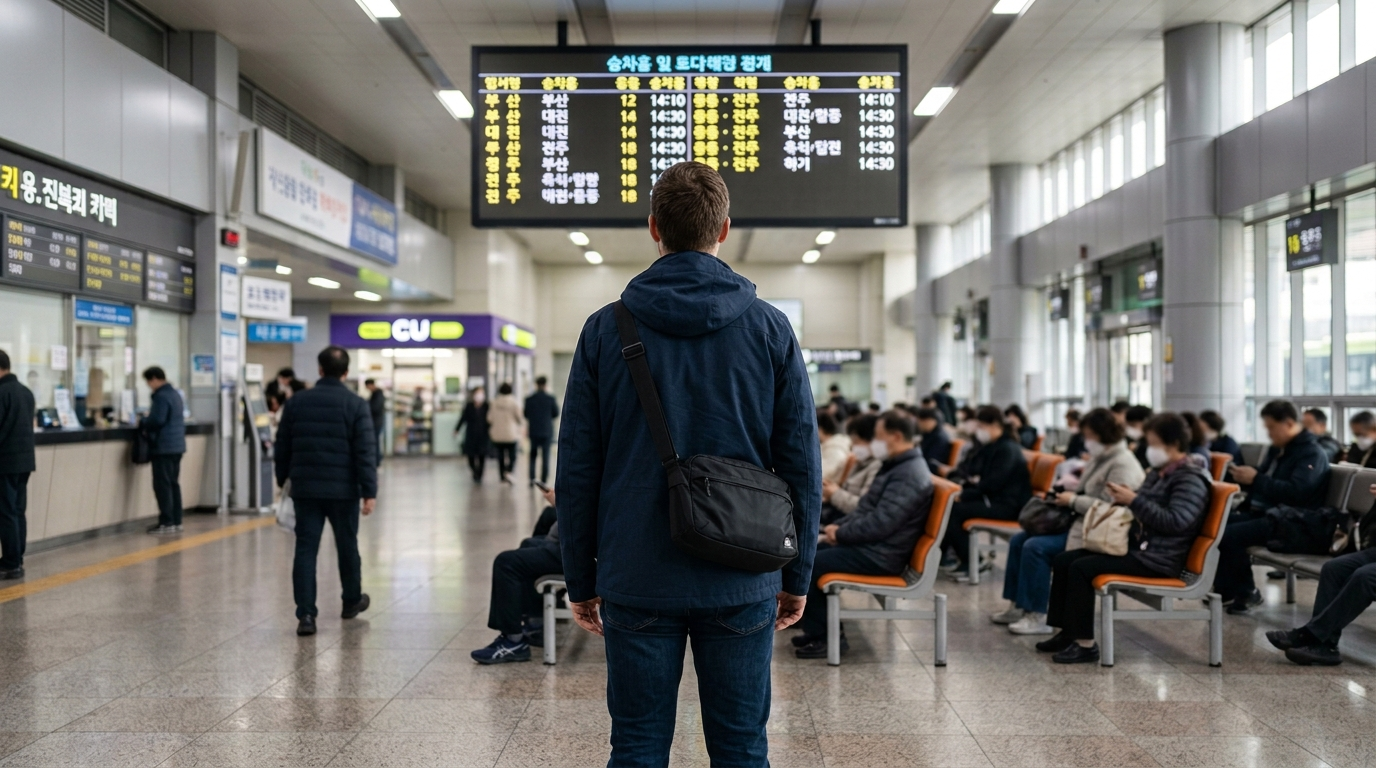
What happens when you try to book an express bus in Korea without a Korean phone number or a Korean credit card? If you’re imagining a smooth five-minute online checkout, it might be worth adjusting that picture. Express bus korea foreigners rely on looks simple from a distance — fast routes, cheap tickets, frequent departures — but the booking layer sits behind verification systems that don’t always cooperate with foreign credentials.
This isn’t a system that hates foreigners. It’s a system built for Korean users, with layers of phone verification and local card processing that nobody thought to translate. The buses themselves are comfortable, affordable, and cover destinations KTX doesn’t reach. The problem sits between you and the ticket — not between you and the seat.
This article walks through what actually works for foreigners trying to ride express buses in Korea, what quietly blocks you at the payment screen, and how to get around each wall before your departure day.
What Most Foreigners Picture at Korean Bus Terminals
Korea has fast internet, polished subway apps, and one of the smoothest KTX booking flows in Asia. So most foreigners assume express bus booking works the same way — visit a website, pick a time, enter your card, done.
That assumption breaks within about ninety seconds on the KOBUS website.
Korea’s express bus network is one of the largest in the country, connecting major cities like Seoul, Busan, Daegu, Gwangju, and Sokcho at prices that often run 30 to 40% cheaper than KTX. According to the Korea Tourism Organization, buses depart from centralized terminals in most cities, operate on tight schedules, and reach areas that trains don’t cover. All of that is true. The part most guides skip is what happens at the payment screen — where the system asks for a Korean credit card, a Korean phone number, or both.
There’s also a terminal problem most people don’t see coming. Seoul alone has four major bus terminals — Seoul Express Bus Terminal (Gyeongbu/Yeongdong lines), Central City Terminal (Honam line), Dong Seoul Terminal, and Sangbong Terminal. Each one serves different destinations. If you show up at the wrong terminal, there’s no transfer — you take the subway across the city and start over.
What Actually Works Without a Korean Card
Not everything is locked behind Korean-only systems. A few booking methods genuinely accept foreign cards and foreign phone numbers.
Walk-up ticket counters at every terminal. This is the most reliable method for any foreigner. You walk in, tell the cashier your destination and departure time — or just show your phone screen with the city name in Korean — and pay with a foreign Visa or Mastercard. No verification. No phone number required. On weekdays and non-holiday periods, seats rarely sell out completely.
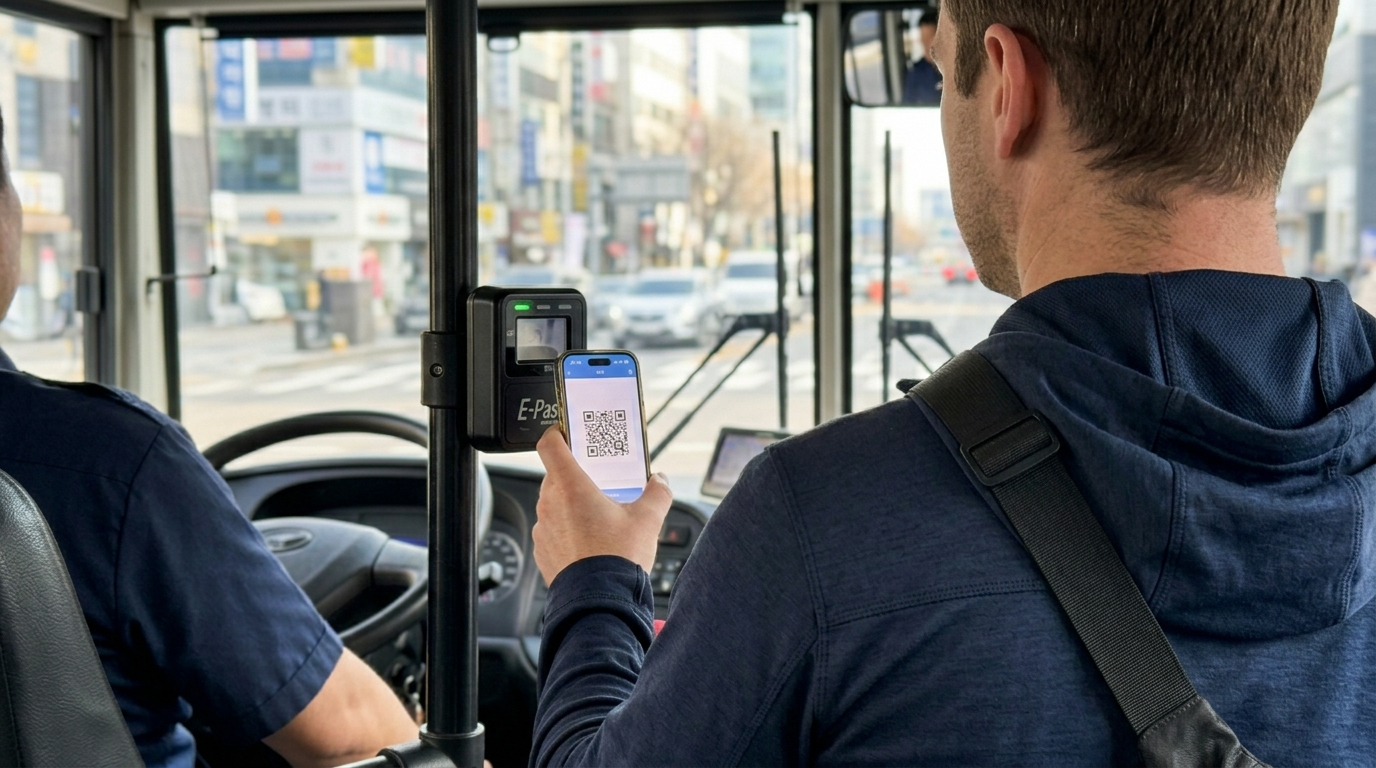
Third-party platforms like Klook and KKday now sell express bus e-tickets for popular routes. You pay with your foreign card, receive a QR code by email, and scan it on the bus when boarding. These platforms handle the Korean payment gateway on their end. The trade-off is selection — they don’t cover every route or every departure time that the Korean booking systems show.
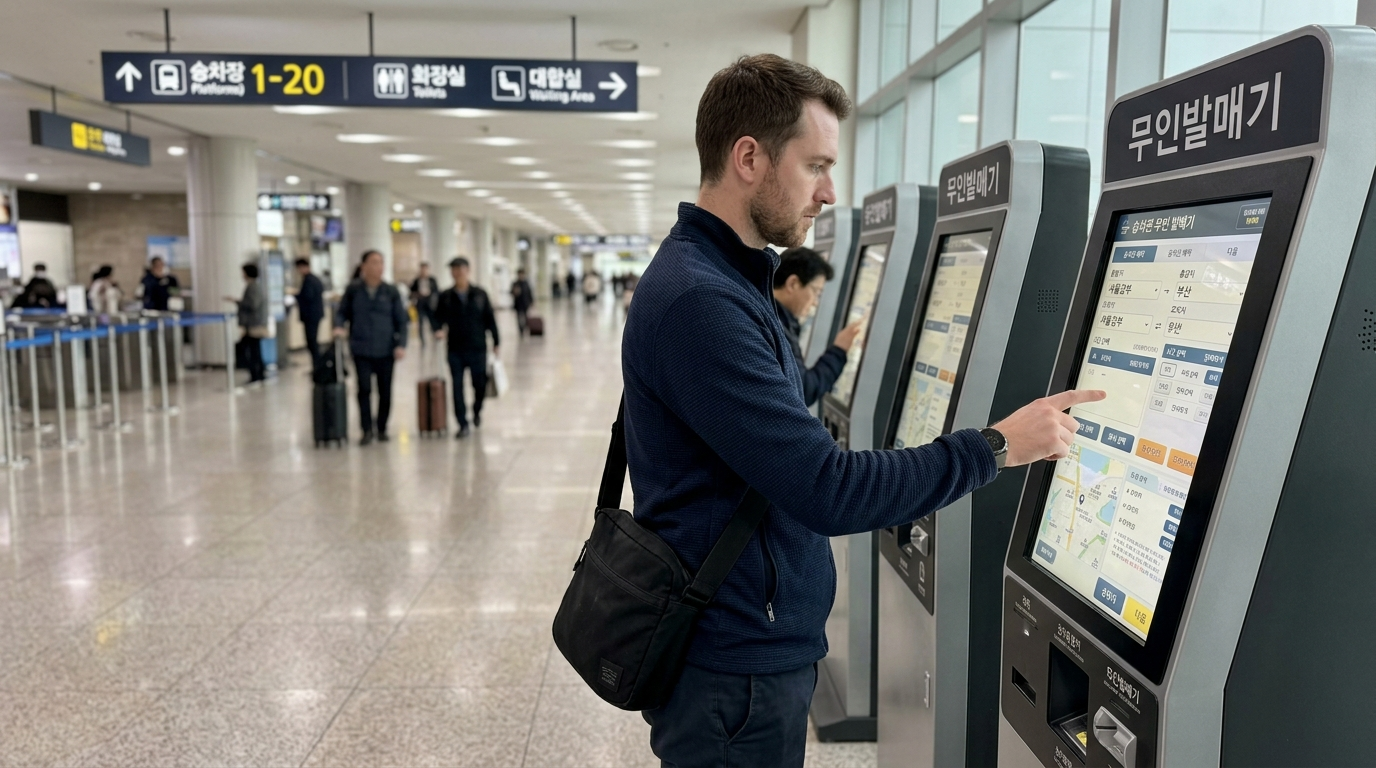
Terminal kiosks (무인발매기) also accept foreign cards in some locations, though the interface is often Korean-only. If you can navigate the touchscreen — departure, destination, date, seat — the card reader at the end tends to process international Visa and Mastercard without issue. This is hit-or-miss, but when it works, it’s faster than the ticket counter.
One thing worth knowing if you’ve used KTX booking as a foreigner: the train system’s international-friendly Korail website has no equivalent in the express bus world. KOBUS exists, and it technically has an English page, but the payment step is where it falls apart for foreign cards.
Where Express Bus Korea Foreigners Get Blocked
The blocks aren’t random. They follow a pattern, and once you see it, you’ll know exactly where to expect friction.
KOBUS online payment. The integrated express bus booking site at kobus.co.kr has English, Japanese, and Chinese language options. Choosing your departure terminal, destination, date, and seat class all works fine. The wall appears at checkout — the payment module runs through a Korean card authentication gateway. Foreign credit cards trigger a 3D Secure verification failure in most cases. Some travelers report occasional success with Mastercard, but the failure rate is high enough that planning around it makes more sense than hoping for the best.
Phone number fields create a second problem. Even when a foreign card clears, the system asks for a Korean mobile number to send booking confirmations. International numbers usually don’t fit the 010-XXXX-XXXX format the field requires. Some people enter a random 010 number and proceed, but then they have no way to retrieve the booking if something changes.
Express buses and intercity buses are separate systems with separate terminals and separate booking platforms. This is the gap that confuses almost every foreigner who hasn’t traveled by bus in Korea before. KOBUS handles express buses (고속버스). Bustago and TxBus handle intercity buses (시외버스). Some destinations only appear on one system, not both. Searching for your city on the wrong platform returns zero results — and you might think the route doesn’t exist when it actually does, just from a different terminal on a different booking platform.
Weekend and holiday availability disappears fast. Popular routes like Seoul to Busan, Seoul to Sokcho, and Seoul to Gangneung sell out during Chuseok and Seollal sometimes days in advance. If your only option is walk-up purchase and the route is sold out, there’s no waitlist.
The Workarounds That Actually Get You on the Bus
None of these blocks are permanent. Each one has a workaround — just not one you’d find by staring at the error screen.
For online booking with a foreign card, skip KOBUS entirely and go through Klook or KKday. Both accept international cards and issue QR-code boarding passes. You board by scanning the code at the bus door — no counter visit, no printed ticket. The limitation is that their route inventory is narrower than what KOBUS shows, so check availability before assuming your specific departure time is covered.
For the terminal mix-up problem, use Naver Map or Kakao Map to search your destination in Korean. The map result typically shows which terminal the bus departs from. Seoul Express Bus Terminal covers Gyeongbu and Yeongdong line destinations — Busan, Daegu, Gyeongju, Sokcho, Gangneung. Central City Terminal covers Honam line destinations — Jeonju, Gwangju, Mokpo. Dong Seoul covers a mix of Gangwon and eastern routes. Nambu Terminal handles smaller intercity routes. If the terminal name includes “종합 (jonghap),” it serves both express and intercity buses from the same building.
For holiday travel, buy tickets in person at least one or two days before your departure. Terminal counters open early, and buying ahead doesn’t require you to be there on departure day — you get a printed ticket with a seat number.
For the express-versus-intercity confusion, think of it this way: if your destination is a major city (Busan, Daegu, Gwangju), it’s probably an express bus on KOBUS. If it’s a smaller town or a place that requires intermediate stops, it’s probably an intercity bus on Bustago or TxBus. When in doubt, check both.
Assumptions That Waste Your Time at the Terminal
A few assumptions show up repeatedly in expat forums and travel groups. Each one costs about thirty minutes to an hour.
Assuming all Seoul terminals are near each other. Seoul Express Bus Terminal and Central City Terminal are in the same station complex at Express Bus Terminal Station (lines 3, 7, 9). That’s convenient. But Dong Seoul Terminal is at Gangbyeon Station on line 2 — entirely across the city. Nambu Terminal is at Nambu Terminal Station on line 3 but in a different direction. If your bus leaves from Dong Seoul and you’re standing at Express Bus Terminal, that’s a 40-minute subway ride.
Assuming bus seats have no class distinction. Express buses come in Economy (일반), Deluxe (우등), and Premium grades. Premium seats include USB-C charging, partition curtains, wider spacing, and sometimes lie-flat recline. The price difference between Economy and Premium on a Seoul-to-Busan run might be ₩10,000 or less. For a four-hour ride, that’s worth knowing about in advance.
Assuming the ticket counter takes cash only. Foreign credit cards work at ticket counters. Amex acceptance is inconsistent, but Visa and Mastercard process without trouble at most major terminals.
Matching Your Trip to the Right Booking Method
Not every method fits every situation. The right approach depends on when you’re traveling and how flexible your schedule is.
If you’re traveling on a weekday with no time pressure, walk up to the terminal counter 30 to 60 minutes before departure. Buses to most destinations run every 15 to 30 minutes during peak hours. You’ll get a seat.
If you’re traveling on a weekend or holiday, book through Klook or KKday at least one to two days ahead. If your route isn’t listed there, go to the terminal the day before and buy at the counter.
If you have a Korean bank card (from a local account), you can use KOBUS directly — the entire booking system opens up, including the mobile app with QR boarding. If you arrived recently and don’t have a local card yet, this option isn’t available, and there’s no workaround for the payment gateway itself. Check what applies to your situation with airport transportation options for foreigners if you’re still in your first week.
If you’re choosing between the express bus and KTX, buses typically cost 30 to 40% less but take longer. Seoul to Busan by bus is about 4 hours and starts around ₩23,000 for Economy. Seoul to Sokcho is about 2.5 hours and starts around ₩22,000. The bus also reaches destinations KTX doesn’t serve directly — Sokcho being the most common example, at least until the planned rail extension is completed.
Before You Head to the Terminal
Pre-Departure Check
☐ Confirmed the correct Seoul terminal for your destination (Express Bus Terminal vs Central City vs Dong Seoul vs Nambu)
☐ Checked whether your route is express (고속버스 → KOBUS) or intercity (시외버스 → Bustago/TxBus)
☐ If booking online: used Klook or KKday with a foreign card — not KOBUS directly
☐ If buying at the terminal: arrived at least 30 minutes early on weekdays, 60+ minutes on weekends
☐ Saved the destination name in Korean on your phone to show at the counter
☐ Brought a Visa or Mastercard — not Amex
☐ Chose bus class (Economy, Deluxe, or Premium) before reaching the counter
☐ Checked for rest stops on routes over 2 hours — buses don’t have onboard restrooms
Quick Answers
Can I use T-money to pay for an express bus ticket?
Not directly. T-money works on city buses and subways, but express bus tickets are purchased separately — either online, at the counter, or through kiosks. The T-money GO app is related to the booking system, but it requires a Korean account setup that most short-term foreigners can’t complete. For city transit to get to the terminal, T-money is essential. For the express bus ticket itself, you’ll need a separate payment method.
Do express buses have Wi-Fi and charging ports?
Most Premium-class express buses include free Wi-Fi and USB-C or USB-A charging ports at each seat. Deluxe and Economy classes vary — some have charging, some don’t. Wi-Fi quality depends on the route and carrier coverage, so downloading entertainment or maps in advance is a safer bet than relying on the onboard connection for a 3- to 4-hour ride.
The Bottom Line
Express bus korea foreigners try to book doesn’t fail because the bus system is bad. It fails because the booking system wasn’t designed with foreign cards or international phone numbers in mind. The buses themselves are clean, frequent, comfortable, and cheaper than KTX for the same route.
The fix is knowing where the blocks sit before you hit them. Use third-party platforms or terminal counters instead of fighting with KOBUS. Confirm your terminal before you leave, not after you arrive. And if you’re traveling on a holiday weekend, buy your ticket a day early — the thirty-minute detour to the terminal saves the stress of watching a sold-out departure board at 7 AM.
The express bus network opens up most of Korea for under ₩30,000 per trip. Once you get past the ticket, the ride itself is the easy part.