Jeju Island korea foreigners hear about constantly — cheap flights, beaches, volcanic hikes, subtropical weather an hour from Seoul. That picture is real. But it only works if three specific details line up before you board that plane.
Here’s what catches people off guard. Jeju is three times the size of Seoul. Public buses exist, but they run on schedules built for residents, not tourists bouncing between attractions on opposite ends of the island. Rental cars solve the problem — until the counter rejects your documents. And accommodation that looked affordable in April can triple by July if you didn’t book far enough ahead.
None of these are dealbreakers. But each one reshapes your trip if you don’t see it coming. This article breaks down the three gaps that trip up foreign visitors most often, compares the options that actually work, and walks through what to lock in before your departure date.
Why Jeju Island Korea Foreigners Visit Doesn’t Go as Planned
Jeju Island sits about 80 kilometers off Korea’s southern coast. It’s volcanic, subtropical, and packed with UNESCO-listed sites. Koreans treat it the way Americans treat Hawaii — a getaway destination with its own rhythm. Flights from Seoul, Busan, and Daegu run multiple times daily, often for under ₩60,000 one-way if booked early.
That accessibility creates an illusion. Because the flight is short and domestic, foreign visitors assume the rest will be equally frictionless. It isn’t.
Jeju stretches roughly 73 kilometers east to west. Driving from Jeju City in the north to Seogwipo in the south takes over an hour, and that’s on a good day. The island’s top attractions — Seongsan Ilchulbong on the east coast, Hallasan Mountain in the center, Jungmun resort area in the southwest — sit hours apart from each other. Without a car, reaching more than two or three spots in a single day becomes a logistical puzzle.
Three things determine whether that puzzle solves itself or eats your schedule: whether you can actually rent a car, how well the bus system covers what you want to see, and whether your accommodation is still available at a reasonable price when you finally book it.
Rental Car Rules — The Document Trap
Renting a car is the default recommendation for Jeju, and for good reason. Parking is free at most major attractions. Roads are well-maintained. Traffic outside Jeju City stays light. The island has no toll roads, so a Hi-Pass device isn’t necessary. For jeju island korea foreigners planning to explore freely, a rental car is the single biggest quality-of-life upgrade.
But the rental counter is where foreign visitors hit their first wall.
Every rental company in Jeju requires three documents: your passport, your home country driver’s license, and a physical International Driving Permit (IDP). Not a digital copy. Not a screenshot. The book-type IDP issued by your home country’s automobile association, based on the Geneva or Vienna Convention on Road Traffic. If your country isn’t a signatory — China, Indonesia, and Taiwan are the most common examples — you cannot rent a car in Jeju at all.
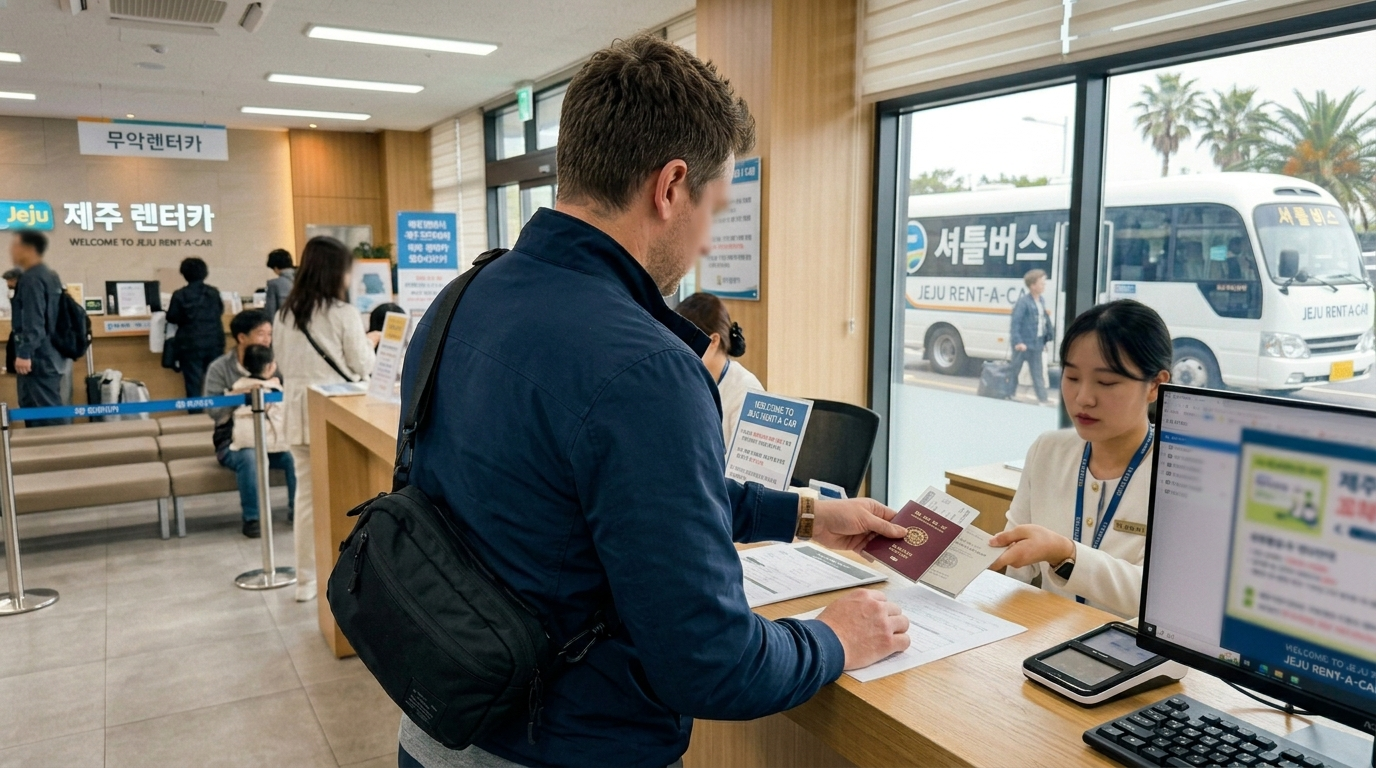
One detail that surprises long-term residents: if you’ve been living in Korea for more than one year, your IDP may no longer be valid for car rental purposes. Some companies enforce this rule strictly. In that case, you’d need a Korean driver’s license instead — which is a separate process involving a health check, written test, and driving test.
The IDP must also have been issued within the past year. Showing up with an expired IDP gets the same result as showing up with none at all.
Most rental car companies cluster around Jeju International Airport in what’s called the “Rent-a-Car Zone,” accessible by free shuttle buses that run every 10 to 15 minutes. Companies like Lotte Rent-a-Car, SK Rent-a-Car, and AJ Rent-a-Car have been the traditional options. More recently, foreigner-focused platforms like Orcar have gained traction by offering English-language booking, online document submission before arrival, and international card payment through Stripe.
Rental costs range from about ₩45,000 to ₩150,000 per day depending on vehicle type, season, and platform. Full-coverage insurance (CDW with zero excess) adds roughly ₩28,000 to ₩43,000 per day but eliminates most financial risk from accidents or damage. For foreign drivers on unfamiliar roads, that surcharge is worth serious consideration.
One more thing worth knowing if you’re troubleshooting: Jeju has an extensive electric vehicle charging network, and EV rentals are common. But jeju island korea foreigners sometimes face problems with the charging station apps, which may require Korean phone verification or Korean payment methods. Unless you’re confident with Korean app ecosystems, a gasoline vehicle is the safer choice for a short visit.
Bus Schedules — The Flexibility Gap
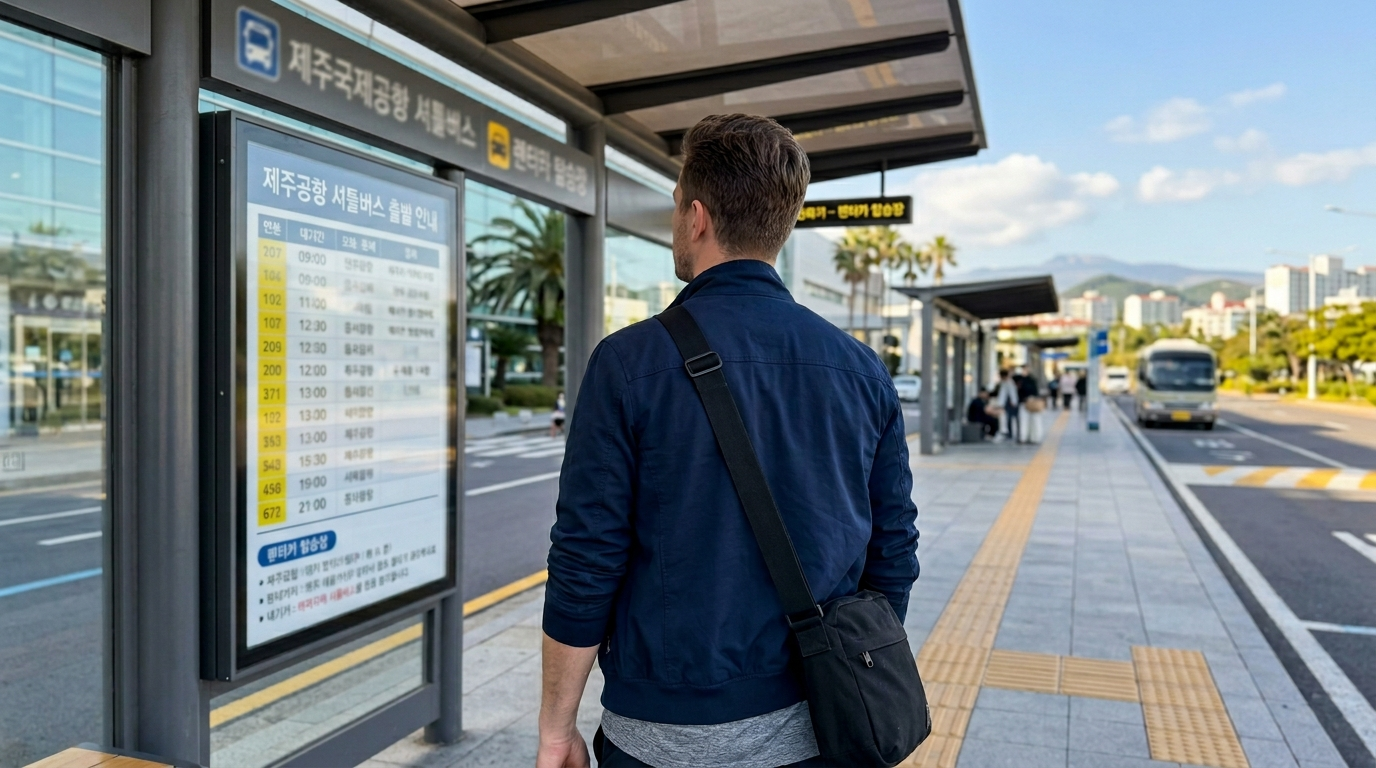
Jeju’s bus system was completely overhauled in 2017, and it’s genuinely better than most visitors expect. Buses cover the entire island. Bus stops have real-time digital displays. A free Jeju bus app, available in English, Chinese, Japanese, and Korean, shows routes and arrival times. Since 2024, buses no longer accept cash — you’ll need a T-money card or a credit card with transportation features.
So what’s the problem?
Frequency. The express buses connecting Jeju City to Seogwipo run reliably and relatively often. But once you step off those main corridors and try to reach specific attractions — a particular beach, a specific oreum (volcanic cone), a restaurant someone recommended — the wait times stretch. Some rural and village bus routes run once every 30 to 60 minutes. Miss one, and your afternoon plan evaporates. If you’re also planning to travel between cities on the mainland by bus, the same kind of schedule gaps apply — see the express bus guide for foreigners for that comparison.
Transfers add another layer. You’re allowed up to two transfers within 40 minutes of tagging off with your transportation card, and you’ll receive a discount. But the transfer window is tight, and the system doesn’t give discounts if you reboard a bus with the same route number.
For context, here’s what a bus-only day on Jeju might look like: You leave your hotel near Jeju Bus Terminal at 8:30 AM. You take a trunk-line bus east to Seongsan Ilchulbong — that’s about 70 minutes. You spend two hours at Sunrise Peak. You catch the next bus south toward Seogwipo — another 50 minutes, assuming you time the connection correctly. By the time you reach Cheonjiyeon Waterfall, it’s already mid-afternoon. Getting back to Jeju City from Seogwipo takes another hour. Three attractions. An entire day.
With a rental car, that same itinerary takes half the time and leaves room for two or three additional stops.
That said, buses work perfectly for visitors staying in one area. If you’re based in Jeju City and want to explore the old town, Dongmun Market, and nearby coastal spots, buses and walking handle it fine. The same applies to Seogwipo City, where key waterfalls, cafes, and the Olle Market sit within a compact zone. The bus-only approach works — it just limits how much ground jeju island korea foreigners can cover in a short trip.
Peak Season Booking — The Price Trap
Jeju’s peak season runs from July through August, with a secondary surge in October during fall foliage season. Korean national holidays — especially Chuseok and Seollal — create their own spikes, with accommodation prices sometimes jumping 50% to 100% above normal rates.
The pricing pattern is predictable. What isn’t always obvious to foreign visitors is the booking timeline.
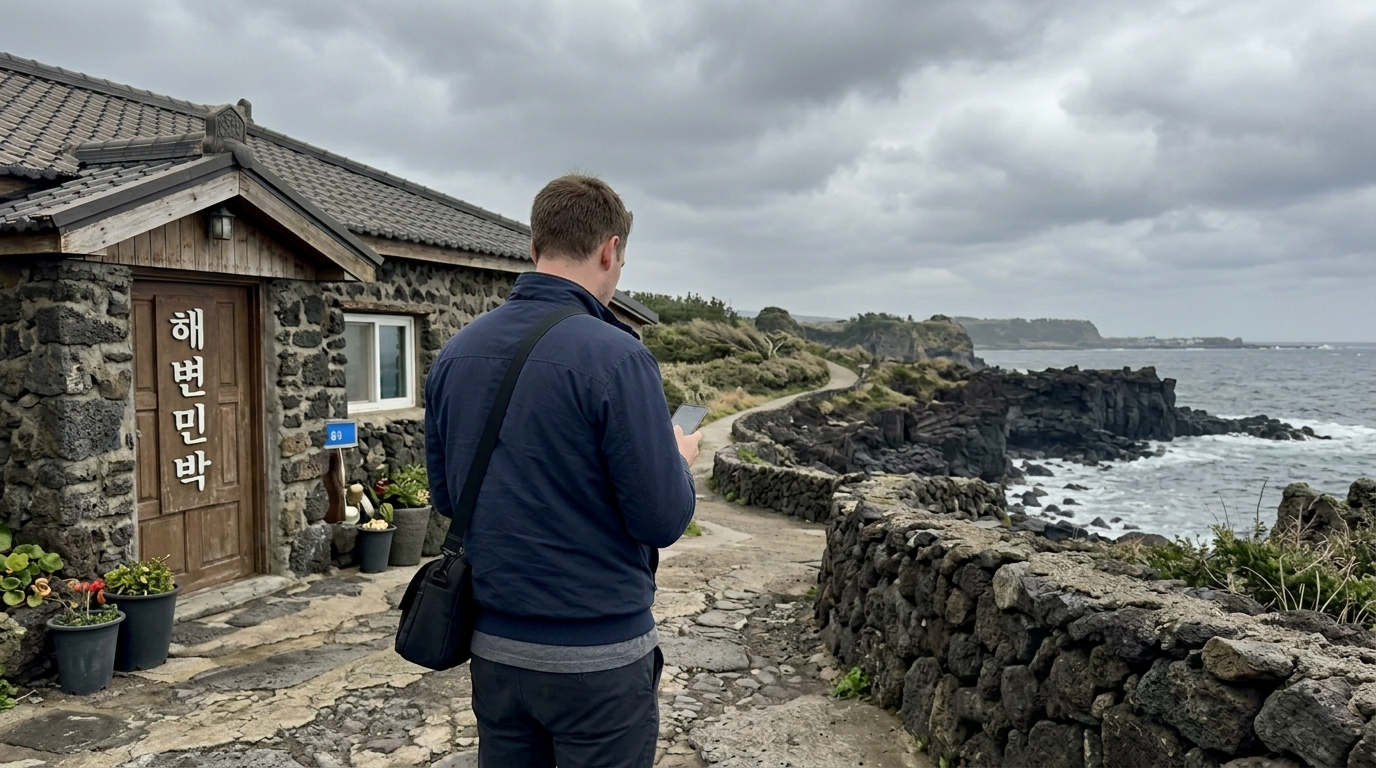
Korean domestic travelers — who make up the vast majority of Jeju visitors — book their summer trips months in advance. By late May, the best-value pensions (Korean-style B&Bs), guesthouses, and mid-range hotels near popular beaches like Hyeopjae and Hamdeok are already full for July weekends. When it comes to accommodation, jeju island korea foreigners searching in June or early July often find only luxury resorts or inconveniently located inland properties left.
A few booking realities that reshape planning:
Global platforms show limited inventory. Booking.com and Agoda list plenty of Jeju properties, but many smaller pensions and family-run stays only appear on Korean platforms like Naver Booking or Yanolja. If you can navigate those platforms — or use a translation tool like Papago — you’ll find more options and sometimes lower rates.
Direct booking discounts exist too. Some smaller stays offer 5% to 10% off for direct reservations made through KakaoTalk or email. The catch: communication is almost always in Korean.
Weekend vs. weekday pricing diverges sharply. A pension that costs ₩80,000 on a Tuesday night might charge ₩150,000 or more on Friday and Saturday. Many pensions also enforce minimum two-night stays on weekends, especially during peak months.
For summer travel, booking 4 to 6 weeks ahead is the minimum for popular coastal areas. For cherry blossom season (April) and fall foliage (October to November), 2 to 3 weeks is usually sufficient. Winter — December through February — offers the deepest discounts, sometimes 30% to 40% below peak rates, though weather becomes a factor. Smart timing is one of the few areas where jeju island korea foreigners can save significantly without compromising the experience.
Car vs Bus vs Taxi — Which Setup Matches Your Trip
The right transportation depends on three things: how long you’re staying, how many places you want to hit, and whether you have a valid IDP. For jeju island korea foreigners, this single decision shapes the entire trip — and there’s no universal right answer.
Rental car makes the most sense if: You’re staying 2 or more days, you have a valid IDP and home license, and you want to visit attractions spread across the island. Driving in Jeju is genuinely easy — roads are well-marked, parking is mostly free, and traffic stays manageable outside Jeju City rush hours. Drive on the right side. Left turns require a green arrow signal. Back-in parking is standard.
Buses work well if: You’re based in one area (Jeju City or Seogwipo), you’re on a tight budget, or your itinerary focuses on easily accessible attractions along main routes. The airport limousine bus (Route 600) connects the airport directly to the Jungmun resort complex and Seogwipo — useful if your hotel sits along that corridor.
Taxis fill the gaps for anyone who doesn’t drive, doesn’t want to deal with bus schedules, and is willing to spend more for flexibility. Kakao T works on Jeju, but availability varies — especially in rural eastern and western areas. For a deeper look at how taxi apps work for foreigners in Korea, check the common failure points before relying on ride-hailing. Hiring a taxi driver for a half-day or full-day tour (roughly ₩100,000 to ₩200,000 for 8 hours) is a legitimate option that many foreign visitors overlook.
Private tours or chartered drivers split the difference. They eliminate the driving stress and the bus limitations, but the cost adds up quickly — typically ₩150,000+ per day for a private driver with vehicle.
A practical hybrid approach works well for jeju island korea foreigners staying 3+ days: rent a car for days when you’re covering long distances across the island, and walk or bus on days when you’re exploring a single town or neighborhood. Some rental companies allow flexible pickup and return times, making this split easier to manage.
Visa-Free Entry to Jeju — What Actually Applies to You
Jeju operates a standalone visa-free entry policy that’s separate from Korea’s national visa rules. This matters because some nationalities that need a visa to enter mainland Korea can enter Jeju without one — for up to 30 days — as long as they fly directly to Jeju International Airport from an international destination. It’s one of the most misunderstood entry rules that jeju island korea foreigners encounter during trip planning.
The key constraint: “directly” means no stopover on the Korean mainland. Singapore → Jeju works. Seoul → Jeju does not qualify for the visa-free program if your nationality normally requires a Korean visa.
Citizens from 23 countries are excluded from Jeju’s visa-free policy entirely, regardless of flight routing. This list includes Afghanistan, Bangladesh, Iran, Iraq, and others designated by Korea’s Ministry of Justice. If you’re unsure whether your nationality qualifies, check the Hi Korea immigration portal or contact the nearest Korean embassy before booking anything.
For visitors already in Korea on a valid visa — tourist, work, student, or otherwise — flying to Jeju from the mainland is domestic travel and doesn’t involve any additional visa process. You just need your passport or ARC.
One more note on K-ETA (Korea Electronic Travel Authorization): if you’re entering Jeju directly from overseas and your nationality falls under the K-ETA exemption list valid through December 2026, you don’t need a K-ETA for Jeju specifically. But if you plan to visit the mainland before or after Jeju, check whether the exemption still covers your nationality. Rules shift, and assumptions get expensive.
What Catches People Off Guard After Landing
Beyond the big three — car, bus, and booking — a few smaller details trip up jeju island korea foreigners regularly.
Google Maps barely functions on Jeju. Korean mapping restrictions mean Google Maps shows limited road data and almost no business information. Use Naver Map or Kakao Map instead. Both have English interfaces, real-time bus tracking, and navigation for drivers.
The island is also bigger than people think. Circling Jeju by car along the coastal Ilju Road takes close to five hours without stops. The vertical distance from north to south is about 31 kilometers, but the mountain roads through Hallasan add significant time. Don’t plan five attractions in one day unless they’re all in the same quadrant.
Payment is mostly cards, but not always foreign ones. Most restaurants, cafes, and tourist sites accept Korean credit and debit cards. Foreign Visa and Mastercard credit cards work at many places, but self-service gas stations and some smaller establishments may reject them. Keep some Korean won in cash as backup. If you’re unsure about paying in Korea as a foreigner, check the specifics before your trip.
Weather deserves its own mention. Jeju sits in a subtropical zone, but the weather shifts fast — especially on Hallasan. A clear morning in Jeju City can become fog and rain at higher elevations within an hour. Pack layers and rain gear regardless of the forecast. Summer also brings occasional typhoon warnings, which can ground flights and close outdoor attractions without much notice. This catches jeju island korea foreigners off guard more than almost anything else.
Connectivity, at least, isn’t a problem. Buses and most bus stops offer free WiFi. Hotels, cafes, and public spaces are well-connected. If you’re relying on mobile data, a Korean SIM, eSIM, or pocket WiFi keeps everything running — maps, translation apps, taxi calls, and real-time bus tracking all depend on a stable connection.
Questions That Come Up Most
Can I visit Jeju for just one day from Seoul?
Technically, yes. Flights take about an hour each way, and budget airlines run multiple daily routes. But factoring in airport time on both ends, you’d have roughly 6 to 8 usable hours on the island. That’s enough to see one or two attractions near the airport or in Jeju City, but not enough to explore the south coast or eastern side. Two full days is the minimum to feel like you’ve actually visited Jeju.
Is Jeju safe for solo female travelers?
Jeju is widely considered one of the safest travel destinations in Asia. Crime rates are low, and solo travelers — including women — move around freely day and night. Standard travel precautions apply (stay aware of your surroundings, keep valuables secure), but Jeju doesn’t present unique safety concerns. The Olle Walking Trails, in particular, are popular among solo hikers.
Do I need to speak Korean to get around Jeju?
Not necessarily, but it helps more than you’d expect. Tourist-facing businesses in Jeju City and major attractions often have basic English signage and some English-speaking staff. But once you move to smaller towns, rural restaurants, or local pension owners, communication shifts to Korean. Having a translation app ready — Papago or Google Translate with the camera feature — solves most situations.
What’s the best time to visit Jeju as a foreigner?
Spring (April to May) and fall (September to November) offer the best combination of pleasant weather, manageable crowds, and reasonable prices. Summer brings peak crowds and heat but also lush green landscapes and beach season. Winter is quiet and affordable but colder, windier, and some outdoor attractions close or reduce hours.
Can I use a Klook or KKday pass for Jeju attractions?
Yes. Both platforms offer Jeju-specific activity bundles, entry tickets, and transportation packages. They’re especially useful for theme parks (like Shinhwa World), guided tours, and water activities. However, many of Jeju’s best experiences — Hallasan hiking, Olle Trails, Seongsan Ilchulbong — are free or require only a small entry fee that you pay on-site.
Before You Fly: What to Confirm
Pre-Departure Checklist
☐ IDP status: Physical copy, issued within the past year, from a Geneva/Vienna Convention country. Confirm it’s the book type, not a card.
☐ Visa or visa-free eligibility: If entering Jeju from overseas, verify your nationality qualifies for the Jeju visa-free program. If entering from the Korean mainland, confirm your existing visa covers the trip.
☐ Accommodation booked — for July/August travel, book at least 4–6 weeks ahead. Check both global platforms and Korean booking sites for better rates.
☐ Transportation decided: Car rental reserved with insurance selected, or bus routes mapped for your itinerary. Download Naver Map or Kakao Map before departure.
☐ T-money card loaded with at least ₩20,000 if relying on buses. Buses no longer accept cash.
☐ Mobile data solution arranged — SIM card, eSIM, or pocket WiFi. Maps, bus apps, and Kakao T all require internet.
☐ Cash backup of at least ₩50,000–₩100,000 in won for places that don’t accept foreign cards.
☐ Rain jacket and layers packed regardless of season. Hallasan weather changes rapidly.
Where This Leaves You
A trip to jeju island korea foreigners talk about with frustration usually comes down to one of these three gaps — not the island itself. The IDP that worked fine in Europe might not be the right type for Korean rental counters. The bus that Google Maps suggests might not exist in Naver Map’s actual schedule. The beachside pension that looks perfect might already be booked three months out.
Lock in those three details — transportation documents, realistic scheduling, and early accommodation booking — and Jeju delivers exactly what everyone says it does. Skip them, and you’ll spend your trip adapting instead of exploring.
Note: Visa rules, rental car policies, and bus schedules can change. Verify current requirements through the Jeju Tourism Organization (visitjeju.net) and the Korea Immigration Service (hikorea.go.kr) before your trip. This article provides general guidance and does not constitute legal or official travel advice.