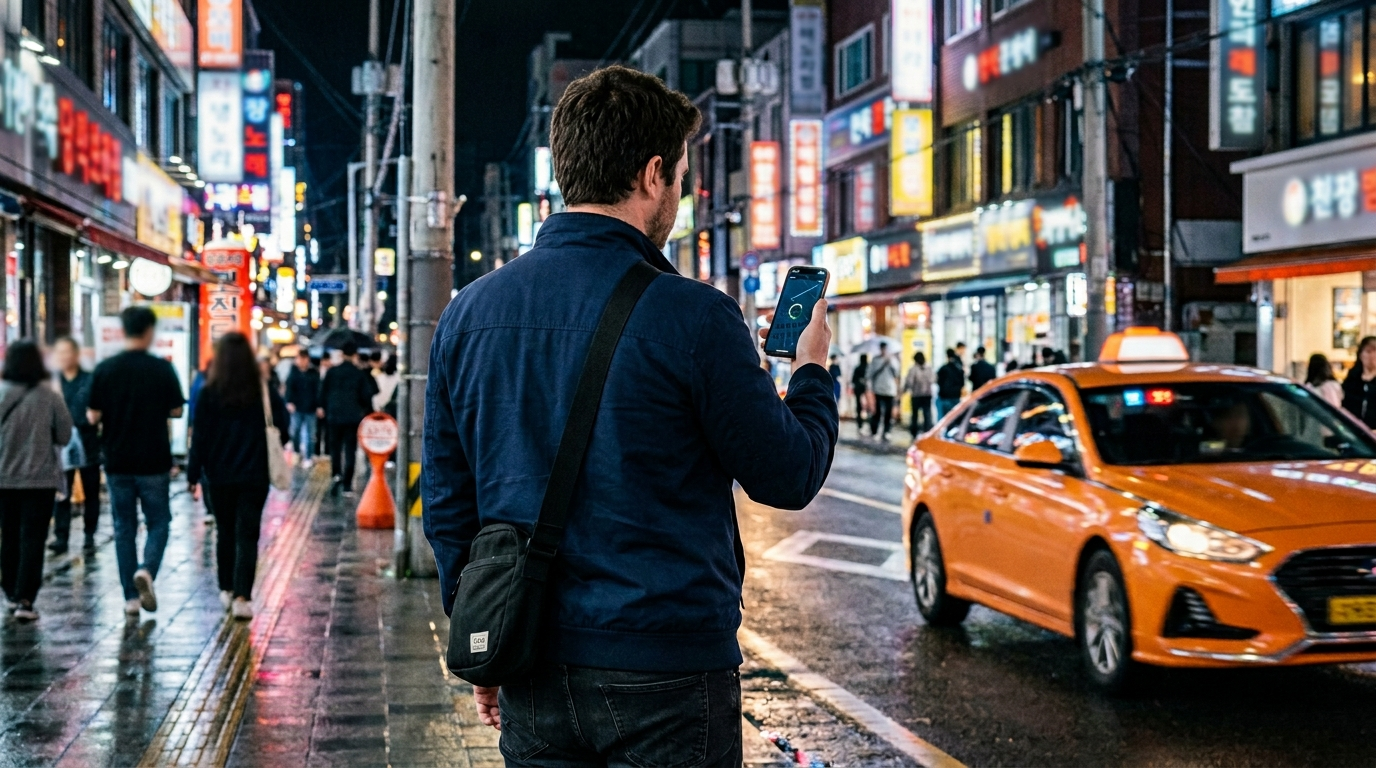
The taxi app Korea foreigners download is usually Kakao T. That part goes fine. You install it, switch the language to English, enter a destination, and hit the call button. A driver gets assigned. A car number pops up on your screen. Everything feels like it’s working.
Then the driver calls you.
That’s where the experience splits in half. For Korean users, it’s a ten-second confirmation call — “I’m outside, blue Sonata.” For you, it’s a conversation you can’t have. The driver speaks Korean. You don’t catch the question. There’s a pause. The call ends. And then the ride gets cancelled. Not because you did anything wrong with the app. Because the system assumes you can speak to the person driving toward you, and when you can’t, the driver moves on to the next passenger.
This article breaks down why taxi app Korea foreigners rely on keeps failing at the ride stage — not the signup stage — and what actually works to prevent each breakdown point.
Where Taxi App Korea Foreigners Rides Actually Break Down
The call goes through. The driver accepts. That feels like success. It isn’t — it’s the beginning of three separate friction points that most taxi app Korea foreigners users don’t see coming until they’re standing on a sidewalk watching their assigned taxi drive past them.
Destination input is the first wall. Kakao T’s English interface lets you type addresses in English, but results are inconsistent. Type “Itaewon” and you’ll get options. Type the actual name of your guesthouse or your friend’s apartment building, and the search returns nothing useful. The app’s search engine prioritizes Korean-registered business names. If a location doesn’t have an official English listing in the system, the English search won’t find it.
The workaround most people try — typing a nearby landmark — creates its own problem. Your driver arrives at the landmark, not your actual destination. Now you need to explain the remaining 200 meters. In Korean.
The second wall is the confirmation call. Korean taxi drivers routinely call passengers after accepting a ride. It’s not optional behavior — it’s a cultural norm baked into the system. They want to confirm your exact pickup spot, ask if you’re already outside, or clarify the route. When a driver calls and hears silence, broken English, or a confused response, cancellation rates spike. Some drivers cancel immediately. Others wait thirty seconds, then cancel. There’s no penalty for the driver, and another Korean-speaking passenger is already waiting in the queue.
Payment is the third wall, and it’s quieter. Inside the app, Kakao T’s automatic payment requires a Korean bank account and Korean phone verification. As of 2026, registering a foreign credit card directly inside Kakao T for in-app payment is still not supported. That means every ride ends with a manual payment to the driver — cash, physical card tap, or T-money. None of these are problems by themselves. But when you don’t know which one a specific driver accepts, the end of the ride becomes another negotiation you didn’t prepare for.
Why the System Works Against You
Korea’s taxi app ecosystem wasn’t designed for foreigners. That’s not a complaint — it’s a structural fact that explains every friction point above. Understanding why the taxi app Korea foreigners depend on behaves this way helps you work around it instead of fighting it.
Kakao T commands over 90% of Korea’s ride-hailing market. It was built for Korean users with Korean phone numbers, Korean bank accounts, and Korean-language communication with drivers. The English interface was added later as a translation layer on top of a Korean-first system. The buttons are in English. The search results, driver communication, and payment infrastructure are not.
This means the app works differently depending on your setup. A foreigner with a Korean phone number, a Korean bank account, and basic Korean reading ability will have an experience almost identical to a Korean user. A tourist with an international SIM and no Korean language skills will hit walls at every step after the initial call.
The driver incentive structure matters too. Any taxi app Korea foreigners use puts them in the same queue as Korean-speaking passengers. When a Korean-speaking passenger and a foreign passenger request rides from similar locations, the driver has a practical reason to choose the one who won’t require extra communication effort. There’s no explicit discrimination mechanism in the app — the friction is built into the workflow itself.
Late-night rides amplify all of this. Between 11 PM and 2 AM, demand in areas like Hongdae, Itaewon, and Gangnam spikes dramatically. Drivers become selective about which rides they accept. The taxi app Korea foreigners open at midnight shows available drivers — but getting one to actually come to you is a different story. According to the Seoul Metropolitan Government’s taxi policy page, the late-night surcharge reaches 40% during peak hours (11 PM to 2 AM), with the base fare climbing to approximately ₩6,700. Even Korean users report difficulty getting rides during this window. For foreigners without in-app Korean communication, it becomes significantly harder.
One more layer: Seoul’s street addressing system doesn’t always match what mapping apps display. A driver navigating to your pin might end up on the wrong side of a building, in a parking garage entrance, or at a different exit of a large complex. Korean users handle this with a quick phone adjustment. Foreigners who can’t take the call are left waiting at a pin that technically correct but practically useless.
4 Patterns That Get Your Ride Cancelled
These aren’t random failures. They follow predictable patterns that every taxi app Korea foreigners user eventually encounters, and once you recognize them, they’re avoidable.
Pattern 1: English-only destination search. You type your destination in English. The app returns results that look close but aren’t exact. You pick the closest match. The driver arrives somewhere nearby but not where you are. When you can’t redirect by phone, the driver waits, then cancels. This happens most often with residential addresses, smaller restaurants, and any location that doesn’t have an official English business listing in Kakao’s database.
Pattern 2 is the unanswered call. The driver calls within 30 seconds of accepting. You see an unfamiliar Korean number. You either don’t answer (thinking it’s spam) or answer and can’t communicate. The driver interprets this as a problem passenger and cancels. Some drivers will try once. Most won’t try twice.
Pattern 3: Wrong pickup spot in complex areas. Large subway stations, university campuses, and shopping districts have multiple exits and entrances. Your GPS pin shows one location. The driver arrives at a different entrance of the same complex. Without a phone call to coordinate, you’re both waiting in the wrong place. After three to five minutes, the driver cancels and picks up the next request.
Pattern 4 is the payment confusion at arrival. You finish the ride. The meter shows ₩12,500. You hand over a foreign credit card. The driver’s terminal rejects it — some older terminals don’t process certain international cards, particularly American Express. You don’t have cash. The T-money card in your pocket has ₩3,000 left. Now you’re negotiating payment options with a driver who wants to move to the next ride, in a language barrier situation, at 1 AM.
What Actually Prevents Each Failure
Each failure pattern has a specific fix. None of them require learning Korean. All of them require preparation before you need the ride — not during. Here’s what changes the taxi app Korea foreigners experience from frustrating to functional.
For destination input: Stop typing English addresses into Kakao T. Instead, use Naver Map to find your destination first. Naver Map’s English search is significantly better at finding specific buildings, restaurants, and addresses. Once you find the correct location, copy the Korean address or use the “share” function to transfer it directly to Kakao T. Alternatively, screenshot the Korean address from Naver Map and paste it into Kakao T’s search bar. This one step eliminates the destination mismatch problem almost entirely.
For the driver call, set up a Korean-language text template on your phone before you need it. Something like: “외국인입니다. 한국어 못합니다. 앱에 표시된 위치에 있습니다” (I’m a foreigner. I can’t speak Korean. I’m at the location shown in the app). When the driver calls and you can’t speak, send this as a text message to the number that just called you. It takes five seconds and gives the driver enough information to proceed without cancelling.
Better yet, consider switching to k.ride for rides where communication matters. Kakao Mobility launched k.ride specifically for foreign users — essentially a taxi app Korea foreigners can use without a Korean phone number or bank account. It uses the same driver pool as Kakao T but supports over 100 languages in its auto-translation chat feature. You can register using a foreign phone number, sign up via Google or Apple account, and — critically — register an overseas credit card for automatic in-app payment. No Korean bank account needed. No cash negotiation at the end of the ride.
For pickup coordination in complex areas, add a note in the Kakao T or k.ride pickup field. Use the Korean name of the specific exit or entrance. “Exit 3” in Korean is “3번 출구.” “Main entrance” is “정문.” If you’re at a subway station, include the exit number. Drivers respond much better to specific Korean location markers than to a GPS pin alone.
For payment, the cleanest solution in 2026 is k.ride’s in-app payment with a foreign credit card. If you’re sticking with Kakao T’s “pay to driver” method, carry a charged T-money card as your primary backup. T-money works in virtually all taxis across Korea and avoids the card terminal compatibility question entirely. Reload it at any convenience store — the whole process takes about 30 seconds.
Uber also operates in Korea under the name “UT” through a partnership with local operators. It accepts your existing international Uber account and credit card. The trade-off: Uber fares run roughly 20–30% higher than Kakao T, and the driver pool is significantly smaller. In Seoul and Busan, it’s a viable backup. Outside major cities, availability drops sharply.
Even After You Fix It — Watch These
You’ve got the destination workflow down. You have a text template ready. Your k.ride account is set up with a foreign card. The taxi app Korea foreigners ride experience improves dramatically. But a few things still catch people off guard even after the main problems are solved.
Late-night surcharges are steeper than they look. Seoul’s standard taxi base fare is ₩4,800 for the first 1.6 kilometers. Between 11 PM and 2 AM, a 40% surcharge applies — the base jumps to roughly ₩6,700. Between 10–11 PM and 2–4 AM, it’s a 20% surcharge. A ride that costs ₩10,000 during the day can hit ₩15,000 or more after midnight. This is regulated by the Seoul Metropolitan Government’s fare structure, not something drivers decide on their own.
If your ride crosses city boundaries — Seoul to Gyeonggi-do, for example — an additional 20% out-of-city surcharge stacks on top. Late at night, crossing city limits, the combined surcharge can reach up to 60%. That ₩50,000 fare for an airport run at 2 AM isn’t a scam. It’s the regulated rate.
Toll fees are another surprise. Highway tolls on routes like Incheon Airport to Seoul are charged to the passenger on top of the meter fare. The driver may ask for toll money separately in cash, or it may be added to the final total. Either way, it’s your cost.
Deluxe taxis — the black sedans with gold stripes — operate on a separate fare structure. The base fare starts at ₩7,000, but they don’t charge late-night surcharges. For trips between 11 PM and 4 AM, a deluxe taxi sometimes ends up costing the same or less than a standard taxi with surcharges applied. Worth considering if the fare estimate looks high on a regular call.
One last detail about airport transportation. International taxis operating fixed-fare routes between the airport and Seoul apply a 20% foreigner surcharge by regulation. This is a government-authorized additional fee, not an overcharge. If you’re comparing app-based metered rides versus international taxi fixed fares, factor this surcharge into your calculation.
Questions That Come Up Most
Can I use Uber instead of Kakao T in Korea?
Uber operates in Korea as “UT” through local partnerships. It works with your existing international account and credit card, which is its main advantage. The drawback is a significantly smaller driver pool compared to Kakao T — roughly a 1:9 ratio. In Seoul and Busan, you can usually get a ride. Outside major cities or during peak late-night hours, expect longer wait times or no available drivers. Fares typically run 20–30% higher than Kakao T for the same distance.
What’s the difference between Kakao T and k.ride?
Both are operated by Kakao Mobility and share the same driver pool. The difference is the user side. Kakao T requires a Kakao account (linked to KakaoTalk) and doesn’t support foreign credit card registration for in-app payment. k.ride was built specifically for foreigners — you can sign up with a Google or Apple account, use a foreign phone number, register an international credit card, and access auto-translation in over 100 languages for driver communication. If you’re a tourist or a new arrival without a Korean bank setup, k.ride removes most of the friction. If you already have a Korean phone number and KakaoTalk, Kakao T gives you access to more features including premium taxi types and delivery services.
Do Korean taxis accept foreign credit cards?
Most Korean taxis have card terminals built into the meter console. Visa and Mastercard have the highest acceptance rates. American Express works in many vehicles but not all. The key variable is the terminal itself — newer terminals in Seoul handle international cards reliably, while older terminals in smaller cities sometimes reject them. Carrying a backup payment method (cash or a charged T-money card) avoids the situation where the terminal doesn’t process your card at the end of a ride.
Is tipping expected in Korean taxis?
No. Tipping is not part of Korean taxi culture and is not expected. The meter fare — plus any applicable surcharges — is the full amount. You don’t need to round up, add a percentage, or hand over extra money. Some visitors try to tip out of habit from their home country, and while drivers won’t refuse, it’s genuinely unnecessary.
Why does my Kakao T registration work but rides keep getting cancelled?
Registration and ride completion are two completely separate problems. Registration requires phone verification and account setup — that’s the process covered in our Kakao T registration guide. Ride cancellations happen after registration, during the actual ride request. The most common causes are unanswered driver calls, unclear pickup locations, or destination input errors. Fixing registration doesn’t fix ride-stage friction. The solutions in this article address the ride-stage problems specifically.
Where to Go From Here
The taxi app Korea foreigners need isn’t necessarily Kakao T — it might be k.ride or even Uber, depending on your setup. The specific taxi app Korea foreigners choose matters less than the preparation you do before your first ride. Get Naver Map for destination searches. Save a Korean text template for driver calls. Set up k.ride with your foreign credit card if you don’t have a Korean bank account. Load your T-money card as a backup payment method.
Do all of that before you’re standing on a street corner at 11:30 PM watching your third assigned driver cancel in a row. The system isn’t broken. It just wasn’t built with you in mind — and the workarounds are simpler than the frustration of figuring them out in real time.