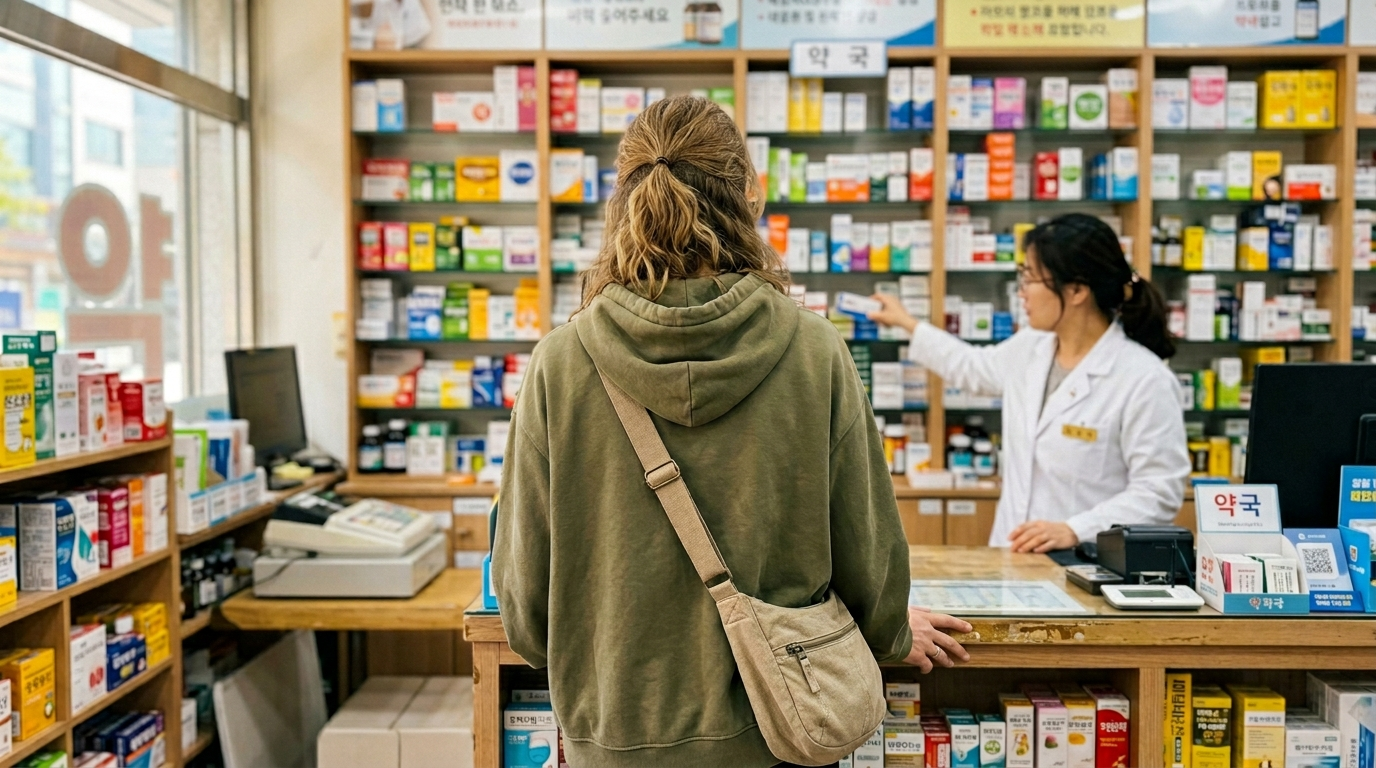
You walk in. The green cross sign is lit, the shelves are full, and the pharmacist looks like they’re ready to help. A Korean pharmacy foreigners visit for the first time feels reassuringly normal — until you ask for something and it doesn’t exist here, or it turns out to need a prescription you don’t have, or the package you’re handed looks nothing like what you expected. The whole experience tends to go sideways in the first two minutes.
The system here runs on a hard boundary. Since 2000, Korea has legally separated the people who prescribe medicine from the people who dispense it. Doctors write prescriptions. Pharmacists fill them. Neither side crosses into the other’s territory — and that line affects what you can buy, how you ask, and what happens if you’re sick at midnight on a Sunday.
OTC (over the counter), prescription-required, and genuinely off-limits — those three categories work differently here than most foreigners expect. What’s below covers each one, including where the gaps show up at the counter.
This article explains how Korea’s pharmacy system works. It is not personal medical advice. For anything involving your own symptoms, medications, or health conditions, consult a licensed pharmacist or doctor in Korea.
What Most Foreigners Expect Walking In
Back home, a pharmacy usually means a store with aisles. You pick things up, read the label, bring it to the register. In Korea, it doesn’t work that way. Almost everything is behind the counter. The pharmacist (약사, yaksa) is the gatekeeper, not a cashier — and they take that role seriously.
The assumption most people arrive with: surely basic medicine is basic medicine anywhere. And for some things, that’s true. But Korean pharmacy foreigners quickly discover that the category of “basic” is narrower here than most Western countries. Some items you’d grab off a shelf at CVS or Boots require a pharmacist interaction at minimum, and others need a doctor’s visit first.
There’s also the language gap. Most neighborhood pharmacies (약국, yakguk) in residential areas are Korean-only. Pharmacists near international hospitals or tourist zones often have some English — but you can’t count on it. The expat workaround is knowing the drug’s ingredient name, not the brand name.
One more thing that surprises korean pharmacy foreigners: the packaging. Medicine here comes in blister packs of 10 or 20 doses — not the bottle of 200 ibuprofen you’d buy in North America. A “pack” for a cold might be three days’ worth, portioned out per dose. Some pharmacists will even repackage prescription meds into individual dose bags labeled with timing instructions.
What Korean Pharmacy Foreigners Can Actually Buy Without a Prescription
The information below reflects general pharmacy practices in Korea. Individual responses to medication vary — always consult a pharmacist or doctor before starting any new medicine.
The good news first. For everyday discomforts, korean pharmacy foreigners are covered without any paperwork at all.
Pain and fever: Acetaminophen and ibuprofen are both available OTC. Ask by ingredient name — 아세트아미노펜 (acetaminophen) or 이부프로펜 (ibuprofen) — rather than a foreign brand. Several Korean-made products containing these ingredients are widely used for headaches; the pharmacist can point you to an appropriate option based on the symptom you describe. No ID required, no prescription needed.
Cold and flu symptoms: Runny nose, sore throat, or mild cold symptoms are generally handled OTC — though persistent or worsening symptoms are worth a clinic visit. The pharmacist will usually ask what your main symptom is and hand you a prepackaged three-day supply. If you say 감기 (gamgi, meaning cold) and point to your throat or nose, they’ll sort it out.
Digestive issues: Upset stomach, indigestion, bloating — common digestive aids (소화제, sohwaje) are standard OTC stock. If you’ve overdone the Korean BBQ, this is the one to know.
Topical creams and patches also fall into OTC territory. The medicated patch called 파스 (paseu) is a Korean staple for muscle pain and sprains — widely used and inexpensive. Antifungal creams, topical antihistamines for skin reactions, and lubricating eye drops for irritation are similarly straightforward.
Vitamins, supplements, and herbal preparations round out the OTC category. Olive Young (올리브영) — technically a health and beauty chain, not a traditional pharmacy — also stocks many of these items alongside skincare.
A small number of OTC items are sold at 24-hour convenience stores (편의점) under a government-designated category called 안전상비의약품 (anjeonsangbiyakpum, meaning “safety essential medicines”). The approved list covers acetaminophen-based fever and pain relief, basic cold and flu relief, digestive aids, antidiarrheal products, and medicated patches. For anything beyond that short list, you need an actual pharmacy.
What Requires a Prescription — No Exceptions
This is where the system catches korean pharmacy foreigners off guard. Some things you’d buy freely at home are simply not available here without a doctor visit first.
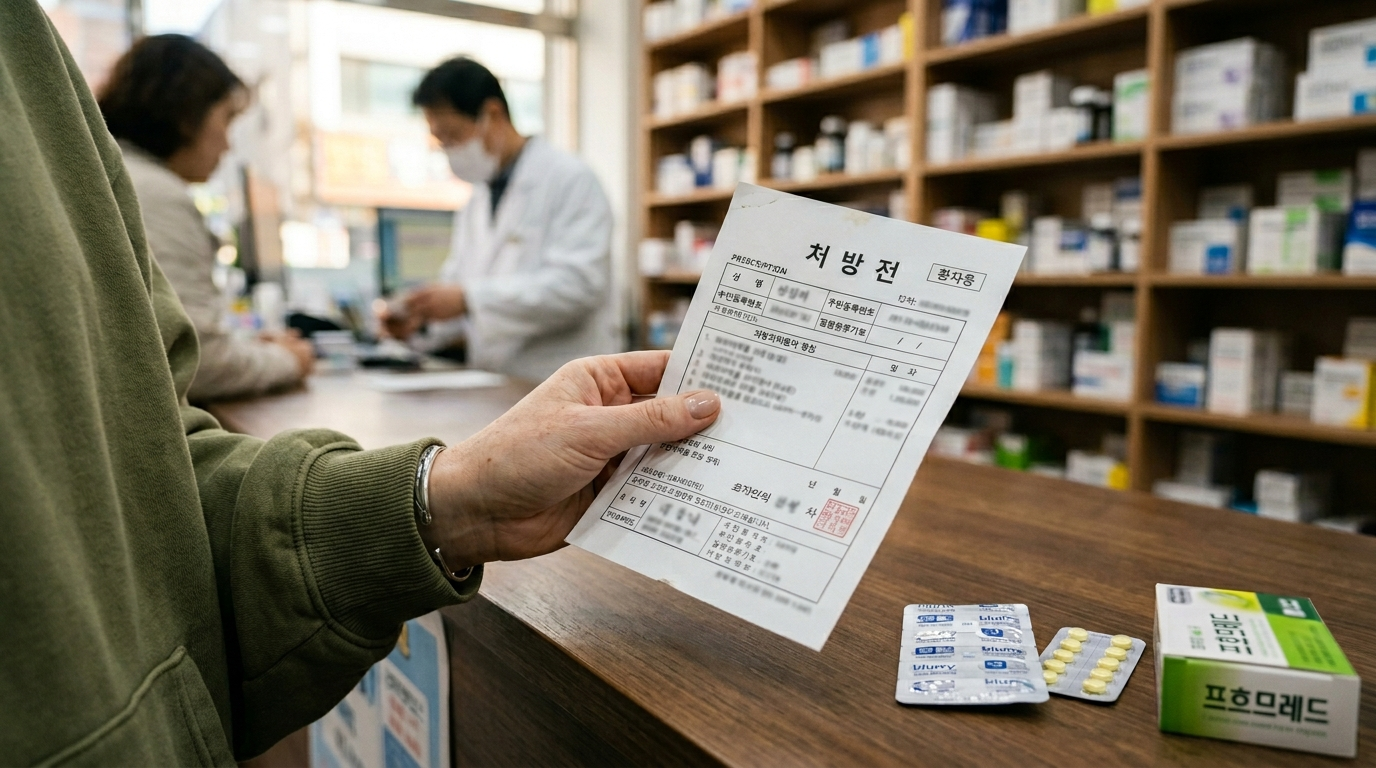
Antibiotics. Antibiotics in Korea are classified as 전문의약품 (jeonmun euiyakpum, prescription-only medicine). Pharmacies are not permitted to dispense them without a prescription, regardless of how mild the infection appears. The route is the same in every case: see a doctor, receive a printed 처방전 (cheobangjeon, prescription slip), and bring that to a pharmacy.
Stronger painkillers. Standard OTC doses of ibuprofen and acetaminophen are available. Anything stronger — codeine-containing medications, higher-dose formulations, or prescription-strength combination anti-inflammatory drugs — requires a prescription. If your pain is beyond what OTC handles, a clinic visit is the faster solution, not pushing at the pharmacy counter.
Hormone-based medications. Birth control pills, steroids, hormonal treatments — all require a prescription. Some foreigners arrive assuming oral contraceptives are OTC because they’re accessible that way in their home countries. They aren’t here.
Psychiatric and sleep medications. SSRIs, benzodiazepines, and most sleep aids — prescription only, and some are controlled substances with additional restrictions.
One thing worth knowing: foreign prescriptions from your home country are not accepted at any korean pharmacy. Foreigners cannot have a prescription written by a doctor outside Korea filled here. If you’ve run out of a maintenance medication, you’ll need to visit a Korean clinic first, explain what you take, and get a local 처방전 issued. The clinic visit itself is fast — typically 10 to 20 minutes at a 의원 (uiwon, local clinic) — and relatively inexpensive even without full insurance coverage.
How to Get What You Need When It Feels Blocked
The most common stuck point for korean pharmacy foreigners: needing an antibiotic when you’re already tired and sick, and not knowing how to get a prescription fast.
The table below covers the situations that come up most — what to say at the counter, and when a pharmacy stop isn’t enough.
| Symptom | What to say to the pharmacist | Consider seeing a doctor if… |
|---|---|---|
| Headache / fever | 머리가 아파요 (meo-ri-ga a-pa-yo) — “My head hurts.” Or ask by ingredient: 아세트아미노펜 / 이부프로펜. | High fever persists more than two days, or headache comes with a stiff neck, confusion, or rash. |
| Sore throat / cold | 목이 아파요 (mo-gi a-pa-yo) — “My throat hurts.” Or 감기약 주세요 (gam-gi-yak ju-se-yo) — “Cold medicine, please.” | Symptoms worsen after three to four days, or swallowing becomes difficult — a prescription may be needed. |
| Stomachache / indigestion | 배가 아파요 (bae-ga a-pa-yo) — “My stomach hurts.” Or 소화제 주세요 (so-hwa-je ju-se-yo) — “A digestive aid, please.” | Pain is severe or doesn’t ease, or comes with fever, persistent vomiting, or blood. |
| Muscle pain / sprain | 근육이 아파요 (geu-nyu-gi a-pa-yo) — “My muscles ache.” Or point to the area and ask for 파스 (paseu), the medicated patch. | Visible swelling or deformity, inability to bear weight, or no improvement after a couple of days. |
| Skin rash / itching | 피부가 가려워요 (pi-bu-ga ga-ryeo-wo-yo) — “My skin is itchy.” Ask by function: 항히스타민 (antihistamine) or 항진균제 (antifungal). | Rash spreads quickly, blisters, or comes with facial swelling or trouble breathing — that is an emergency, call 119. |
| Eye irritation / redness | 눈이 충혈됐어요 (nu-ni chung-hyeol-dwae-sseo-yo) — “My eye is red.” Ask for 인공눈물 (artificial tears). | Pain inside the eye, any change in vision, or discharge that doesn’t clear within a couple of days. |
This table is a communication aid, not a diagnostic tool or dosage guide. The pharmacist decides what is appropriate for your situation.
Telling the Pharmacist About Your Medications, Allergies, and Conditions
This step matters more than most people realize, and it’s the one korean pharmacy foreigners skip most often when there’s a language barrier. What you’re already taking, what you react badly to, and any ongoing condition all change what a pharmacist can safely hand you. Korean pharmacists routinely ask about this — the problem is that the question often arrives in Korean and gets waved off.
Saying it first, before they ask, solves the problem. These are the phrases that cover most situations:
I’m currently taking medication.
저는 지금 약을 복용 중이에요.
(jeo-neun ji-geum ya-geul bo-gyong jung-i-e-yo)
I’m taking [ingredient name]. Is this okay to take together?
[약 이름] 복용 중인데 같이 먹어도 되나요?
([yak i-reum] bo-gyong jung-in-de ga-chi meo-geo-do doe-na-yo)
I’m allergic to [substance].
저는 [물질]에 알레르기가 있어요.
(jeo-neun [mul-jil]-e al-le-reu-gi-ga i-sseo-yo)
I’m allergic to penicillin.
저는 페니실린 알레르기가 있어요.
(jeo-neun pe-ni-sil-lin al-le-reu-gi-ga i-sseo-yo)
I have a chronic condition. — substitute as needed:
고혈압이 있어요 (go-hyeo-ra-bi i-sseo-yo) — high blood pressure
당뇨가 있어요 (dang-nyo-ga i-sseo-yo) — diabetes
간 질환이 있어요 (gan jil-hwa-ni i-sseo-yo) — liver condition
신장 질환이 있어요 (sin-jang jil-hwa-ni i-sseo-yo) — kidney condition
I’m pregnant / breastfeeding.
임신 중이에요 / 수유 중이에요.
(im-sin jung-i-e-yo / su-yu jung-i-e-yo)
Please write down how to take it.
복용법 좀 적어 주세요.
(bo-gyong-beop jom jeo-geo ju-se-yo)
Two habits make this far easier for korean pharmacy foreigners in practice. Write the ingredient names of your regular medications into your phone notes before you ever need them — pharmacists here recognize international ingredient names such as acetaminophen, metformin, or atorvastatin far more reliably than foreign brand names. And if you don’t know the ingredient name, a photo of the original packaging works: the pharmacist can usually identify it from the printed composition.
The phrases from Korean phrases for hospital and pharmacy visits extend this into clinic situations, where the same information gets asked again.
When You Need a Prescription Fast
Korea’s 의원 (local clinic) system is built for exactly this. These are small neighborhood clinics — not full hospitals — that handle general illness: colds that turned into sinus infections, UTIs, ear infections, skin infections. Walk-in is usually fine. You’ll pay a consultation fee (which may range roughly ₩5,000–₩15,000 with NHIS coverage, or ₩15,000–₩30,000 without, depending on the clinic and treatment — confirm at the counter), and the doctor will issue a prescription on the spot. Most visits take under 30 minutes total. You then take your printed prescription to any pharmacy nearby — clinics are almost always surrounded by pharmacies — and collect your medication.
For the language barrier at the pharmacy itself, three approaches work consistently:
First: ingredient names rather than brands. Say “ibuprofen” or “acetaminophen” rather than Advil or Tylenol. Pharmacists understand international ingredient names even when they don’t speak English fluently.
Second: symptom pointing, using the phrases in the table above. Even two or three memorized expressions cover most counter interactions.
Third: Naver Papago on your phone. Type your symptom in English, show them the Korean. Pharmacists in areas with foreign residents deal with this regularly and it works fine.
If your NHIS (National Health Insurance Service) coverage is active, prescription drugs cost significantly less — typically 20–40% of the listed price, plus a small dispensing fee. Without NHIS coverage, you pay full price, but prescription medications in Korea are still generally cheaper than in most Western countries. A short antibiotic course without insurance may range roughly ₩10,000–₩20,000 depending on the medication — confirm the cost at the pharmacy counter. See the health insurance guide for foreigners if you’re not sure of your current coverage status.
Late-Night and Weekend Pharmacy Access for Foreigners
Standard pharmacy hours in Korea run roughly 9 AM to 7–9 PM on weekdays, shorter on Saturdays, and most are closed on Sundays. That gap is a real problem when symptoms hit on a Sunday night. Korean pharmacy foreigners dealing with a late-night situation have two main paths.
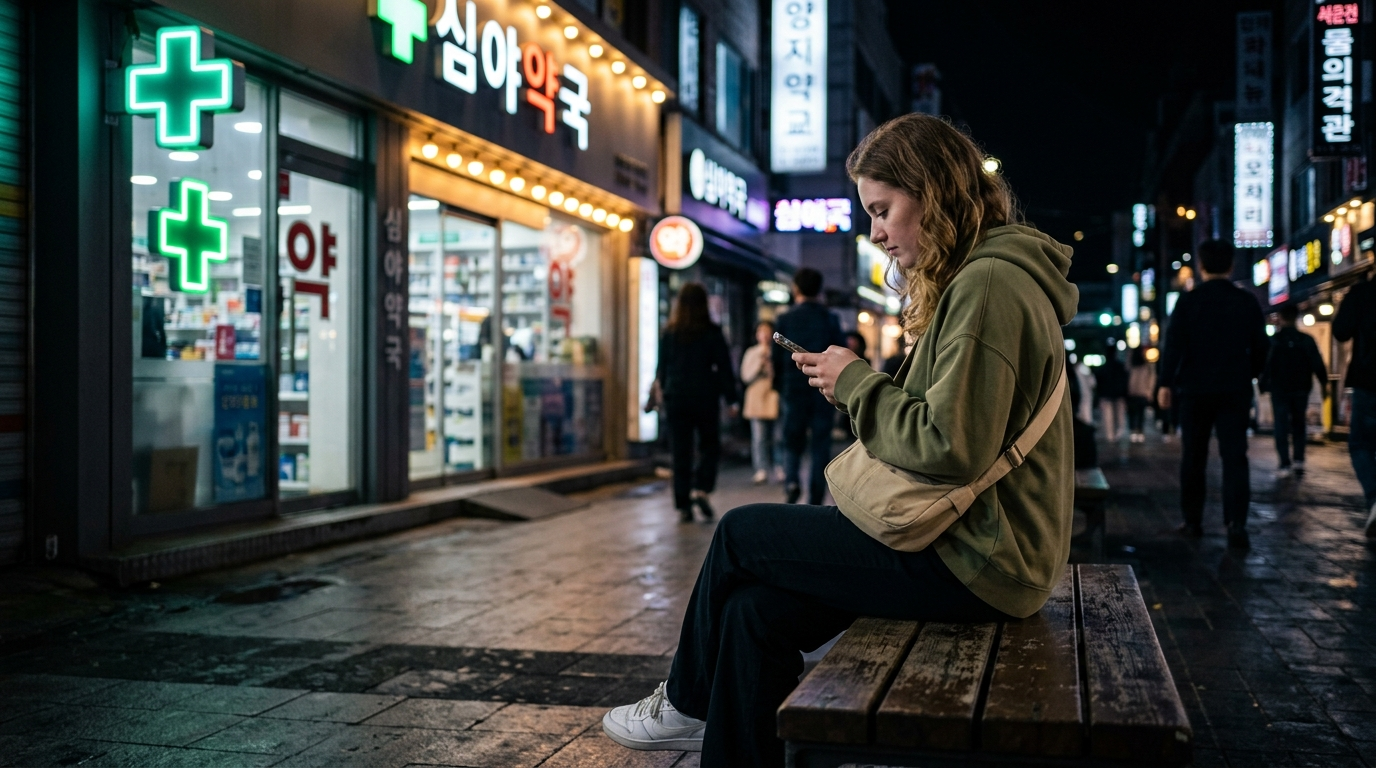
심야약국 (simya yakguk, late-night pharmacies) are locally designated pharmacies that stay open late — commonly until around 1 AM, though hours vary by location. They’re fully staffed by a licensed pharmacist and offer the same services as a daytime pharmacy. Coverage is uneven, which is the part korean pharmacy foreigners tend to discover the hard way: large cities have them in most districts, smaller cities may have only one or two, and hours change without much notice. That makes verification before you travel the important part.
Step by Step: Finding a Late-Night Pharmacy
- Call 1339 first. This is the 24-hour medical information line, with interpretation support available. Tell the operator your district (구, gu) and what you need; they can direct you to a pharmacy that is actually open at that moment. This is the most reliable option because it’s live information rather than a cached listing.
- Check E-Gen online. Open e-gen.or.kr, go to the pharmacy search (약국 찾기), and filter by your region and by night-time operation. The site is run by the National Emergency Medical Center and lists operating status by facility.
- Search Naver Map. Type 심야약국 or 24시 약국 and filter to places open now. Results show distance, listed hours, and a phone number.
- Call before you go. This is the step people skip. Listed hours on map apps lag real closures, especially on holidays. A 20-second phone call saves a 20-minute walk.
- If nothing is open, use a convenience store. CU, GS25, and 7-Eleven stock the 안전상비의약품 list around the clock: acetaminophen-based pain and fever relief, basic cold and flu relief, digestive aids, antidiarrheal products, and medicated patches. Enough to get through the night for minor symptoms.
- For anything urgent, go to a hospital emergency room (응급실). ERs operate 24 hours and can both treat and dispense. For a sinus infection at midnight, this is expensive overkill — but for chest pain, breathing difficulty, severe allergic reactions, or a high fever that won’t come down, it’s the correct call. Emergency number is 119. The emergency numbers guide for Korea covers which number to use in which situation.
Late-night pharmacy designations and hours change. Verify by phone (1339) or on e-gen.or.kr before traveling to a specific location.
One note on the convenience store option: it exists for symptom relief, not treatment. If what you actually need is an antibiotic or any other prescription medication, no amount of searching will produce it outside the clinic-then-pharmacy route. Knowing that in advance saves an hour of walking around at 2 AM.
Before You Go: What Korean Pharmacy Foreigners Should Verify First
- Know the ingredient name of any medication you regularly take — brand names don’t always translate
- Have your allergies written down, in Korean if possible — penicillin allergy above all
- Bring your ARC card or passport for identification (required for prescription pickup)
- If picking up a prescription: bring the printed 처방전 from your doctor, and check the validity date printed on it
- If you need antibiotics, go to a 의원 (local clinic) first — the visit is fast and the prescription process is same-day
- Check your NHIS insurance card is current if you want the covered copay rate
- After 9 PM: call 1339 or check e-gen.or.kr rather than relying on map listings alone
- For Sunday and overnight minor symptoms: 24-hour convenience stores carry the 안전상비의약품 basics
- Do not attempt to fill a foreign-country prescription — Korean pharmacies cannot accept them
Common Questions About Korean Pharmacies for Foreigners
Can I buy ibuprofen and cold medicine at a Korean pharmacy without any prescription?
Yes. For korean pharmacy foreigners, both are available OTC. Ask by ingredient name — 이부프로펜 (ibuprofen) or 아세트아미노펜 (acetaminophen) — and the pharmacist will hand you an appropriate product. Cold symptom relief is also OTC; describe your main symptom and they’ll typically prepare a three-day pack. No prescription and no ID check are required for these items.
How do I tell the pharmacist I’m allergic to something, if I don’t speak Korean?
The single most useful sentence is 저는 [물질]에 알레르기가 있어요 (jeo-neun [substance]-e al-le-reu-gi-ga i-sseo-yo), meaning “I’m allergic to [substance].” Most drug names are close to their English pronunciation in Korean — 페니실린 is penicillin, 아스피린 is aspirin — so substituting the name usually works. If you’re carrying an allergy card or a note in your phone, showing it is equally effective. Do this before the pharmacist selects a product, not after.
What happens if I need antibiotics over the weekend or at night?
You need a clinic visit for the prescription first. On weekdays, neighborhood 의원 clinics handle this in under 30 minutes. For after-hours or weekend situations, a 심야약국 can fill a prescription you already have, but no pharmacy can dispense antibiotics without one. If it’s urgent and clinics are closed, a hospital emergency room can both assess and prescribe. For more on how Korean hospital visits work for foreigners, see the hospital visit guide.
My home country prescription ran out — what do I do?
Korean pharmacy foreigners face this situation regularly, and the answer is a clinic visit, not a pharmacy visit. Korean pharmacies cannot legally accept foreign prescriptions. Visit a 의원 clinic, bring the original packaging or a photo of your home-country prescription, and the Korean doctor can assess and issue a local 처방전. Many common maintenance medications have Korean equivalents available. If yours doesn’t, the doctor can discuss alternatives — which is a conversation to have before you run out, not after.
The Bottom Line
Korean pharmacy foreigners navigate isn’t complicated once you understand the one rule that drives everything: prescribing and dispensing are legally separated, and that’s been true since 2000. OTC access is straightforward for everyday things — pain, cold, digestion, topical treatments. The wall goes up for antibiotics, stronger medications, and anything hormone-based. All of those need a clinic visit first, which is genuinely fast and affordable in Korea’s 의원 system.
The preparation that actually pays off for korean pharmacy foreigners is small. Know your medications by ingredient name. Have your allergies written down where you can show them. Keep 1339 saved in your phone. And remember that the pharmacist is a trained professional who wants the information you’re carrying — the two minutes it takes to communicate what you’re already taking is the part of this that protects you.
If you’re navigating the wider healthcare system as a foreigner, the health insurance guide covers your coverage options by visa type and stay length. And if you’re still building out your vocabulary for medical situations, the Korean phrases for hospital and pharmacy visits has the specific expressions that come up at the counter.
Sources and Verification
- Ministry of Food and Drug Safety (식품의약품안전처, MFDS) — official classification of 일반의약품 (OTC) and 전문의약품 (prescription-only), and the designated 안전상비의약품 list for convenience store sale. Verified September 2026.
- E-Gen / National Emergency Medical Center (국립중앙의료원 중앙응급의료센터) — pharmacy and emergency facility search by region and operating hours. Verified September 2026.
- 1339 — 24-hour medical information and emergency guidance line, with interpretation support. Verified September 2026.
- Pharmaceutical Affairs Act (약사법) — the statutory basis for the 의약분업 separation of prescribing and dispensing, in effect since 2000.
Note: This article explains how Korea’s pharmacy system works and is not personal medical advice. It does not provide dosage guidance or advice on combining medications. Medication regulations, pharmacy designations, hours, and NHIS coverage details change over time. For anything involving your own symptoms, medications, allergies, or health conditions, consult a licensed pharmacist or doctor in Korea.
Related guides: Hospital Visit in Korea · Hospital & Pharmacy Korean Phrases · Health Insurance for Foreigners · Emergency Numbers in Korea
Last reviewed: September 2026