
What actually happens when you realize your visa is about to expire — and the HiKorea appointment page shows nothing available for three weeks? That’s the moment most foreigners in Korea discover that visa extension Korea foreigners deal with isn’t just a form and a fee. It’s a timing problem, a document problem, and sometimes a “you picked the wrong office” problem, all stacked on top of each other.
One thing to settle first: this guide covers registered foreigners holding a long-term status — people who already have an ARC with a stay period printed on the back. In Korea’s own terminology, the procedure is “extension of sojourn period for registered foreigners.” If you entered visa-free or on a short-term visitor status and have no ARC, you’re in a different procedure with different rules, and almost nothing below transfers.
Within long-term statuses, deadlines, documents, and eligible filing methods vary by individual status — and the gap between what you expect and what works at the counter is where people get stuck. Which group you fall into isn’t something you can infer from someone else’s experience. Here’s what’s possible, what isn’t, and where the system quietly blocks people who start too late.
What Most Foreigners Expect the Extension to Look Like
The assumption usually goes like this: you check your ARC expiry date, visit the immigration office a week before it expires, hand in a form, pay ₩60,000, and walk out with a stamp. Maybe you figured you’d do it online through HiKorea in ten minutes.
That version of the visa extension Korea foreigners imagine does exist — for some statuses, in some jurisdictions, when every document lines up perfectly. But the reality for most people involves at least one surprise they didn’t plan for.
One common expectation is that every status follows the same process. It doesn’t. The application form is shared — Integrated Application Form No. 34 — and so are three other items every applicant brings. What gets attached on top of those four is where statuses diverge, and the divergence is wide enough that a checklist written for a student status can be actively misleading for a work status. Korea Immigration publishes those attachments per status rather than as one universal list, which is itself the signal: there’s no single document set to memorize.
Another expectation: that you can apply anytime before expiration. Technically, applications open four months before your current stay expires. But “up to four months” doesn’t mean “anytime in the last week” will work smoothly. The closer you cut it to the deadline, the fewer options you have if something goes wrong.

What Actually Works — And What Doesn’t
The core of visa extension Korea foreigners navigate is this: file the application before your current period expires, either through HiKorea’s e-Application system or in person at the immigration office covering your registered address. Two figures are worth writing down. The application fee is ₩60,000, reduced by 20% when filed through e-Application rather than in person; marriage immigrant (F-6) status is set lower, at ₩30,000. And the filing window opens four months before your current period of stay expires. (Both confirmed against Korea Immigration Service and HiKorea guidance on 18 September 2026. Fees and windows are set by ministerial rule and can be revised — check the current figure on HiKorea before you pay.)
Processing time is the figure nobody can give you honestly. Korea Immigration doesn’t publish a single turnaround covering every status and every office, and the numbers circulating in expat groups are individual experiences rather than a standard. Once filed, the reliable place to watch is your HiKorea My Page, which shows an e-Application’s status as it moves.
What you can’t do: apply after your visa has already expired and expect a clean outcome. Staying past the permitted period is a violation of the Immigration Control Act regardless of intent. Consequences scale with duration and can extend to re-entry restrictions.
You also can’t assume your own status is eligible for online filing. Not every category qualifies for e-Application. Some require an in-person appointment booked through HiKorea’s reservation system — and those slots fill up, especially at busier offices.
And you can’t change your status through this process. The visa extension Korea foreigners apply for keeps your current status active for a longer period. If your circumstances changed — you finished studying and started working, say — that’s a status change application, a different procedure with its own conditions.
Online Filing vs. In-Person Visit: Which One Applies to You
Korea has been pushing immigration paperwork toward digital channels, and from the second half of 2026, employment-information reporting for work-status holders moved to online filing through HiKorea. That direction extends to extensions too — but not universally, and not automatically for everyone.
HiKorea’s e-Application system at hikorea.go.kr handles online extensions for many registered foreigners. The process: log in, open Civil Application, select extension of sojourn period, choose your status, upload scanned documents, pay through the portal, submit. You’ll get a receipt number for tracking.
Whether the visa extension Korea foreigners file runs through a browser or a counter is set per status, not by preference. Rather than guessing from your visa letter, read the answer off the portal itself. Eligibility is decided per status and, in some cases, per individual file — so the same status can route two people differently.
| Route | How you know it applies to you | What to do next |
|---|---|---|
| Online is available | You log in to HiKorea, open e-Application, and extension of sojourn period is selectable for your status without an error. | File online. The 20% fee reduction applies to this route. Keep the receipt number and track progress in My Page. |
| Visit is required | The e-Application route is greyed out, rejects your file, or your case involves an employer change, a status question, or a document immigration wants to see in original form. | Book a visit reservation on HiKorea for the office covering your registered address. Reservation first, documents second — the slot is the scarce item. |
| Confirmation needed | The portal is ambiguous, your status recently changed, your address on file is out of date, or guidance you’ve read contradicts what you see. | Call 1345 before filing anything. Confirming eligibility by phone costs one call; a wrongly routed application costs a non-refundable fee and weeks. |
Routing rules for the visa extension Korea foreigners file are set per residence status and can be revised. Structure confirmed against HiKorea e-Application guidance, 18 September 2026.
For in-person applications, the reservation is mandatory. Walk-ins without a booking are generally turned away. The reservation system shows available slots by office — and this is where the timing trap begins, because popular offices can be booked out for weeks.
One thing that surprises people: the office handling your case is determined by your registered address, not where you happen to be standing. If you moved and didn’t update your address registration, that has to be fixed before the extension can proceed — and sometimes before you can even book.
Employment Permit System workers (E-9) and visit-employment holders (H-2) follow a different rhythm. Their stay is tied to the employer’s permit and the Employment Center process, so the employer usually starts the paperwork. If you hold one of these statuses, confirm the order of steps with your employer and 1345 rather than following the self-filing route described here.
The Document Gaps That Cause Rejections
Four documents are common to every visa extension Korea foreigners file, across all residence statuses: the Integrated Application Form (Form No. 34), your passport, your ARC, and proof of your current place of residence. That’s the shared floor, and it’s short on purpose.
Everything above that floor is set per status, and this guide deliberately doesn’t reproduce those lists. Status-specific requirements are revised without notice, sub-categories within a single letter code carry different conditions, and a list copied into a blog post is wrong the moment the rule changes — which is exactly how people arrive at a counter holding the wrong folder. Korea Immigration maintains the authoritative version in the HiKorea guidance on extension of sojourn period, which routes to the per-status manual. Read your own status there, not a summary of it.
If the manual’s terminology is the obstacle rather than the requirement itself, the vocabulary used across Korean civil applications is covered in our guide to Korean terms in official documents — the same terms appear on Form No. 34.
Where most rejections happen isn’t missing the obvious documents. It’s the details inside them. An unsigned contract. A housing address that doesn’t match your registration. A passport that expires before your requested extension period ends.
Immigration officers handling a visa extension Korea foreigners submit can also request additional documents at their discretion, even when the published checklist is satisfied. This varies by jurisdiction, which is why checking the current requirement for your own status before filing matters more than any guide — including a guide from last year, or advice from a friend on a different status.
One check happens outside your folder entirely. Immigration reviews unpaid National Health Insurance premiums during an extension, and arrears can shorten the period of stay you’re granted. If you’ve missed NHIS payments — common for regional subscribers who never set up auto-debit — settle them before you file. How the premium system works is covered in our guide to health insurance for foreigners in Korea.
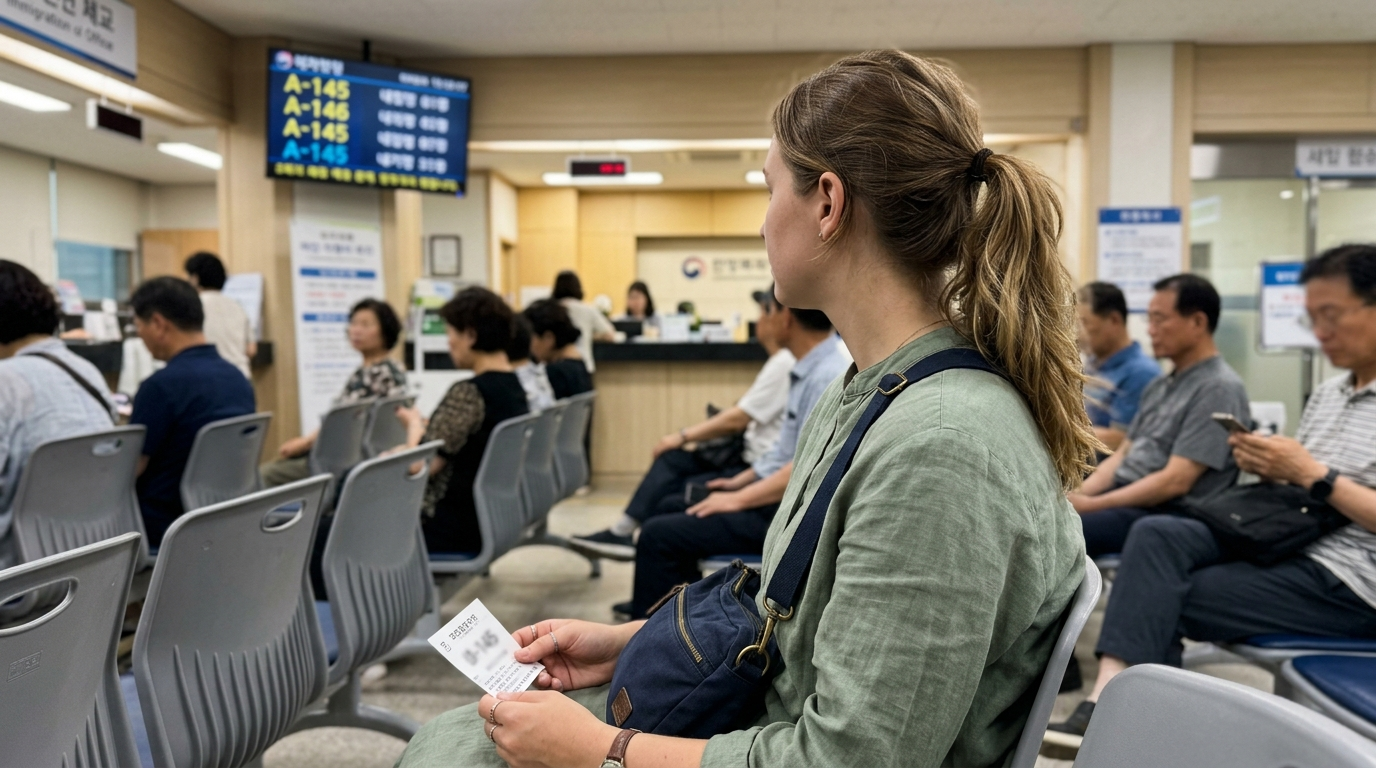
The Timing Trap Nobody Warns You About
You can file starting four months before your current stay expires. Most people don’t start until four weeks before — and that’s where problems begin.
The visa extension Korea foreigners plan around breaks into five stages. Knowing which one you’re standing in tells you what actually governs your position — and what doesn’t.
| Stage | When | What governs your position |
|---|---|---|
| Window opens | 4 months before expiry | Earliest date an application is accepted. Nothing obliges you to file this early — but every option you have later is wider if you start here. |
| Reservation | 2–3 months before expiry | For visit cases, the slot — not the paperwork — is the binding constraint. Booking is tied to the office covering your registered address, so an outdated address blocks the booking itself. |
| Filing | Before the expiry date | The date on the receipt is what matters. Fees are non-refundable once submitted, so eligibility questions belong before this point, not after. |
| Under review | Varies by office and case | Your position while a decision is pending isn’t something to assume from a forum post. Keep the receipt, track it in HiKorea My Page, and if your expiry date passes while the case is open, ask the handling office directly what your status is and get the answer from them. |
| Decision | On notification | Check the new expiry date against what you applied for before you file the paperwork away. |
Here’s the sequence that catches people off guard. You check your ARC, see 30 days left, and try to book a visit. The next available slot is five weeks out. Your expiry date arrives before the appointment does.
Now you’re stuck, and the fallback is genuinely uncomfortable. Applicants in this position are commonly told to present themselves at the office with complete documents and wait — but what that turns into on the day depends on the office and the case, which is precisely why it shouldn’t be treated as a plan. If you can see the collision coming, call 1345 while you still have days rather than hours.
Congestion also isn’t evenly spread through the year. The question of vanished appointment slots surfaces in expat forums on a predictable cycle — heaviest around the start of each academic term, when offices near universities absorb a concentrated wave of student-status applications at once. If your own expiry date happens to sit inside one of those stretches, the four-month window stops being a nicety and starts being the reason you get seen at all.
The safe window for any visa extension Korea foreigners need is two to three months before expiration, and treating that as the real deadline rather than the printed one is what separates a routine filing from a scramble. Appointment availability is better, there’s room to gather a missing document, and if an officer asks for something additional you can produce it without panic.
Visa Extension Korea Foreigners Can Still File — Workarounds That Help
If the online system won’t offer e-Application for your status, don’t assume the website is broken. Call 1345 — the Immigration Contact Center. It runs in twenty languages — including Vietnamese, Thai, Mongolian, Indonesian, Russian, Nepali, and Chinese — from 9 AM to 10 PM on weekdays, with Korean, English and Chinese continuing after 6 PM. They can confirm whether your specific case qualifies for online filing or needs a visit.
If slots at your jurisdictional office are fully booked, it’s worth knowing that quieter branch offices exist — but you can only apply at the office covering your registered address, so this only helps if you were already going to update your address registration for genuine reasons. Moving your registered address to chase a shorter queue isn’t a workaround; it’s a separate problem.
For document issues, prepare everything in duplicate — originals and copies — before the appointment or the upload. Scan as clear PDFs rather than phone photographs. HiKorea’s upload system enforces file size limits, so compress in advance; unreadable attachments are a routine cause of delay, and a delay caused by a blurry scan still consumes your remaining window.
If the visit itself is the part you’re bracing for, the counter exchange is more predictable than it feels. The phrases that come up at Korean government windows — being called, being asked for a missing item, being told to return — are covered in our guide to Korean phrases for government offices, and immigration counters run on the same script. Interpretation support through 1345 can also be joined into a call at the office.
If an employer or school controls part of your paperwork, push early. Waiting for an administrator to start the process on their own timeline is one of the most common reasons people end up scrambling in the final fortnight.
For anyone unsure how the visa extension Korea foreigners file applies to their own case — especially where a job change, an employer change, or a move between categories is involved — a licensed immigration professional is worth the fee. Published guidance covers the general shape; individual files carry variables no checklist anticipates.
A word on how to use all of this. What’s described here is process shape — the order of steps, where the constraints sit, which questions to ask and of whom. It isn’t legal or immigration advice, and it can’t be, because the determining variables sit in your individual file: your status, your sub-category, your office, your history. Requirements and fees are revised without fanfare. Confirm the specifics against HiKorea or 1345 before you file, and treat any source offering a confident universal answer — this one included — as a starting point rather than an authority. Extensions go most smoothly when the rest of your registration chain was set up cleanly in the first place — worth a quick check if you’re not sure it was.
Questions That Come Up Most
How much does a visa extension cost in Korea?
The application fee is ₩60,000, with a 20% reduction applied when filed through HiKorea’s e-Application rather than in person. Marriage immigrant (F-6) status is set at ₩30,000, and certain categories are exempt entirely. These amounts are fixed by ministerial rule and revised periodically — the figures here were checked on 18 September 2026, and HiKorea carries the current schedule. Note that the fee is non-refundable once submitted, including when an application is later refused, which is an argument for resolving eligibility questions before you pay rather than after.
Can I extend my tourist visa in Korea?
This is the boundary case for this article, so it’s worth stating plainly: nothing described above applies to you if you’re here as a short-term visitor without an ARC. That’s a separate procedure under separate conditions, and the four-month window, the e-Application route, and the fee structure described here are all features of the registered-foreigner process. Short-term stays aren’t built for routine extension, and exceptional grounds — a medical situation, a departure made impossible by circumstances outside your control — are assessed case by case rather than granted as a matter of course. Visa-exempt entry is narrower still. Contact the immigration office or call 1345 with your actual entry status; it’s the only route to an answer that applies to you.
What happens if my visa expires before the extension is processed?
Two situations that look similar and aren’t. If you filed before your expiry date and a decision is still pending, your receipt is the document evidencing when you applied — but don’t infer from it what your standing is on any given day, and don’t plan a departure, a contract, or a job start around an assumption. Take the receipt number to the handling office or to 1345 and have them tell you where you stand. If you didn’t file before expiry, that’s a different matter entirely: staying past the permitted period is a violation of the Immigration Control Act regardless of intent, with consequences that scale by duration and can extend to re-entry restrictions. There, the useful move is contacting immigration promptly rather than waiting, and a licensed immigration specialist is worth the fee.
How early can I apply for a visa extension in Korea?
Four months before your current period of stay expires. Starting early — at least two to three months out — gives you the best chance of securing an appointment and handling document problems without time pressure.
Is the 2026 online-only reporting rule the same as visa extension?
No. The online employment-information reporting that took effect through 2026 applies to work-status holders reporting job details through HiKorea. It’s a separate obligation from the visa extension Korea foreigners file. That said, if you hold a work status, having your employment information reported correctly before filing can prevent complications during review.
What to Watch After Approval
Getting the visa extension Korea foreigners apply for approved isn’t the end of it. A few things to verify immediately.
Check the new expiry date on your ARC or in your HiKorea account against what you applied for. Errors happen, and catching one now is far easier than correcting it later.
If your address changes afterwards, you have 15 days from the move to report it, and a change of employer may require a report or prior permission depending on your status. Failing to report can complicate your next extension or other status-related applications down the line.
Set a calendar reminder for your next filing window the moment approval comes through — dated four months before the new expiry, not on it. The people caught by timing are rarely disorganized; they’re people who assumed they’d remember, across a year, a date they saw once.
One pattern worth naming: extensions sit inside a chain of registrations that reference each other. Address, employer, status, and card all have to agree before a counter will move. Anyone who set that chain up carefully on arrival — the sequence covered in our guide to your first 3 days in Korea — finds extensions are mostly administrative. Anyone who let a link drift usually discovers it here, at the worst possible moment.
Where to Go From Here
The visa extension Korea foreigners go through isn’t complicated in theory. It becomes complicated when people start too late, assume their status works the same as someone else’s, or discover a missing document on the day of the appointment.
Every visa extension Korea foreigners complete starts in the same place: hikorea.go.kr. Log in, read the requirements for your own status, and either file online or book an appointment — ideally two to three months before your expiry date. If anything is ambiguous, call 1345 before guessing.
For context on how the ARC delay process connects to extension timing, or how your ARC card status affects other services while you wait, those guides cover the downstream effects.
The window is open. Use it before it closes.
Sources and verification
Figures and procedures on this page were checked against the following on 18 September 2026. Additions made on 20 October 2026 — the health insurance arrears check, the E-9/H-2 note, 1345 language coverage, and the address-change deadline — were checked the same day. Where a source and common advice disagreed, the official source was followed.
- HiKorea — Extension of sojourn period, including the per-status guidance manual (filing window, common documents, per-status requirements)
- Government of Korea — Services for foreigners, extension of stay (English-language procedure summary, four-month filing window)
- Korea Immigration Service and the 1345 Immigration Contact Center (fees, exemptions, multilingual support hours)
- Ministry of Justice — 1345 Immigration Contact Center (20 supported languages, weekday and evening hours)
- National Health Insurance Service (premium arrears reflected in stay-period review)
This page describes process structure for registered foreigners holding long-term status. It is not legal or immigration advice, requirements vary by individual status and office, and rules are revised without public notice. Confirm your own case with HiKorea or 1345 before filing, and consult a licensed immigration specialist where a status change, an employer change, or an expired period is involved.
Last reviewed: October 2026