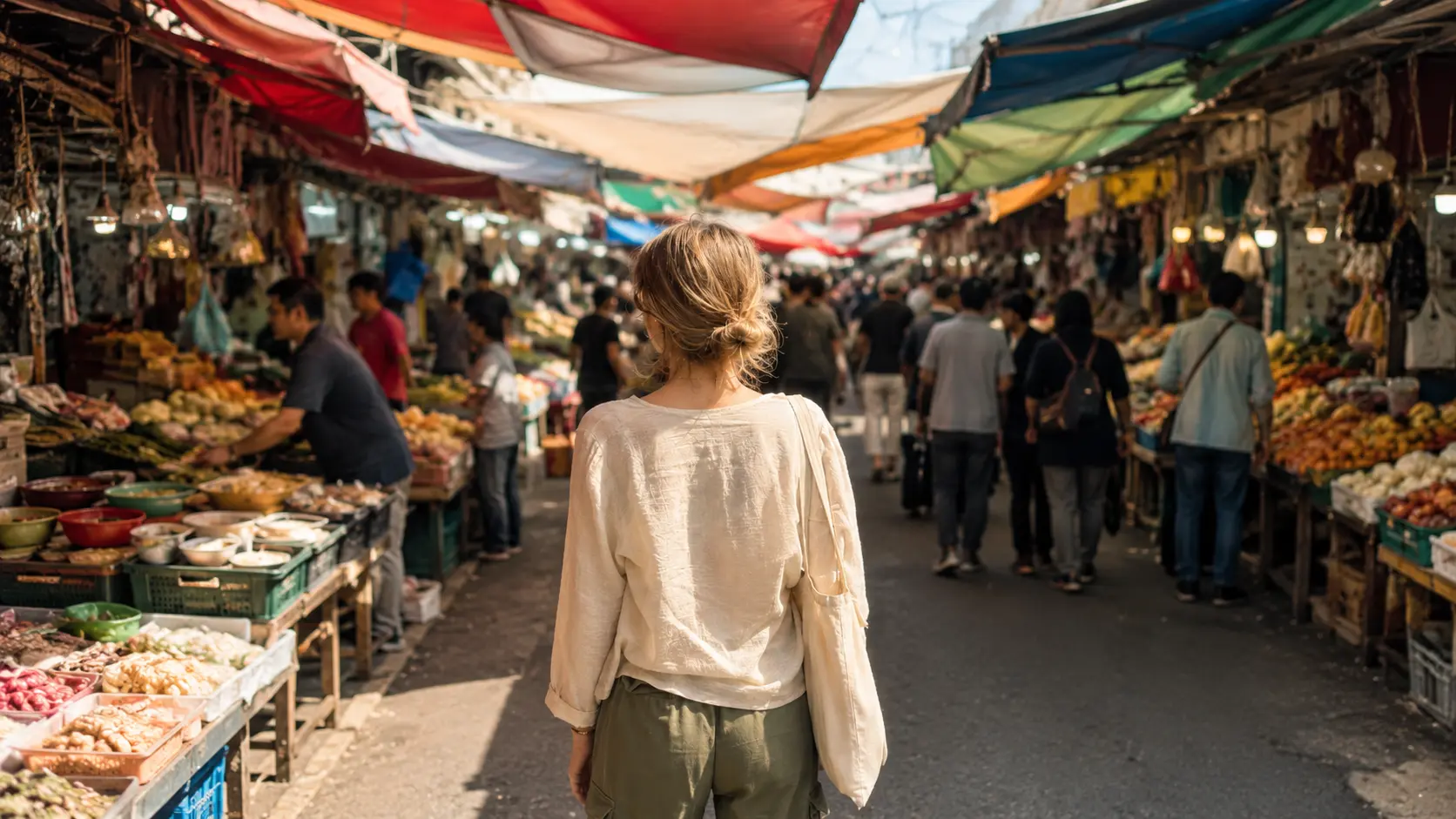
About 70% of foreigners who walk into a Korean traditional market end up pointing at things and hoping for the best. That works — until it doesn’t. The moment you need a different size, want to know if something’s returnable, or just want to ask whether they take cards, pointing hits a wall. Korean phrases shopping market situations actually require aren’t the textbook greetings most language apps teach. They’re the mid-transaction expressions that come up when you’re standing in front of a vendor, holding a jacket that’s clearly too small, and you have about four seconds before the next customer pushes in.
Korean markets run on a kind of rapid verbal shorthand. Vendors talk fast, prices aren’t always posted, and the whole exchange assumes you already know how things work here. If you don’t speak any Korean at all, you can still survive. But with about a dozen practical expressions — not textbook Korean, but the phrases people actually use in Namdaemun or Gwangjang Market — the experience shifts from stressful guessing to something that feels more like actual shopping.
This guide follows the actual sequence of a market visit: entering, asking prices, trying things on, negotiating, paying, and handling problems. Each section covers the exact Korean expressions that fit that moment — with pronunciation and the English meaning side by side.
Walking In — The First Words That Set the Tone
Most Korean market vendors will call out to you as you walk by. Sometimes it’s a friendly 어서 오세요 (eoseo oseyo) — “Welcome!” Other times they’ll shout what they’re selling, or wave a sample at you. You don’t need to respond to all of it.
But when you do stop at a stall and want to browse, one phrase works everywhere:
구경하고 있어요 (gugyeonghago isseoyo) — “I’m just looking.”
Among the essential korean phrases shopping market browsing requires, this is the escape hatch. It tells the vendor you’re interested but not committed. Without it, some vendors assume you’re ready to buy the moment you touch something. In busy markets like Namdaemun (남대문시장) or Dongdaemun (동대문시장), vendors can be pushy — not out of rudeness, but because that’s the pace of the place. Saying 구경하고 있어요 lets you browse without pressure.
If you want to actually engage, start with:
이거 뭐예요? (igeo mwoyeyo?) — “What is this?”
Simple, direct, and vendors hear it all the time. It opens the conversation without committing you to anything.
Asking Prices Without Looking Lost
Prices at Korean traditional markets aren’t always displayed. Department stores and chain shops label everything. Markets often don’t. That means you need to ask — and the phrase is short:
얼마예요? (eolmayeyo?) — “How much is it?”
You’ll use this more than any other expression. Point at the item, say 얼마예요, and the vendor will tell you the price — usually fast and in Korean numbers. This is where things get tricky if you haven’t learned Korean numbers yet.
Two number systems exist in Korean. Prices use the Sino-Korean system: 만 (man) = 10,000, 천 (cheon) = 1,000, 백 (baek) = 100. So 삼만 원 (samman won) = ₩30,000. If you can’t catch the number, ask:
써 주세요 (sseo juseyo) — “Please write it down.”
Most vendors will grab a calculator or their phone and punch in the number. No embarrassment. It happens constantly, even between Korean customers who didn’t catch the price in a noisy market.
One thing worth noting: at Gwangjang Market (광장시장) and other heavily touristed markets, the Korea Tourism Organization has been working with vendors on fixed-price displays after complaints about inconsistent pricing for foreign visitors. If you see a posted price, that’s usually the final price — no negotiation expected.
Sizes, Colors, and Trying Things On
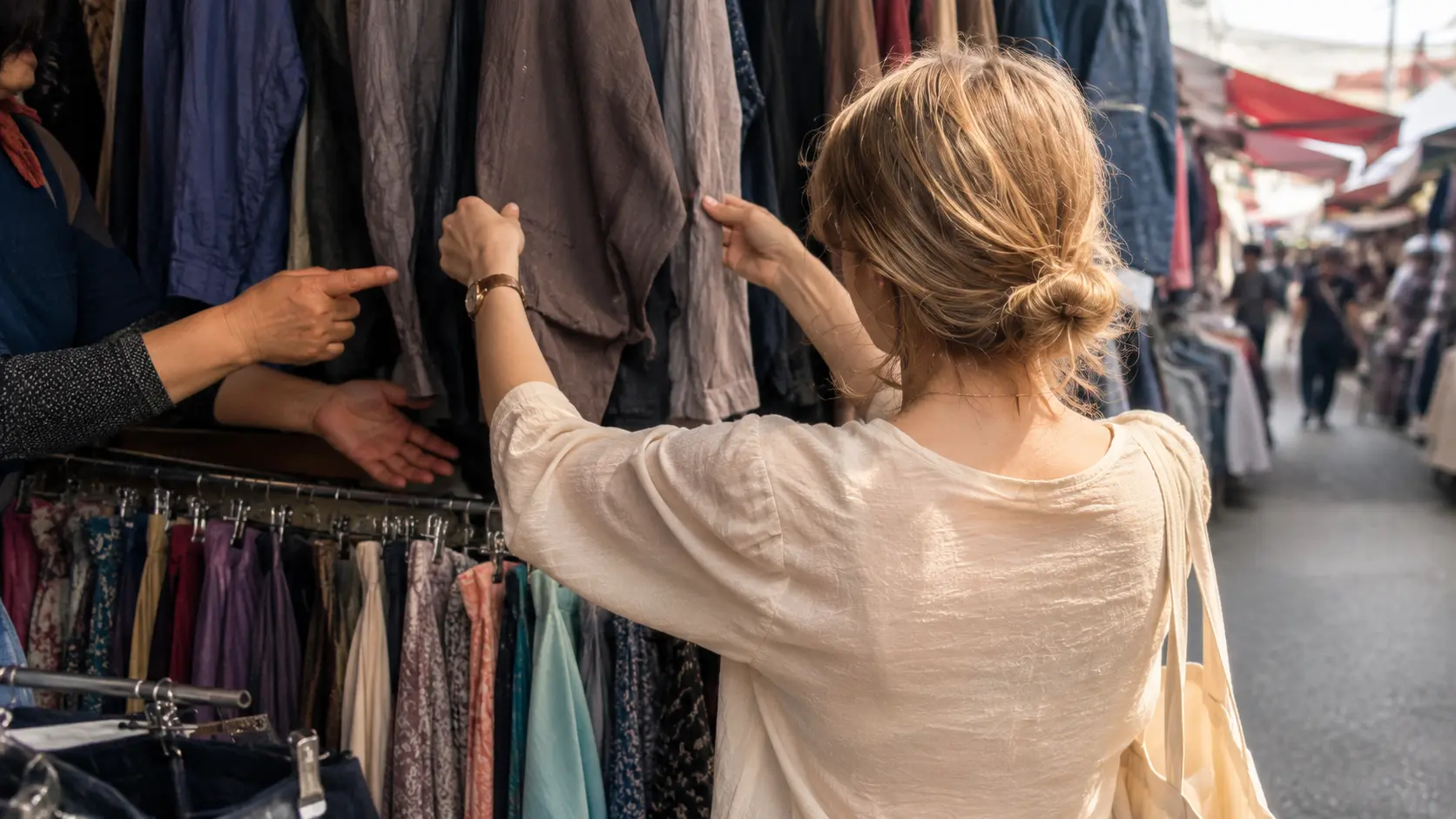
This is where korean phrases shopping market visits really start to matter. Korean clothing sizes don’t follow the S/M/L system most foreigners expect. Women’s sizes use a double-digit code: 44 (XS), 55 (S), 66 (M), 77 (L), 88 (XL). Men’s sizes go by chest measurement in centimeters: 90, 95, 100, 105. Shoes are measured in millimeters — 250mm, 260mm, 270mm — not US or EU sizes.
The phrase that saves you:
더 큰 사이즈 있어요? (deo keun saijeu isseoyo?) — “Do you have a bigger size?”
Swap 큰 (keun, bigger) for 작은 (jageun, smaller) if you need the opposite. Korean ready-to-wear runs roughly one Western size smaller on tops, and the cut tends to be slimmer through the shoulders and hips. If something labeled 66 feels tight, that’s not unusual — it’s just the Korean fit standard.
Then there’s 프리 사이즈 (peuri saijeu) — “Free Size.” You’ll see this label everywhere, especially at underground shopping malls and Instagram-brand shops. It sounds inclusive. It’s not. Free Size in Korea is typically cut to fit between a Korean 44 and 55, which is roughly a US 0–4 or UK 4–8. Anyone above a Western Medium will likely find Free Size too small.
To try something on:
입어 봐도 돼요? (ibeo bwado dwaeyo?) — “Can I try this on?”
The fitting room is 탈의실 (taruisil) or sometimes just 피팅룸 (pitinglum). Not every market stall has one. Department stores and clothing shops always do, but a stall in Dongdaemun might just have a curtained corner.
For colors: 다른 색 있어요? (dareun saek isseoyo?) — “Do you have a different color?” You can point at a specific color on your phone screen if you don’t know the Korean word for it.
The Art of Asking for a Better Price
Bargaining in Korea works. But only in specific places.
Traditional markets (전통시장, jeontongsijang) — yes. Wholesale markets like Namdaemun — yes. Small independent clothing shops — sometimes. Department stores (백화점, baekhwajeom), chain stores, convenience stores — never. If a price is printed on a tag or posted on a sign, it’s fixed.
The core bargaining phrase:
깎아 주세요 (kkakka juseyo) — “Please give me a discount.”
Don’t lowball. Among the korean phrases shopping market vendors hear from foreigners, an unreasonably low offer is the fastest way to shut down a conversation. Korean vendors get offended by offers that feel disrespectful, and they’ll shut the conversation down instead of negotiating. A reasonable ask is 10–20% off the stated price. If you’re buying multiple items, you have stronger leverage:
많이 사면 싸게 해 주세요 (mani samyeon ssage hae juseyo) — “If I buy a lot, can you make it cheaper?”
Cash helps too. Credit card payments cost the vendor a processing fee. If you offer to pay in cash, that’s sometimes enough reason for a small discount without even asking directly.
One expression that pops up in market culture is 첫 손님 (cheot sonnim) — “first customer.” Being a vendor’s first customer of the day is considered lucky in Korean market culture. If you happen to be there early, mentioning it can nudge the price down slightly. It’s more cultural than transactional, but it works.
And if the price still doesn’t feel right, the polite exit:
좀 더 둘러볼게요 (jom deo dulleobbolgeyo) — “I’ll look around a bit more.”
No one takes this personally. Walking away is a normal part of market shopping here.
Korean Phrases Shopping Market — Questions That Come Up Most
Do I need to speak formal Korean at markets?
Use polite forms (요 endings) with everyone. Market vendors are informal by nature, but a foreigner speaking casual Korean (반말, banmal) to an older vendor can come across as rude. Stick with 요-form sentences — 얼마예요, 주세요, 있어요 — and you’re fine. It’s polite without being stiff.
What if the vendor doesn’t understand my Korean?
Slow down and repeat the key word. Korean phrases shopping market vendors hear from foreigners don’t need to be perfect — vendors are used to non-native pronunciation. If spoken Korean fails completely, show the phrase on your phone screen. Most vendors will read it and respond. The Korean phrases for government offices guide covers similar strategies for when verbal communication doesn’t land.
Is it rude to touch products before buying?
At clothing stalls, touching and examining is expected. At food stalls, ask before sampling — 시식해도 돼요? (sisikaedo dwaeyo?) means “Can I try/taste this?” Most vendors say yes, especially at traditional food markets. But don’t reach over and grab. Wait for the vendor to offer, or ask first.
Can I bargain at Olive Young or department stores?
No. Chain retailers and department stores have fixed prices. Bargaining is reserved for traditional markets, wholesale markets, and small independent shops. If you want to save money at chain stores, look for 세일 (seil, sale) signs or ask: 할인 있어요? (harin isseoyo?) — “Is there a discount?” This asks about existing promotions, not personal discounts.
Paying — Cards, Cash, and Receipts
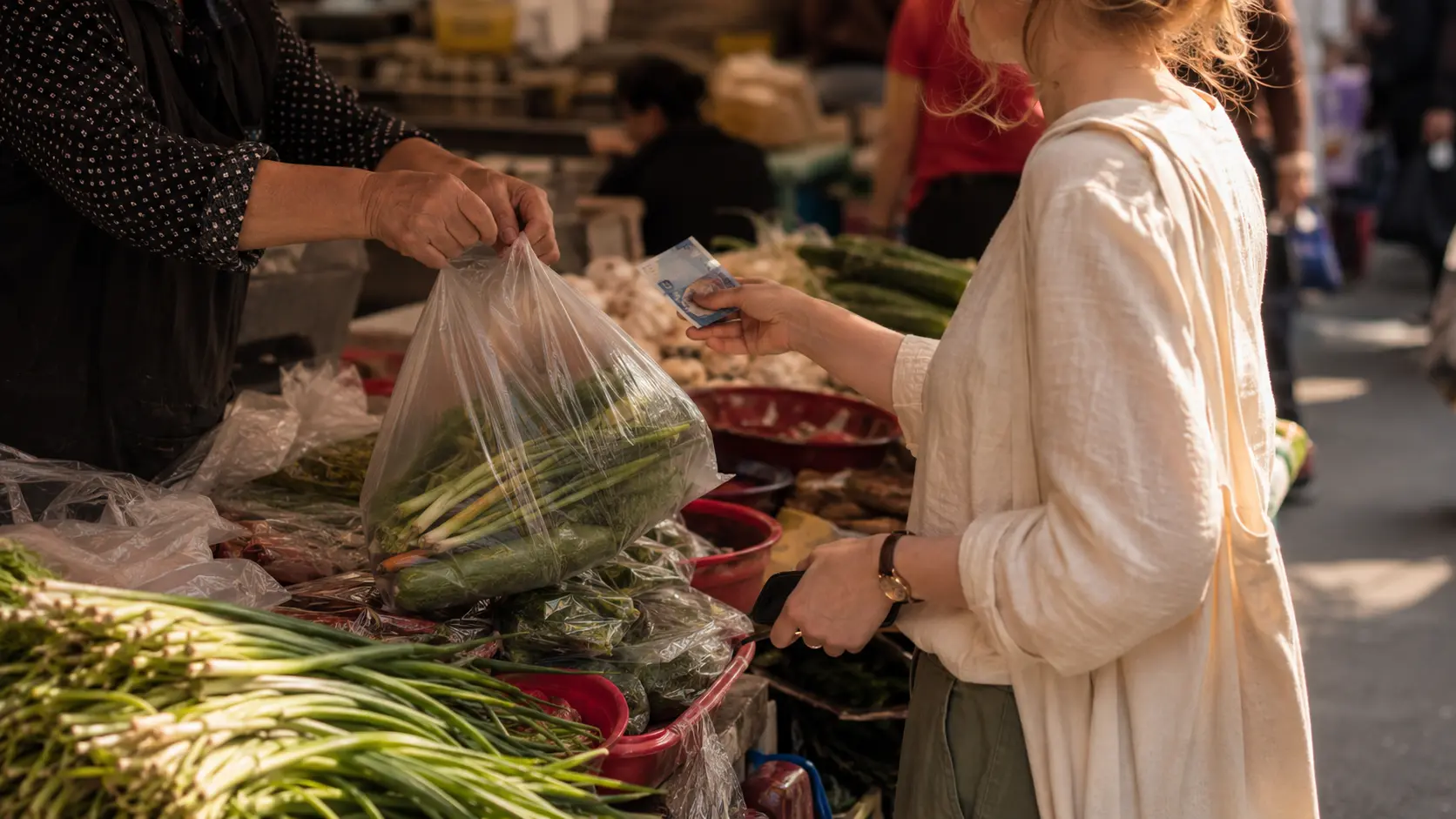
Korea is one of the most cashless countries in the world. But the korean phrases shopping market transactions need often assume cash is involved. Traditional markets are an exception to Korea’s digital payment norm. Many small vendors still prefer cash, especially for transactions under ₩10,000. Bigger stalls and fixed shops inside markets usually accept cards.
The phrase to check:
카드 돼요? (kadeu dwaeyo?) — “Do you take cards?”
If the answer is no: 현금만요? (hyeongeummanyo?) — “Cash only?” Then you know. If you need to use your foreign card specifically, check out the paying in Korea guide for details on which foreign cards work where.
After paying, you might want a receipt:
영수증 주세요 (yeongsujeung juseyo) — “Receipt, please.”
If you’re a tourist staying under six months, keep that receipt — purchases of ₩15,000 or more at Tax Free participating stores qualify for a VAT refund of roughly 5–8%. Look for 택스 프리 (taekseu peuri) or 사후환급 (sahuhwan-geup) signs at the shop.
One cultural note: hand over cash or your card with both hands, or with your right hand while lightly touching your left forearm. This isn’t mandatory, but vendors notice — and it signals respect. It costs you nothing and occasionally nudges a vendor toward friendlier treatment.
Returns, Exchanges, and When the Answer Is No
At traditional markets, most sales are final. No receipt system, no return policy, no tracking. That’s why the korean phrases shopping market sellers understand — especially around returns and exchanges — matter so much before you hand over money.
At stores, malls, and department stores, the rules are different. Under Korea’s consumer protection law, online purchases allow returns within seven days. In-store purchases depend on the store’s own policy — most major retailers allow exchanges within a few days if the item is unused and has tags attached.
The phrases you need:
교환할 수 있어요? (gyohwanhal su isseoyo?) — “Can I exchange this?”
환불돼요? (hwanbuldwaeyo?) — “Can I get a refund?”
If the answer is no — and at market stalls it usually is — you’ll hear:
교환 안 돼요 (gyohwan an dwaeyo) — “Exchange is not possible.”
It’s not personal. It’s how markets work. This is exactly why trying before buying, confirming the size, and checking for defects at the stall matters. Once you walk away, it’s done.
서비스 — The Free Extra You Didn’t Expect
Of all the korean phrases shopping market culture introduces to foreigners, 서비스 (seobiseu) might be the most surprising. Korea has a unique culture around this word. It sounds like the English word “service,” but in Korean shopping culture, it means something completely different: a free extra that the seller gives you as a gesture of goodwill.
At a food market stall, 서비스 might be an extra piece of tteok or a few more dumplings tossed into your bag. At a clothing stall, it might be a pair of socks thrown in with your purchase. At a restaurant, it’s often a side dish, a drink, or an extra serving.
You can ask for it — carefully. If you’re buying multiple items or spending a noticeable amount:
서비스 없어요? (seobiseu eopseoyo?) — “No 서비스?”
Say it with a smile. It works better as a light joke than a demand. This shows up every week in expat forums — someone discovers 서비스 culture and suddenly their market trips feel like a completely different experience. If a vendor says 이거 서비스예요 (igeo seobiseu-yeyo), it means “this one’s on the house.” Take it, say 감사합니다 (gamsahamnida), and move on.
Grocery-Specific Phrases for Market Stalls
The korean phrases shopping market food stalls require add another layer to the experience. Unlike grocery marts where everything is pre-packaged and labeled, market food stalls sell by weight, by bunch, or by the vendor’s judgment.
Key phrases:
1킬로에 얼마예요? (il killo-e eolmayeyo?) — “How much per kilogram?”
이거 하나 주세요 (igeo hana juseyo) — “One of these, please.”
조금만 주세요 (jogeumman juseyo) — “Just a little, please.”
That last one is useful when vendors start piling food into a bag. Korean market vendors tend to sell in quantities that assume you’re feeding a family. If you’re cooking for one, 조금만 주세요 prevents you from walking away with three kilograms of garlic.
For allergies or dietary restrictions, the critical phrase is:
이거 [ingredient] 들어 있어요? (igeo [ingredient] deureo isseoyo?) — “Does this contain [ingredient]?”
Common ingredients to know: 땅콩 (ttangkong, peanuts), 해산물 (haesanmul, seafood), 우유 (uyu, milk), 밀 (mil, wheat), 돼지고기 (dwaejigogi, pork). If you have a serious allergy, showing a Korean-language allergy card on your phone is more reliable than trying to pronounce ingredients in a noisy market. The restaurant phrases guide covers dining-specific allergy communication in more detail.
And the bag question — Korean markets charge for plastic bags (usually ₩100–300), or you can bring your own:
봉투 필요해요 (bongtu piryohaeyo) — “I need a bag.”
Quick-Reference Phrase Sheet
| Situation | Korean | Meaning |
|---|---|---|
| Browsing | 구경하고 있어요 | Just looking |
| Price | 얼마예요? | How much? |
| Write it down | 써 주세요 | Please write it |
| Bigger size | 더 큰 사이즈 있어요? | Have a bigger size? |
| Try on | 입어 봐도 돼요? | Can I try this on? |
| Different color | 다른 색 있어요? | Different color? |
| Discount | 깎아 주세요 | Discount, please |
| Bulk discount | 많이 사면 싸게 해 주세요 | Cheaper if I buy more? |
| Cards OK? | 카드 돼요? | Accept cards? |
| Receipt | 영수증 주세요 | Receipt, please |
| Exchange | 교환할 수 있어요? | Can I exchange? |
| Refund | 환불돼요? | Refund possible? |
| Free extra | 서비스 없어요? | No freebie? |
| One of these | 이거 하나 주세요 | One of these, please |
| Just a little | 조금만 주세요 | Just a little, please |
| Contains? | 이거 [재료] 들어 있어요? | Does it contain…? |
| Need a bag | 봉투 필요해요 | I need a bag |
Save these korean phrases shopping market trips need on your phone before heading out. Most of these phrases are under five syllables, which makes them easy to memorize and fast to use in a noisy, crowded market. The street food guide covers ordering phrases specific to food carts and pojangmacha stalls, which use slightly different expressions.
Where to Go From Here
Korean market shopping doesn’t require fluency. It requires about fifteen phrases, used at the right moment, in the right order. The korean phrases shopping market situations demand aren’t complicated — they’re just specific. The difference between pointing and actually communicating comes down to matching the right expression to the right transaction moment.
Start with 얼마예요 and 이거 주세요. Add 깎아 주세요 and 카드 돼요 the next time. Within three or four market visits, the korean phrases shopping market regulars use stop being something you look up and start being something you just say. That’s when market shopping stops feeling like a foreign experience and starts feeling like shopping.
Disclaimer: Language usage can vary by region, generation, and individual vendor. The phrases in this guide follow standard polite Korean (존댓말) and are appropriate for most retail and market situations. For formal or legal transactions, professional interpretation may be needed.