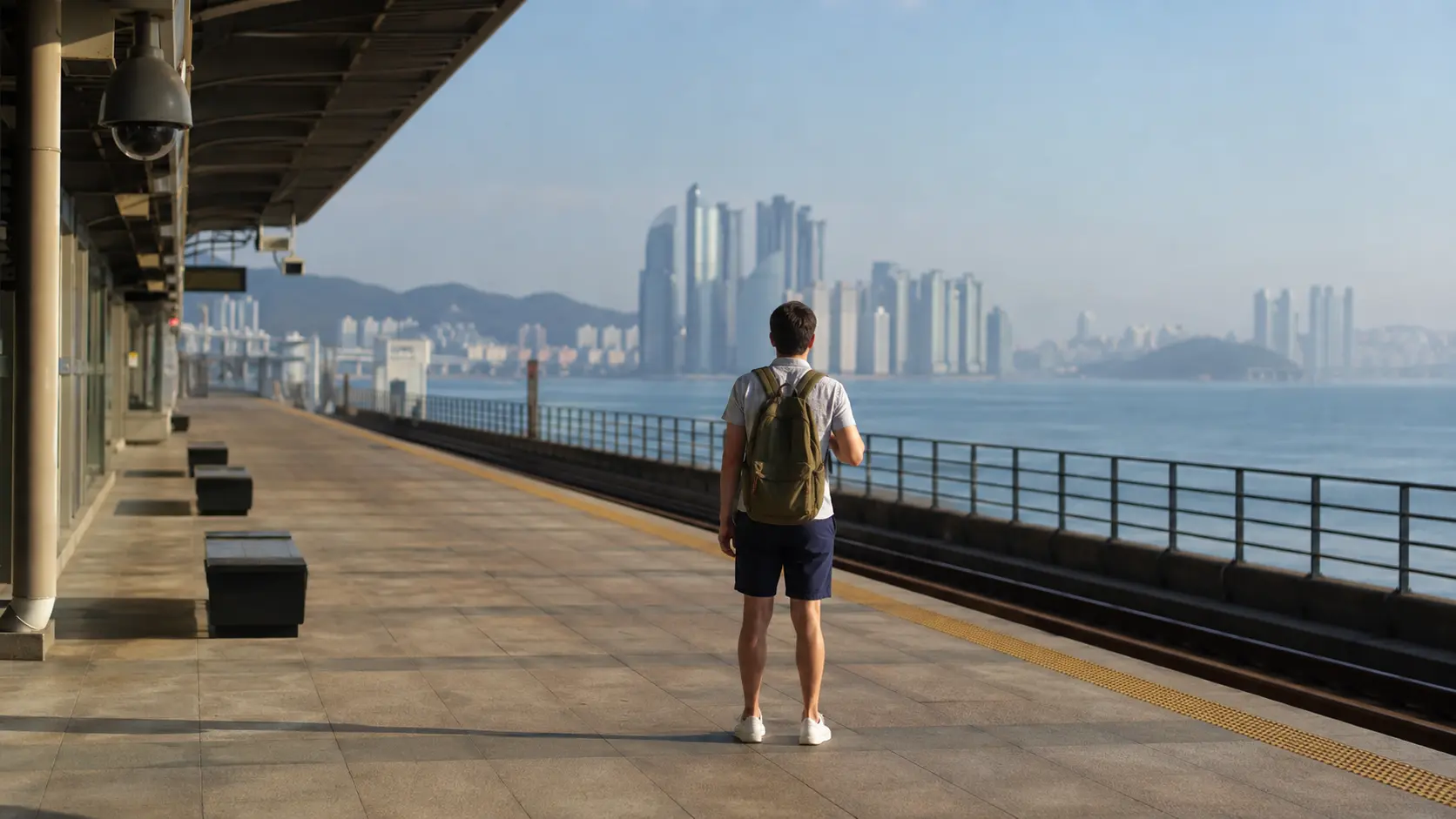
Busan travel Korea foreigners plan in summer usually looks simple on a map. Blue water along one edge, a clean grid of metro lines, four or five place names you already recognize from other people’s photos. Two nights feels like plenty.
Then you arrive. The city stretches roughly 40 kilometers along the coast with mountains wedged between the neighborhoods, so one half gets covered thoroughly and the other half not at all. The two areas most visitors came for sit at opposite ends of the metro map, and moving between them eats an hour of the day. Each way.
“The pattern is predictable enough that you can spot it in expat forums every July. Someone books two nights next to the beach, then spends both days riding back and forth to the markets at the other end of the line. Nothing goes wrong exactly. The weekend just gets eaten by the train.”
Why Busan Doesn’t Behave Like One City
Seoul trains you to think in circles. Everything loops back toward the middle, and wherever you’re staying, the center is usually twenty minutes away.
Busan is a line. The city grew along a coastline squeezed between the sea and a wall of hills, so instead of one downtown there are several strung out end to end, connected mostly by Line 1 and Line 2 of the metro. Haeundae (해운대) sits far east on Line 2. Nampo (남포동) and the old port district sit southwest on Line 1. To go from one to the other, you ride into Seomyeon (서면) in the middle, change lines, and ride back out again. Forty minutes if the timing is kind. Closer to an hour if it isn’t.
The fare system reflects that shape. Busan charges by zone rather than by continuous distance the way Seoul does: one price for trips under 10 kilometers, a higher one for anything beyond that, with card fares running below single-journey ticket prices. Transfers between metro and city bus are discounted, with a window of about 30 minutes to make the connection. Current amounts are published by the Busan Metropolitan City transport page, and it’s worth a glance before you land, because “it’s cheap either way” stops being true when you cross the city four times in two days.

None of this is a problem if you know about it on the booking screen. It becomes a problem when you’ve already paid for three nights next to the beach and then discover the market you came for is at the other end of the line. Busan travel Korea foreigners describe afterward usually splits into two categories — the day at the water, and the day spent riding between stations.
The Haeundae Side: Sand, Towers, and Fixed Hours
Haeundae is the Busan that shows up in photographs, and most Busan travel Korea foreigners book in July starts right here. A long crescent of sand, glass towers behind it, a coastal train line running east toward Songjeong.
The thing that surprises people is that the beach runs on a schedule. It isn’t a stretch of sand you wander onto whenever you like — it opens for a defined season with lifeguards, marked swimming zones, and daily hours. For 2026, Busan opened Haeundae and Songjeong on June 26, with Haeundae staying open through September 15 and Songjeong through August 31; the other city beaches followed from July 1. Operating hours run 09:00 to 18:00, and the district posted the full schedule in its official beach season announcement. Jellyfish barrier nets and expanded no-swimming areas are part of the same setup.
Outside those hours and zones, you’re swimming at your own risk with nobody watching. In practice that means a 7 p.m. arrival in August gets you a lovely walk and a closed water line.
The other Haeundae fixture is the Blue Line Park, where the Sky Capsule crawls above the shore on an old rail bed. It went viral, and the booking system never recovered. A one-way capsule for two ran ₩40,000 as of mid-2026 after a May price revision, with first departures moved up to 8:30 a.m., and slots regularly sell out weeks ahead online. The parallel beach train is cheaper and far easier to get onto at short notice.
What Haeundae gives you: water, night views, hotel supply, and a metro station that puts you on Line 2 without a transfer. What it takes: distance from nearly everything historic, and prices that sit noticeably above the west side.
The Nampo Side: Markets, Hills, and Cash
This is where the KTX drops you, and where Busan travel Korea foreigners plan around food tends to end up anyway. Busan Station sits in the old port district on Line 1, four stops from Toseong and a short ride from Jagalchi — which means if you booked a hotel in Haeundae, your first act in Busan is a 45-minute commute with luggage.
Jagalchi Market (자갈치시장) is the anchor here, and it runs on rules that catch card-dependent travelers off guard. Many stalls prefer cash, and small vendors in the outdoor lanes often accept nothing else. Foreign-issued credit cards are unreliable across the market generally. The buying process also has two payments most people don’t expect: you choose and pay for seafood at a downstairs stall, then pay a separate preparation fee upstairs where it’s cleaned, sliced, and served. Confirm both numbers before anyone reaches into a tank. That habit alone prevents most of the market stories foreigners tell afterward.
If foreign cards failing is a recurring theme for you, our breakdown of why cards fail when paying in Korea as a foreigner covers the underlying reasons.
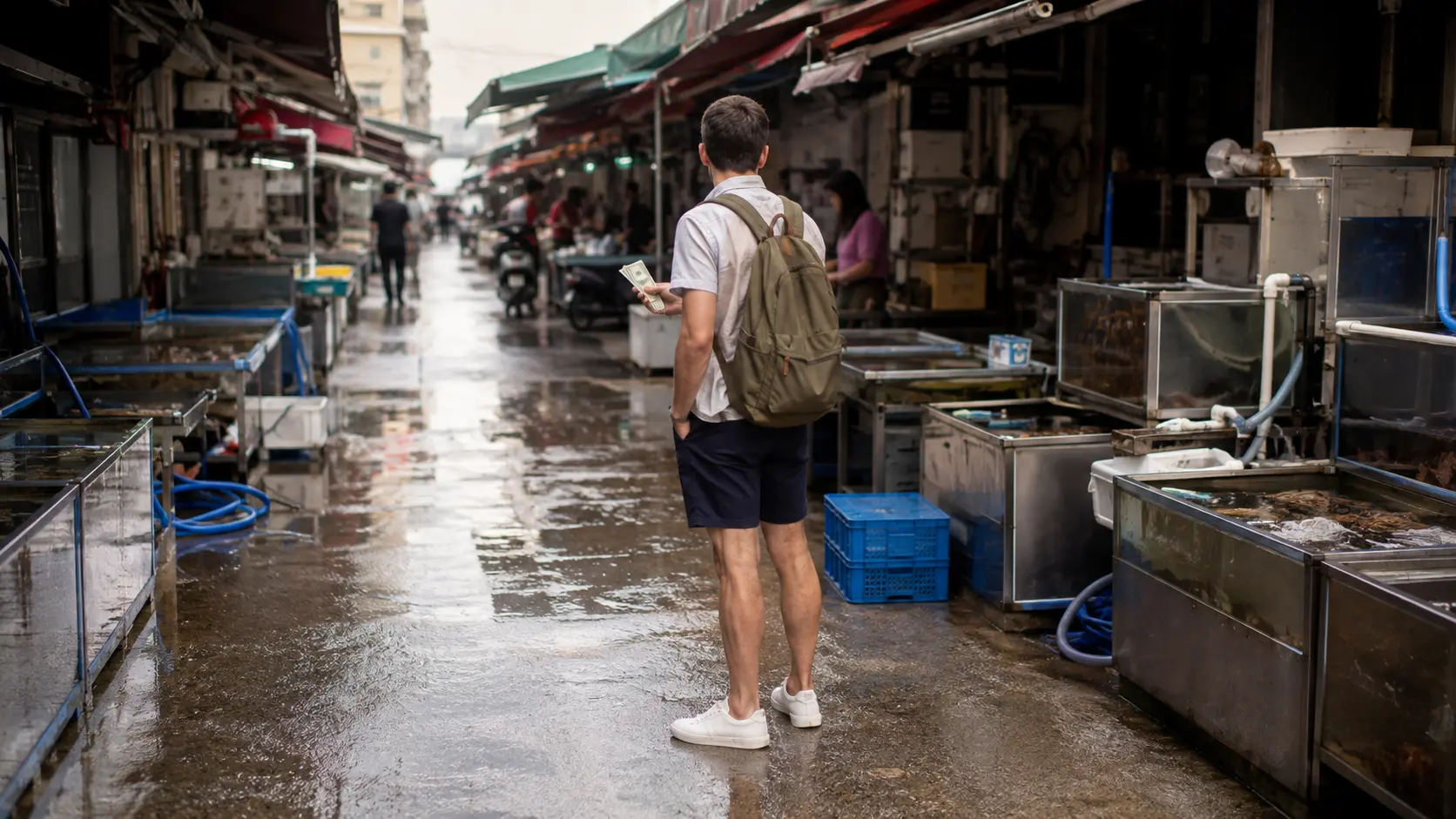
Gamcheon Culture Village (감천문화마을) is the other reason to base yourself west. Entry is free. Getting there is the fiddly part: Toseong Station on Line 1, exit 6, then one of the small green neighborhood buses — Saha 1-1, or Seo-gu 2 and 2-2 — up the hill. You can walk it in 20 to 25 minutes if you enjoy gradients. Most people don’t, twice.
Give the village two to three hours. It’s built on a slope, the alleys are narrow, and in July and August the climb is genuinely hot.
Haeundae and Nampo, Side by Side
Same city, two different trips.
| Haeundae (east) | Nampo / old port (west) | |
|---|---|---|
| Metro line | Line 2 | Line 1 |
| From KTX Busan Station | ~45 min, one transfer | 5–15 min, no transfer |
| Core draw | Beach season, coastal rail, night skyline | Seafood market, hillside village, street food |
| Payment reality | Cards widely accepted | Carry cash for markets |
| Time-locked activities | Beach hours, Sky Capsule slots | Market freshness, daylight for the village |
| Suits | Summer swimmers, families, resort weekends | Short stays, food trips, walkers |
Neither column is the correct answer. The mistake is refusing to choose, and Busan travel Korea foreigners regret afterward is almost always the trip that paid for that indecision in metro time.
Questions That Come Up Before Booking
Does my Seoul transport card still work in Busan?
Yes. T-money and Cashbee both work on Busan’s metro, buses, and light rail, so the card in your wallet from Seoul is fine — no second card needed. Top it up before you leave, since convenience-store recharges take Korean cash only. Our guide to what foreigners miss about the T-money card on day one covers the tap-out habit that costs people their transfer discount.
How much cash should I actually carry?
For a two-day trip, ₩50,000 to ₩100,000 in notes covers markets, small stalls, and the occasional taxi driver who waves off a foreign card. Restaurants, cafés, and hotels take cards without drama. The cash is for Jagalchi, Gukje Market, and street food, not for the city at large.
Can I fit Haeundae and Gamcheon into the same day?
You can, and it will be a travel day. Realistically that’s beach in the morning, an hour of metro, then the village in the afternoon with a hot climb waiting for you. Splitting them across two days costs nothing extra and makes both better — the Busan travel Korea foreigners enjoy most is rarely the compressed version.
Is flying from Seoul faster than the train?
Rarely, once the full door-to-door picture is counted. The flight itself is under an hour, but airport transit at both ends plus check-in usually lands you around three and a half hours. The KTX runs roughly 2 hours 15 minutes to 2 hours 45 minutes depending on the service and drops you in central Busan. Our KTX booking guide for foreigners covers the payment screen that blocks many foreign cards.
Where Busan Travel Korea Foreigners Lose Half a Day
Four things account for most of the wasted hours, and all four are fixable on the booking screen.
Arrival mismatch. The KTX arrives at Busan Station in the west. If your hotel is east, budget the transfer with luggage into your first afternoon rather than assuming you’ll drop bags and go. Standard one-way fare on the Seoul–Busan route sits around ₩59,800 in economy, with departures running from roughly 05:15 to 22:40, and weekend seats disappear early.
Time-locked attractions. The beach closes its supervised window at 18:00. Sky Capsule slots open in weekly batches and sell out. Neither responds to enthusiasm on the day.
The third is subtler. Busan is a port city with a lot of hills, and walking distances that look short on a map are frequently vertical. Gamcheon, Bosu-dong, the stairs behind Nampo — none of it is flat.
The last piece is return timing. Trains north stop earlier than people assume, and Sunday evening is the worst booking slot of the week — lock the return before the outbound, not after. If the train is full or the fare feels steep, the express bus route to Busan is a workable fallback with its own booking quirks.
Fare details, zone boundaries, and first and last train times for the city network are published by Busan Transportation Corporation in English.
Picking a Base by How Long You’re Staying
One night. Stay west, near Busan Station or Nampo. You’ll be walking distance from the market, a short bus from the village, and a five-minute ride from your train home. Skip the beach or accept it as a photo stop.
Two nights in summer. Stay east. The beach season is the reason you came, morning water is the best part of the day, and one dedicated west-side day handles the market and Gamcheon comfortably.
At three nights or more, split the stay: two nights east, one night west, moving hotels on the middle day. It sounds fussy. It also saves roughly two hours of metro time compared with commuting from one base all weekend.
Busan travel Korea foreigners do while living in Korea rather than visiting changes the math again — you don’t need to compress everything into one weekend, and the shoulder months of September and October give you warm water with a fraction of the crowd. If you’re weighing this against an island trip, our comparison of the travel traps that reshape a Jeju trip lays out where the two destinations differ on cost and transport.
What This Comes Down To
Busan rewards a decision made before you book, not after you arrive.
Pick the half of the city that matches the trip you actually want — water and skyline in the east, food and history in the west — then treat the other half as a planned day trip rather than a daily commute. Carry cash for the markets. Check the beach window and the capsule slots before you build a schedule around either. Book the train home first.
The Busan travel Korea foreigners remember is rarely the itinerary with the most stops on it. It’s the one that stopped fighting the shape of the city.
Eric Youn lived abroad for over 15 years and writes practical Korea living guides based on firsthand experience.