
The café two blocks from campus needs someone for weekends. The owner likes you, the pay is fair, and he says you can start Saturday. Most students in this spot never stop to think about a part-time work permit in Korea — the visa says “student,” the job is small, and Saturday is close.
That gap is where the trouble usually starts. A D-2 or D-4 visa lets you study here. It doesn’t let you work. Permission for a job comes separately, from immigration, and it has to arrive before the first shift — not on the day you apply, and not on the day your school signs a form.
None of this is hard once you see the order. It just isn’t obvious, and the people around you — the owner, a classmate who has “been working for months” — often don’t know the rules either. Below is what actually happens, where it tends to go wrong, and how the approval works from the first conversation to the first paycheck.
The Saturday Shift That Starts the Problem
Look at it from the owner’s side for a second. He needs hands on the weekend. He may have hired foreign students before, and nobody ever came asking. So when he says “start this Saturday,” he usually means it kindly.
Kindness isn’t permission.
Here’s the part that catches people. A student who works without approval can be treated as working illegally, and the employer who hired them can face penalties too. Universities put this on their own notices, usually in bold, because it keeps happening. The consequences run from fines to having your stay cut short — and a record like that has a way of resurfacing later, when you extend your visa or try to switch to a work visa after graduation.

The scale matters, too. Korea had roughly 350,000 international students by August 2026, according to Justice Ministry figures reported by The Korea Herald. More students means more weekend jobs near campus — and more attention on who is working without a part-time work permit in Korea.
Why a Student Visa Doesn’t Come With Work Rights
Korea treats studying and working as two separate activities. Your D-2 or D-4 status covers the first one. Anything you get paid for falls under what immigration calls an activity outside your status of stay, and that needs its own approval.
For students, that approval is the part-time work permit in Korea. It isn’t a general license to work anywhere. It’s tied to one workplace, one set of duties, a fixed period, and a weekly hour cap.
Who can apply, and when, depends on the exact subtype printed on your ARC:
- Degree students (D-2-1 to D-2-4) and exchange students (D-2-6) have no waiting period — though “no waiting period” still means after alien registration, school confirmation, and immigration approval.
- Korean language trainees (D-4-1) and foreign language trainees (D-4-7) generally can’t apply until six months after their status began, and attendance of 90% or higher is usually checked.
- Research students (D-2-5) and students who finished coursework but stayed on without graduating because of missing credits generally fall outside the standard student program.
Degree students are usually expected to have at least a C average (2.0) in the semester before applying. In a first semester with no transcript yet, that can sometimes be skipped — if the school and the immigration office agree.
| Program | Language standard | Not met | Met | With bonus conditions |
|---|---|---|---|---|
| D-4 language trainee | TOPIK 2 / KIIP 2 | 10 hrs | 20 hrs | 25 hrs |
| D-2 associate degree | TOPIK 3 / KIIP 3 | 10 hrs | 25 hrs (weekdays) | 30 hrs (weekdays) |
| D-2 bachelor’s, years 1–2 | TOPIK 3 / KIIP 3 | 10 hrs | 25 hrs (weekdays) | 30 hrs (weekdays) |
| D-2 bachelor’s, years 3–4 | TOPIK 4 / KIIP 4 | 10 hrs | 25 hrs (weekdays) | 30 hrs (weekdays) |
| D-2 master’s / doctoral | TOPIK 4 / KIIP 4 | 15 hrs | 30 hrs (weekdays) | 35 hrs (weekdays) |
Two details the table hides. D-2 degree students who meet the language standard have no separate immigration hour cap on weekends, public holidays, or vacations — but only at the approved workplace, doing the approved duties. D-4 trainees don’t get that; their weekly cap holds all year. And the bonus tier isn’t automatic. It can apply if your school is a government-certified university, you had an A average last semester, or you reached TOPIK 5 or KIIP stage 5. Immigration decides whether it applies, not you or your employer.
English-track students can sometimes use English scores instead — TOEFL iBT 71, IELTS 5.5, or CEFR B2, for example — when both the school and the immigration office accept them.
These numbers move. In October 2026, the Justice Ministry announced plans to simplify student work eligibility around language ability and grades, and to raise the language bar to KIIP Level 3, with some measures starting this year. Treat the table as a map, and the current notice on HiKorea as the ground.
Four Ways Students End Up Working Without Approval
Almost nobody sets out to work illegally. These are the four paths students drift into before their part-time work permit in Korea is in hand, usually because someone nearby said it was fine.
Treating the receipt as a green light
The HiKorea e-application ends with a submission screen. It looks official. It isn’t approval. A common pattern goes like this: apply on Monday, start at the café that weekend, get the approval ten days later. Those first weekends still count as unauthorized work. The start date written on your contract doesn’t change that either.
Counting the six months from the wrong day
Language trainees often count from the day they landed, or from the first day of class. The waiting period is generally counted from when the D-4 status began. If you changed status inside Korea — from a short-term visa, say — the clock may have started later than you think. One email to the language institute’s office settles it.
Adding a second job, or switching branches
A permit names a workplace. Moving to the same chain’s other location, picking up a second job, or changing employers generally needs approval before your first shift there. Hours from every job are also added together against one cap. A 15-hour café job plus a 15-hour restaurant job is a 30-hour week, not two separate 15s.
Taking a job that was never on the list
Some work stays off-limits on a student permit, whatever the hours: delivery riding, designated driving, construction, dispatched or subcontracted labor, door-to-door sales, insurance sales, and private tutoring or language-conversation teaching (that belongs to other visa types). Manufacturing is restricted, with exceptions considered only around TOPIK 4 and only with prior approval. Several universities have also warned students about immigration crackdowns on delivery work specifically.
One quieter trap: if the employer’s business registration lists manufacturing or construction, you may face extra questions — even if your actual job is pouring coffee at the front.
Getting a Part-Time Work Permit in Korea, in the Right Order
The sequence that works is really three approvals stacked on top of each other — the employer’s, the school’s, then immigration’s. Each one leans on the one before it, so skipping ahead rarely saves time.
Step 1 — Settle the job on paper
Agree on the workplace, duties, hourly wage, working days, weekly hours, and contract period, then put it all in a standard employment contract signed by both of you. Ask for a copy of the business registration certificate too. Set the start date a couple of weeks out; the review takes time, and a date that has already passed only creates pressure to start early. The wage should be at least the 2026 minimum of ₩10,320 an hour.
Step 2 — Get your school’s confirmation
Bring the contract to your international office and ask for the part-time work confirmation form for international students. Some schools handle this through a student portal; others want you at the counter. They’ll look at enrollment, grades or attendance, and language proof. If the staff hesitate about the type of job, listen. They see far more rejections than any one student does.
Step 3 — Apply to immigration, then wait for the result
Apply through HiKorea’s e-application or by booking a visit at your immigration office. Expect to need your passport, ARC, the integrated application form, the school confirmation, a certificate of enrollment, a transcript or attendance record, language proof, the contract, and the business registration copy. The fee for student work permits is reduced to ₩20,000, compared with ₩120,000 for most other permissions of this kind.
Then wait for the actual result, and read it. Check the approved workplace, duties, period, and hours against your contract. Your first shift comes after that — not before.
If anything is unclear, such as whether a job counts or whether your hours fit, the immigration contact center at 1345 answers in several languages; our guide to emergency and help numbers in Korea lists it alongside the others worth saving. Sorting out the part-time work permit in Korea early tends to make the rest of the semester’s paperwork feel lighter, and there is usually more of it waiting than new students expect.
After Approval: The Permit Has Edges
Approval feels like the finish line. It’s closer to a fence with one gate in it.
The permit covers what it lists, and only that. If the owner asks you to help at his second shop, or to move from the counter to something different, check first whether that needs a change. The same goes for a new employer — the approval doesn’t travel with you.
Permits also run for a set period, generally not beyond your permitted stay. When you extend your visa, look at whether the part-time work permit in Korea needs renewing as well. Our visa extension guide covers the timing on that side.
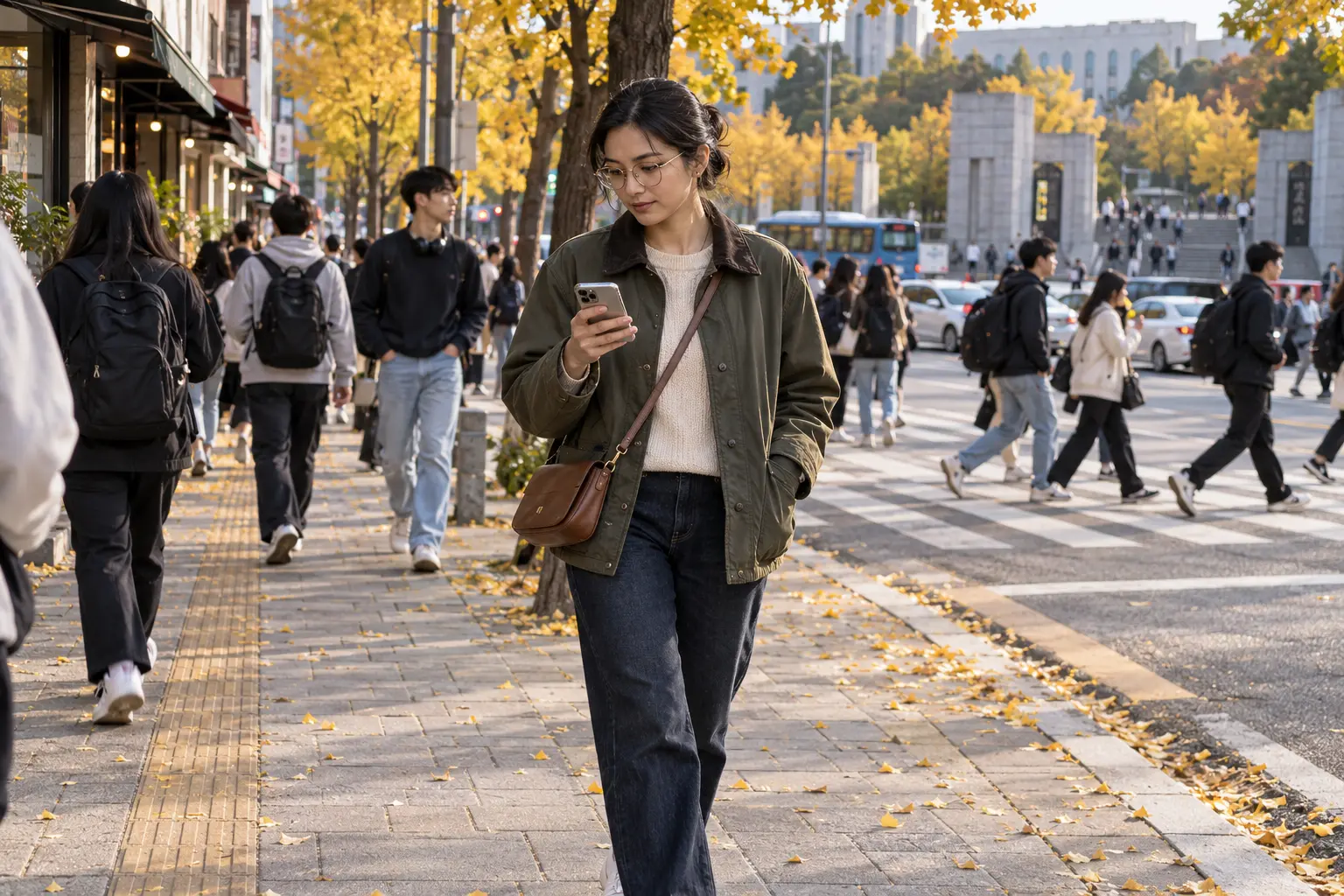
Then there’s the everyday pressure. A busy Friday, a manager who asks you to stay two more hours, a coworker who calls in sick. Saying yes can feel like part of fitting in, especially in workplaces where flexibility is expected — our piece on Korean work culture explains why that expectation runs deep. But if extra hours push you past your weekly cap, the problem lands on your visa record, not theirs.
Keep your own paper trail: the contract, the permit result, and pay records. Employers are supposed to check your status and hours. Some don’t. When that happens, you’re still the one holding the visa.
And re-check the rules each time your part-time work permit in Korea comes up for renewal. With the October 2026 announcement on the table, some details in this guide may shift during the 2026–27 academic year.
Questions Students Ask Right After Applying
Do on-campus jobs need a permit?
Sometimes not. Simple, temporary work on campus, research tied to your studies at your own university, or a required field-practice semester may be exempt. But that exemption has to be confirmed by the school department — a professor saying “it’s fine” is not the same thing.
I’m on a D-4 visa and arrived four months ago. Can I start sooner?
Under the current rules, generally no. The six-month wait applies to D-4-1 and D-4-7 trainees. If you have the time, it may be worth putting it toward TOPIK 2 — reaching that level moves the weekly cap from 10 hours to 20.
What if I’ve already worked before the approval came through?
Stop working first, then talk to your international office. They know how your local immigration office tends to handle these cases. For anything that might carry legal consequences, getting advice through 1345 or a legal aid service is safer than guessing from forum threads.
Before You Say Yes to Saturday
The job offer, the school form, and the immigration approval can feel like one thing. They’re three, and only the last one lets you work.
Contract, confirmation, application, result — then the first shift. Every part-time work permit in Korea runs through those same four stops. If you’re still early in your first semester, our student arrival checklist puts the rest of the paperwork in order around it.
Everything here reflects the rules as of October 2026, and they change often. Before you rely on any number in this guide, confirm it with your school’s international office, the HiKorea notice, or 1345.