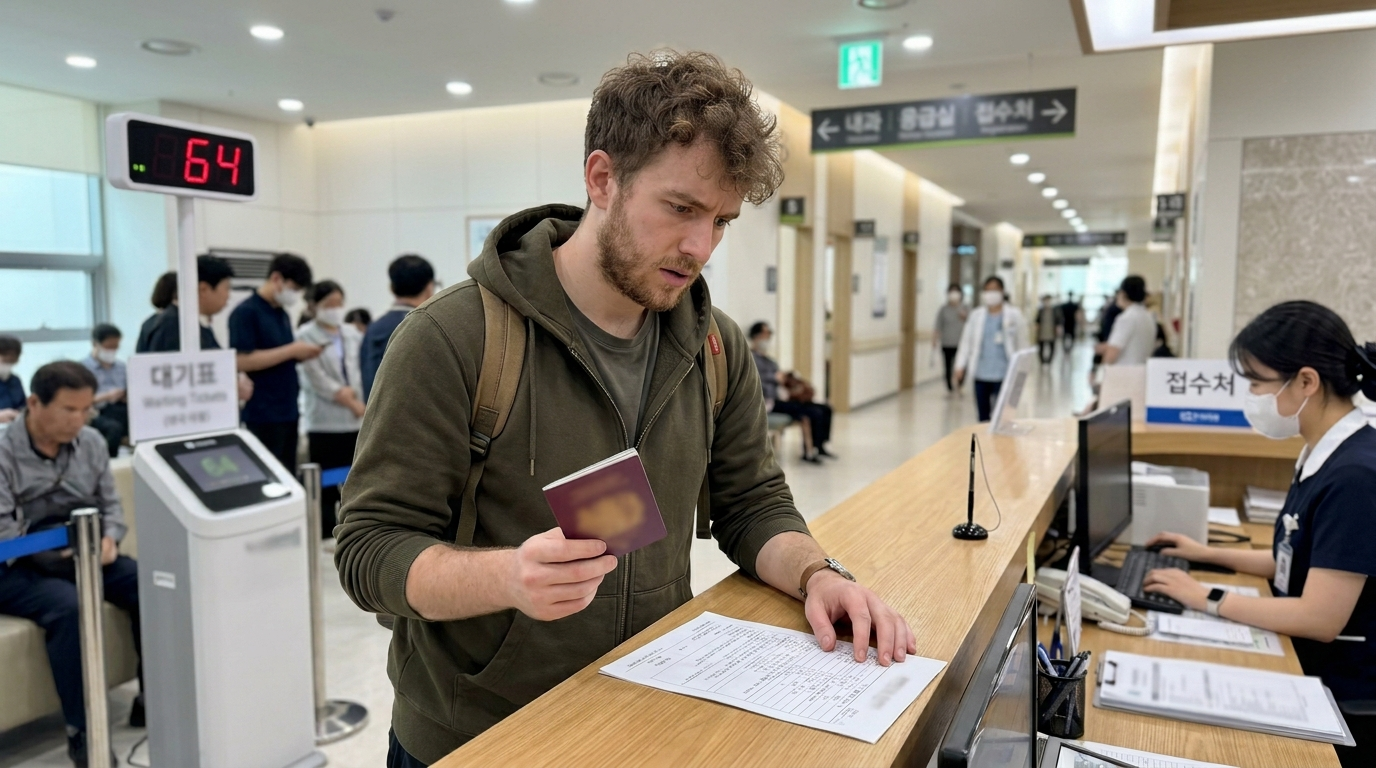
You’re sitting in a Korean hospital lobby at 9 AM, holding a small plastic number card. Names flash across the display screen above the counter — all in Korean. The intake form someone just handed you doesn’t have a single line of English, and the person behind you is already getting impatient.
A hospital visit Korea foreigners face for the first time almost always starts like this. Not with a medical crisis, but with a process that assumes you already know how everything works. The care itself is fast, affordable, and surprisingly thorough. But the path from the front door to the pharmacy counter follows a sequence no one explains — and the right path depends entirely on what brought you in.
Someone with a broken wrist at 2 AM needs a completely different entry point than someone with a persistent cough on a Tuesday afternoon. And both of those look nothing like the person who just needs cold medicine but doesn’t realize Korean pharmacies require a prescription for most of it. This article splits the hospital visit Korea foreigners experience into three real scenarios, so you can skip straight to the one that matches your situation.
Disclaimer: This article provides general information based on common foreigner experiences at Korean medical facilities. It is not medical advice. Policies, costs, and insurance rules may change. Always confirm current details with the hospital or your insurance provider directly.
Why the Right Path Depends on What Brought You In
Korean hospitals operate on a high-volume, walk-in model. There’s no calling ahead to book a slot three weeks from now. You show up, register, wait, see the doctor, pay, and leave — often within an hour or two for minor issues. The system is efficient once you understand its rhythm.
But Korea’s medical system has a clear hierarchy of facilities, and choosing the wrong one wastes time and money. A cold doesn’t need a university hospital. A fractured ankle doesn’t belong at a neighborhood clinic. And a headache at midnight has different options than the same headache at noon.
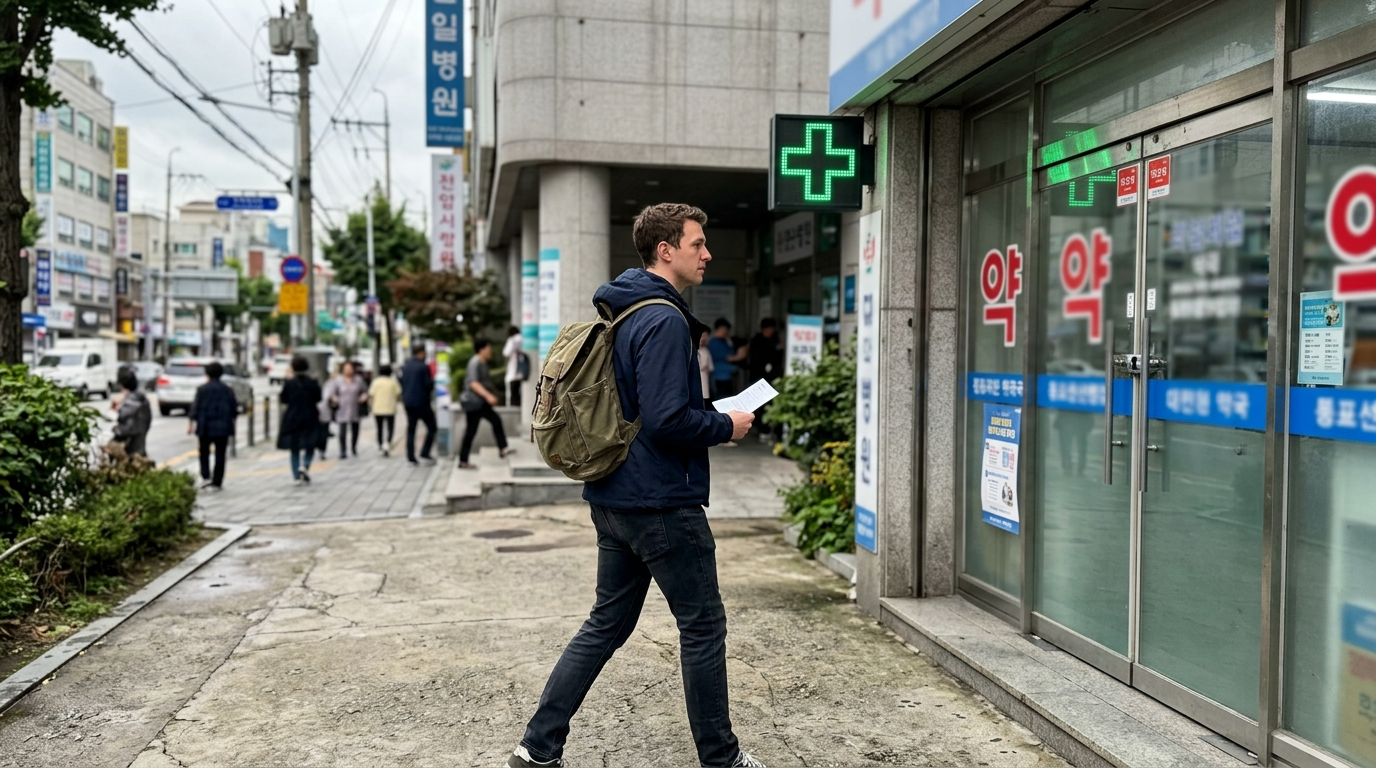
Here’s the part that trips up nearly every foreigner on the first visit: the hospital does not give you medicine. Korea’s pharmacy-hospital separation law (의약분업) means you walk out of the hospital with a printed prescription slip, then find a nearby pharmacy (약국) to fill it. This single detail causes more confusion than anything else in the entire process. Look for the green cross sign — pharmacies cluster within a block or two of most hospitals.
The three scenarios below cover most situations a foreigner will encounter. Each one follows a different path through the system.
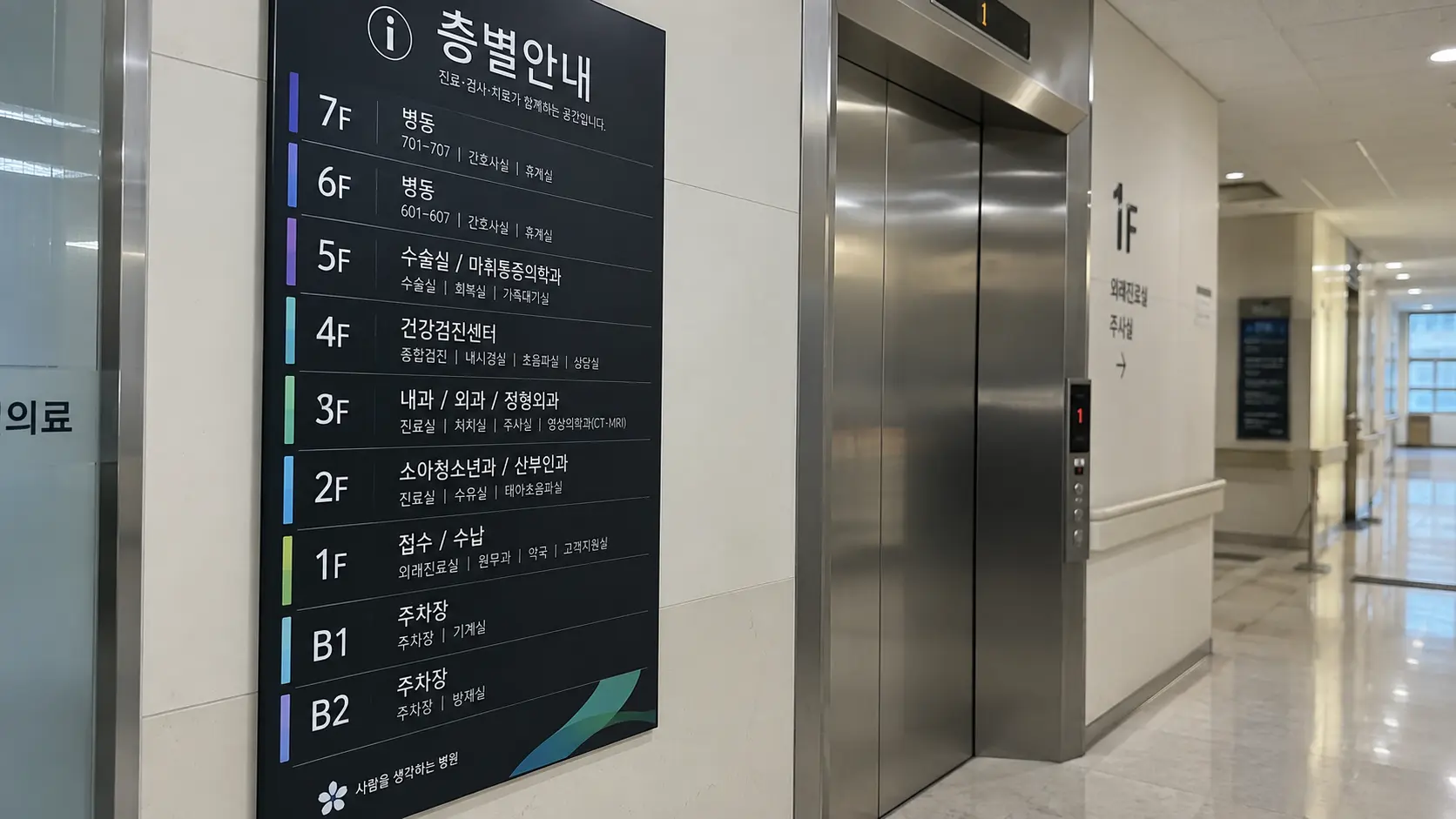
Which Facility Matches Your Situation
Korea’s medical system has four tiers — defined by law (의료법 제3조) based on bed count and specialist staffing. This table maps common foreigner situations to the right entry point. Costs shown below are the patient’s out-of-pocket portion and vary by facility, tests ordered, and individual circumstances.
| Symptom / Situation | Where to Go | Appointment? | Bring |
|---|---|---|---|
| Cold, sore throat, mild fever, stomach issue, skin rash | Local clinic (의원) 1–29 beds, outpatient focus |
Walk-in | Passport or ARC, payment method |
| Fracture, infection needing monitoring, moderate injury, specialist referral | Hospital (병원) 30–99 beds, inpatient capable |
Walk-in or call ahead | Passport or ARC, referral letter if given, insurance docs |
| Complex condition, multi-department workup, surgery, second opinion | General hospital (종합병원) 100+ beds, 7+ departments |
Appointment recommended | Passport or ARC, prior test results, referral letter |
| Rare/severe disease, organ transplant, advanced cancer treatment | Tertiary hospital (상급종합병원) Severance, Asan, SNUH, Samsung — ministry-designated |
Required (referral usually needed) | Passport or ARC, referral letter from lower-tier facility, all prior records |
| Headache, mild pain, digestive issue, hangover | Pharmacy (약국) No doctor needed for many OTC items |
Walk-in | Nothing required (cash or card) |
| Chest pain, difficulty breathing, severe injury, loss of consciousness | Emergency room (응급실) Dial 119 — ambulance is free |
No — go immediately | Whatever you have. ID can come later |
Facility classification based on Korea’s Medical Service Act (의료법 제3조). Bed counts and department requirements verified via HIRA Hospital & Pharmacy Finder (건강보험심사평가원 병원·약국 찾기). For real-time ER availability, check E-Gen Emergency Portal (응급의료포털). Sources verified September 2026.
If It’s a Real Emergency — 119 and What Happens Next
For genuine emergencies — chest pain, severe injuries, difficulty breathing, loss of consciousness — dial 119. This connects you to Korea’s fire and emergency medical services. Ambulances are free. There is no charge for the ride.
Emergency rooms (응급실) at Korean hospitals operate 24/7. You don’t need insurance or ID to receive emergency treatment. Staff stabilize you first and sort out paperwork after. That said, having your passport or ARC card (외국인등록증) available speeds up the administrative side once you’re being treated.
One thing that surprises people: Korean ERs triage by severity, not arrival order. If your condition is classified as less urgent, you’ll wait while more critical patients go first. This is standard practice globally, but it can feel frustrating when you’re in pain and watching others go ahead.
During an emergency hospital visit Korea foreigners sometimes panic about language. Calling 1345 connects you to the Immigration Contact Center, which provides interpretation in 20 languages — including English, Chinese, Vietnamese, Japanese, Thai, Mongolian, Indonesian, Russian, Arabic, and Tagalog. After 18:00, only Korean, English, and Chinese lines remain available. Some expats save both 119 and 1345 in their phones. For a full breakdown of what each emergency line handles, see the Korea emergency numbers guide.
If You Need a Doctor but It’s Not Urgent
This is the scenario most foreigners actually encounter: a cold, sore throat, stomach issue, skin problem, or minor injury that needs a doctor but isn’t an emergency. The hospital visit Korea foreigners describe as “confusing” almost always falls into this category — because the process itself has five steps that nobody lays out clearly.
Choose the right facility first. Korea has three tiers. A local clinic (의원) handles most everyday problems — colds, fevers, mild injuries, stomach trouble. These are everywhere in Korean neighborhoods, wait times are usually under 30 minutes, and costs stay low. A hospital (병원) has more departments and diagnostic equipment for moderate cases like fractures or infections. University hospitals (대학병원) like Severance, Samsung Medical Center, or Seoul National University Hospital sit at the top — built for complex cases, not coughs. Going to a university hospital for a cold means longer waits, higher costs, and sometimes a referral requirement from a smaller clinic.
If English support matters, international clinics (국제진료센터) inside major hospitals have bilingual staff and handle documentation in English. The trade-off is that consultation fees sometimes carry a premium.
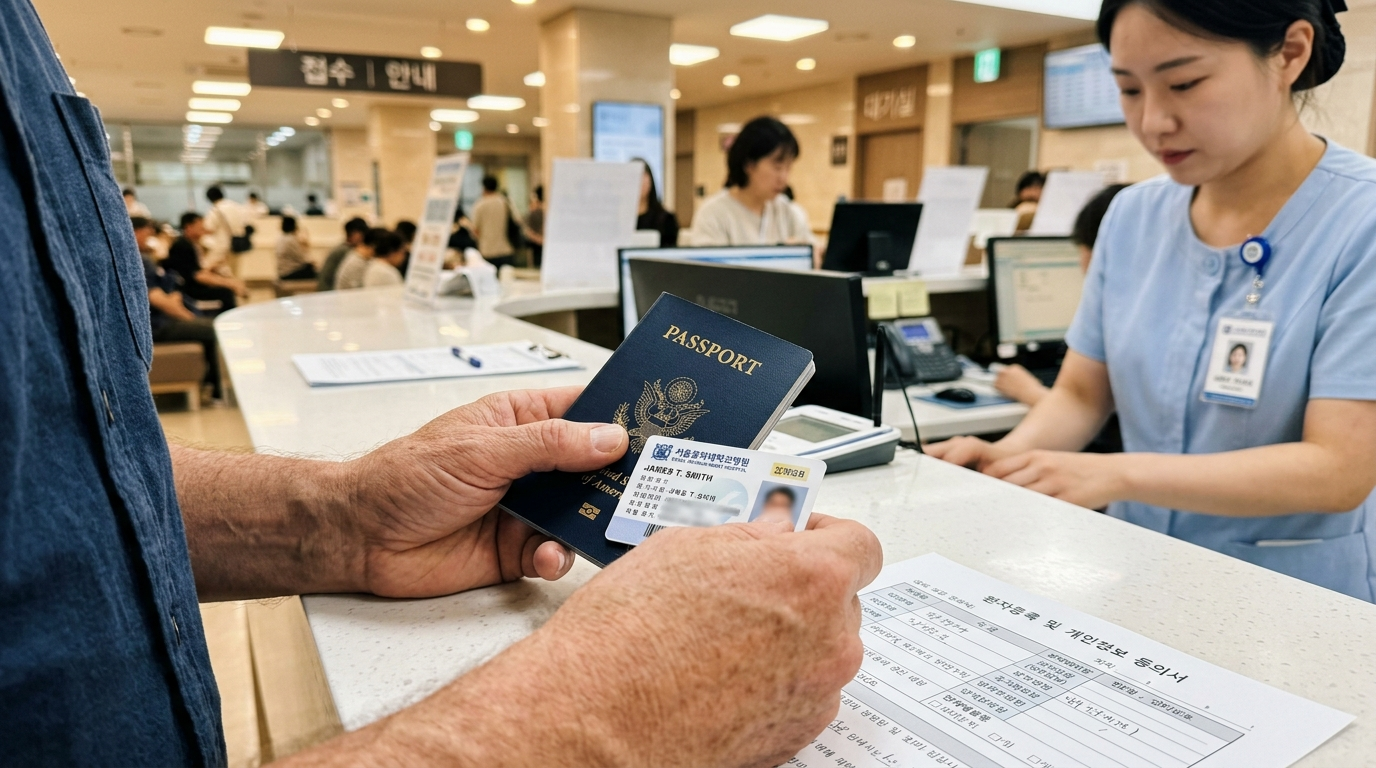
Registration (접수). Present your passport or ARC at the reception desk. First-time visitors get a patient record (진료기록부) created and receive a patient number card (진료카드). Larger hospitals have kiosk machines for this, but they’re almost always Korean-only — the information desk (안내데스크) staff can help.
Consultation (진료). Your number gets called. The doctor’s visit is typically brief — 5 to 15 minutes for a standard issue. Korean doctors tend to be direct. Having a translation app ready helps if your Korean is limited, though many urban doctors speak some English.
If tests are needed — blood work, X-rays, other diagnostics — they happen in a different department within the same building, and results often come back during the same visit.
Payment (수납). After everything is done, the billing counter (수납 창구) calculates the total and applies National Health Insurance (국민건강보험) coverage if applicable. Card and cash both work. You walk away with up to three documents — know which ones you’re holding:
- 영수증 (yeongseujeung) — the payment receipt. Keep this for travel insurance reimbursement claims.
- 처방전 (cheobangjeon) — the prescription slip. Take this to a pharmacy. Without it, the pharmacy cannot fill your medication.
- 진단서 (jindanseo) — a medical certificate or diagnosis document. Not issued automatically — request it at the billing counter if your insurer or employer requires one. There is usually a separate fee (₩5,000–₩20,000 depending on the facility).
Pharmacy (약국). Take the prescription to a nearby pharmacy. They fill it on the spot, usually within 10–15 minutes. The pharmacist may explain dosage in Korean, so having Papago or Google Translate open is useful. Pharmacy costs are separate from the hospital bill. For details on what Korean pharmacies sell without a prescription and what requires one, see the Korean pharmacy guide for foreigners.
This shows up every single week in expat forums: someone walks out of the hospital thinking they’re done, then realizes the prescription slip in their hand isn’t optional decoration.
If You Just Need Medication Without Seeing a Doctor
Not every hospital visit Korea foreigners worry about actually requires a doctor. Sometimes you just need ibuprofen, cold medicine, or something for an upset stomach. In many countries, you’d grab it off a shelf at any store. Korea works differently.
Most medications — even many that would be over-the-counter in the US or Europe — require a pharmacy visit in Korea. Pharmacies sell these without a prescription in many cases, but you still need to ask the pharmacist directly. They’ll select the right product, explain the dosage, and ring you up. Prices are usually ₩3,000–₩10,000 for basic medication.
Korean convenience stores carry a very limited range of OTC items — basic pain relievers, digestive medicine, and hangover remedies. But anything the doctor would normally prescribe, and many items you’d expect to find on a store shelf back home, require an actual pharmacy. If you’re not sure which category your situation falls into, the pharmacy is always the safer first stop.
Hospital Visit Korea Foreigners — What Insurance Actually Changes
Your insurance status changes a hospital visit Korea foreigners navigate more than any other single factor. The same clinic consultation can cost ₩5,000 or ₩50,000 depending on your coverage.
If you’re enrolled in Korea’s National Health Insurance (NHI), the system covers roughly 50–70% of most outpatient costs automatically. They scan your ARC at the billing counter, the coverage applies, and you pay the copay. A basic clinic visit often comes in under ₩15,000.
Without NHI, you’re paying the full uninsured rate. How much depends on what the doctor orders:
| Visit Type | With NHI (copay) | Without NHI (full cost) |
|---|---|---|
| Clinic consultation only | ₩5,000–15,000 | ₩30,000–50,000 |
| Consultation + blood test | ₩15,000–40,000 | ₩70,000–120,000 |
| Consultation + X-ray or imaging | ₩20,000–50,000 | ₩100,000–200,000 |
| Pharmacy (prescribed medication) | ₩3,000–10,000 | ₩5,000–25,000 |
Ranges reflect typical outpatient visits at local clinics (의원) and mid-tier hospitals (병원). University hospitals and international clinics may charge higher base fees. Exact amounts depend on the facility, specific procedures, and individual circumstances. These are not fixed rates.
Here’s what catches most people off guard: Korean hospitals don’t bill foreign travel insurance directly. You pay everything upfront, collect all receipts — consultation, tests, pharmacy — and file a reimbursement claim with your insurer afterward. If you’re expecting a cashless experience like some international hospitals in Southeast Asia offer, Korea doesn’t work that way.
The full breakdown of how insurance coverage changes between arrival and ARC enrollment — including the gap period where you’re effectively uncovered — is in the health insurance guide for foreigners. If you haven’t sorted out your ARC yet, the ARC card process directly affects when your NHI coverage activates.
What to Have Ready Before You Walk In
Regardless of which scenario matches your situation, these items prevent the most common stalls at the hospital registration counter:
☐ Passport or ARC card — without this, registration stalls before it starts
☐ NHI card or insurance documents, if you have them
☐ Cash + card — some smaller clinics still prefer cash
☐ Translation app on your phone (Papago or Google Translate with Korean downloaded offline)
☐ Symptoms written in Korean if possible — even a screenshot from a translator helps the reception desk
☐ Nearest pharmacy located before you arrive — most cluster within one block of the hospital
☐ Travel insurance policy number if relevant — and be ready to pay upfront regardless
If you’re still in your first few days in Korea and don’t have Korean apps set up yet, downloading Papago before arriving at the hospital makes a noticeable difference. The Korean phrases for hospital and pharmacy visits cover the expressions that actually move things along — from telling the receptionist what hurts to confirming dosage at the pharmacy counter.
A Few Things Worth Clarifying
How much does a hospital visit Korea foreigners pay without insurance?
It depends on your insurance status and what the doctor orders. At a local clinic (의원), a consultation-only visit runs roughly ₩5,000–15,000 with NHI or ₩30,000–50,000 without. Add blood work and the uninsured total can reach ₩70,000–120,000; add imaging and it climbs to ₩100,000–200,000. Pharmacy costs sit at ₩3,000–25,000 depending on the medication and your coverage. University hospitals and international clinics charge higher base fees than neighborhood clinics. The cost table earlier in this article breaks it down by visit type. That gap between insured and uninsured rates is one reason getting your ARC sorted early matters practically, not just administratively.
Can I see a doctor in Korea without speaking Korean?
Yes. International clinics at university hospitals in Seoul have bilingual staff trained to handle foreign patients. Smaller neighborhood clinics may have limited English ability, but many urban doctors understand basic medical vocabulary. Translation apps like Papago handle medical terms reasonably well for real-time communication. For emergencies, calling 1345 connects you to live interpretation. The language barrier is real, but it’s navigable — and it shouldn’t stop you from getting care.
Final Thought
Korean hospitals deliver fast, affordable care. The system works — it just works on assumptions you’ve never been told about. Medicine comes from a separate pharmacy. Payment happens before you leave. Insurance either applies automatically through your ARC or doesn’t apply at all.
A hospital visit Korea foreigners navigate smoothly almost always comes down to two things: bringing your passport or ARC, and knowing the pharmacy is your next stop after the billing counter. Everything else — the kiosk, the prescription slip, the brief consultation — falls into place around those two anchor points.
Most people are surprised by how quick the whole process turns out to be. And if the cost difference between insured and uninsured rates gave you pause, the health insurance breakdown covers what to sort out before your next visit.
Official Sources & Tools
- HIRA Hospital & Pharmacy Finder (건강보험심사평가원 병원·약국 찾기) — search clinics and hospitals by location, specialty, and facility tier
- E-Gen Emergency Portal (응급의료포털) — real-time ER bed availability and nearby emergency rooms
- National Health Insurance Service (국민건강보험공단) — coverage verification and foreigner enrollment info
- 119 — Fire & Emergency Medical Services (free ambulance, 24/7)
- 1345 — Immigration Contact Center (20 languages daytime; Korean, English, Chinese after 18:00)
Last reviewed: September 2026