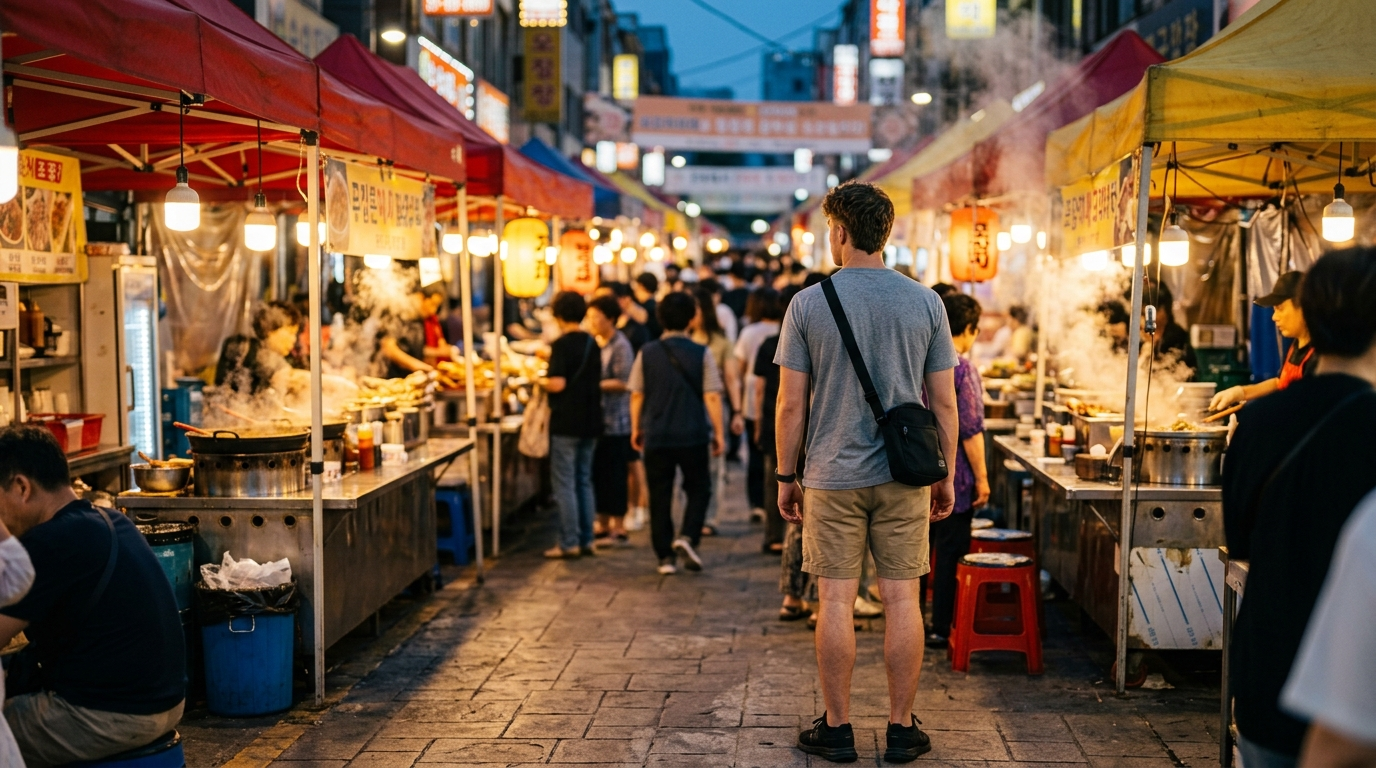
You’re standing in front of a tteokbokki cart at Gwangjang Market, watching a line of Koreans point at things, hand over cash, and walk away chewing within thirty seconds. You step up. The vendor stares. You stare back. There’s no menu board. No English sign. No price tag you can find. The person behind you is already sighing.
Korean street food foreigners try for the first time looks effortless from the outside — until you’re the one holding up the line. The problem isn’t the food. It’s the five unspoken rules that every Korean already knows and no travel blog actually explains. Cash expectations, ordering etiquette, spice levels that hit harder than expected, allergy risks hiding in plain sight, and market-specific systems that vary block by block.
Most of these rules take one bad experience to learn. This guide covers them before that happens — so your first market visit ends with food in your hands, not confusion on your face.
Why There’s No Single Way to Order Korean Street Food
Korean street food operates on completely different systems depending on where you are. A tornado potato cart in Myeongdong accepts credit cards and has pictures taped to the glass. A bindaetteok vendor in Gwangjang Market has been making the same mung bean pancakes for forty years, has no written menu, and only takes cash. A pojangmacha (포장마차) tent in Hongdae at midnight runs on handwritten cardboard signs and trusts you to keep your own tab.
That’s three completely different ordering experiences within one city.
The mistake most korean street food foreigners make is treating all stalls like one system. They’re not. The market type determines the rules, and showing up to a cash-only traditional market with only a Visa card means walking away hungry. Understanding which situation you’re walking into changes everything about how smoothly the experience goes.
If You’re at a Tourist-Heavy Market Like Myeongdong
Myeongdong street food is the easiest entry point for korean street food foreigners encounter for the first time. Most stalls here have photo menus or the food itself is visible — tornado potatoes (회오리감자) spinning on skewers, corn dogs dripping cheese, grilled lobster tails laid out on ice. Point at what you want, pay, eat.
Card payment works at most Myeongdong stalls, though not all. A few older vendors still prefer cash. The prices here run slightly higher than traditional markets — a tornado potato costs around ₩4,000–6,000 depending on toppings, where the same basic item in a student district runs ₩3,000.
Here’s what catches people off guard: Myeongdong food stalls mostly open in the evening. If you show up at 2 PM expecting a street food crawl, you’ll find cosmetics shops and not much else. The carts fire up around 5–6 PM and run until roughly 10 PM. After that, the crowd thins and only a handful of vendors stay open.
The real risk in Myeongdong for korean street food foreigners isn’t getting lost or confused. It’s overpaying for something mediocre. Some stalls cater almost exclusively to tourists and charge accordingly. If a stall has a line of Koreans waiting, that’s a strong signal. If it only has tourists, proceed with lower expectations.
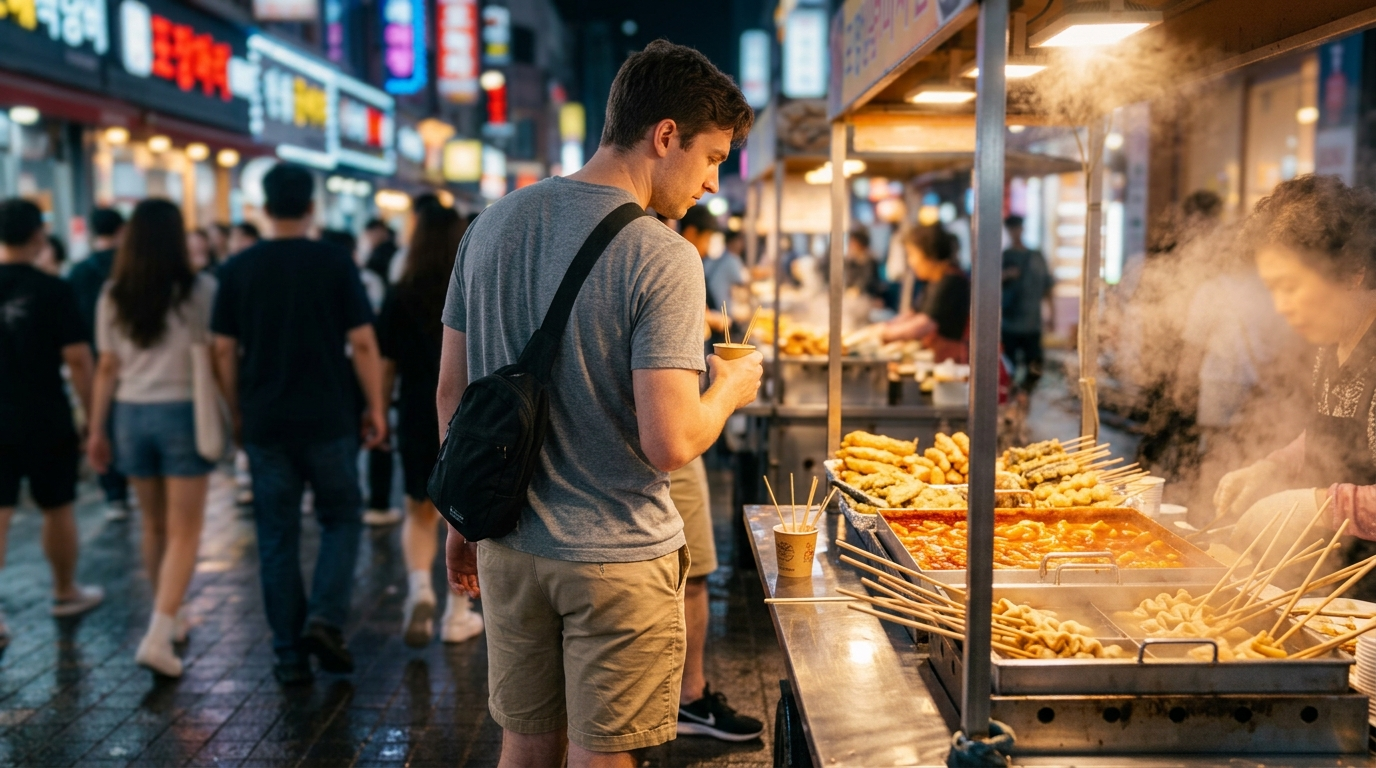
If You’re at a Local Market Like Gwangjang or Namdaemun
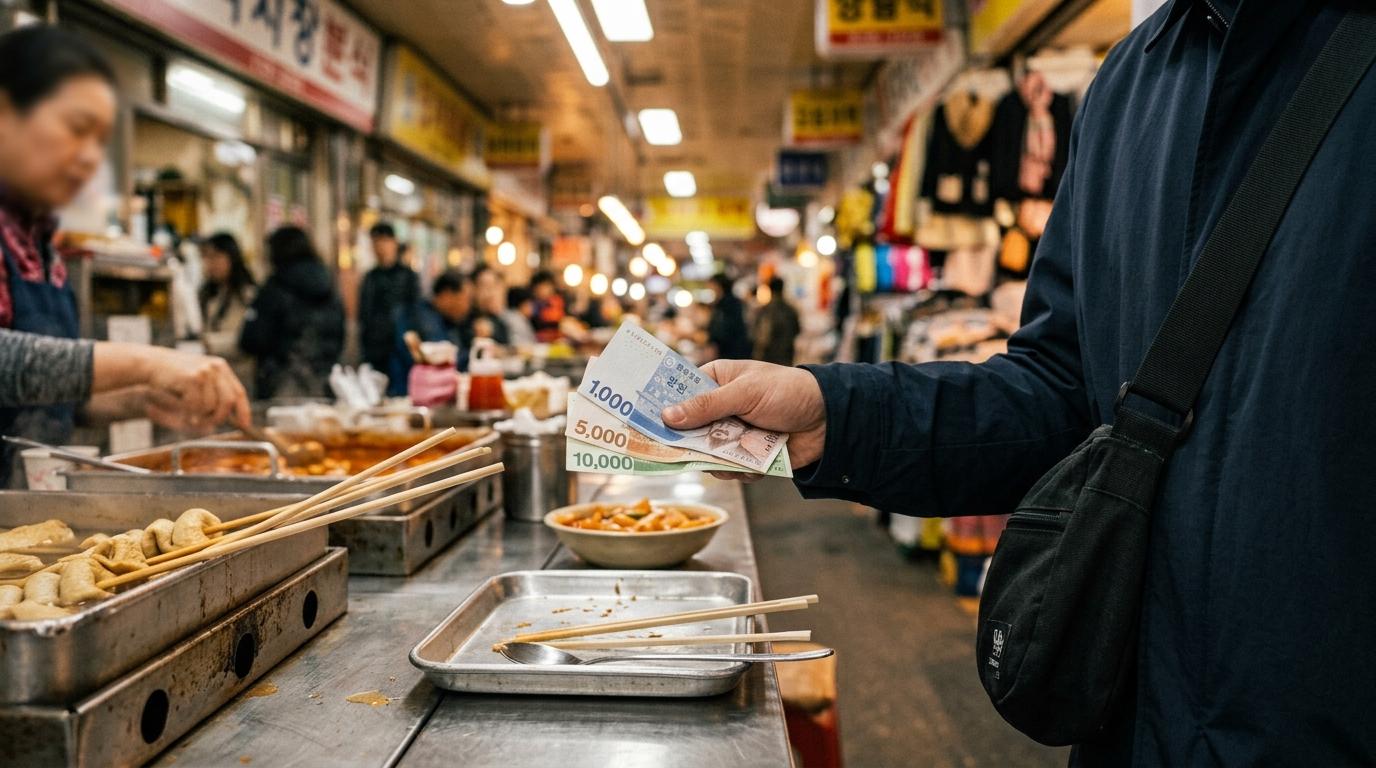
This is where things shift for korean street food foreigners exploring beyond the tourist zones. Traditional markets are cash-first territory. Gwangjang Market and Namdaemun Market — two of the biggest and most famous — operate almost entirely without card readers at their food stalls. You need Korean won in small bills: ₩1,000 and ₩5,000 notes work best.
How much to bring? Budget ₩30,000–50,000 for a proper market day. That sounds like a lot, but Korean street food is designed for sampling — you eat four or five different things across multiple stalls, not one large meal. A plate of bindaetteok (mung bean pancakes) runs ₩5,000–7,000. Mayak gimbap at Gwangjang — those addictive thumb-sized rice rolls — cost around ₩3,000 for ten pieces. Tteokbokki portions start at ₩3,000–4,000.
Ordering at these stalls works differently than you might expect. There’s usually no menu to read. You point at what you want, or you say “이거 주세요” (igeo juseyo — “this one, please”). The vendor serves it. You eat it standing or sitting on a plastic stool. If there’s a broth pot nearby — usually eomuk (fish cake) broth — that broth is free. Take a cup, pour, drink it between bites. This is normal. Koreans do it constantly.
One thing that surprises first-timers: the best stalls have the longest lines. In Korean street food culture, the queue is the review. A thirty-minute wait at a Gwangjang Market bindaetteok stall is not unusual, and the food is almost always worth it. Lines also mean faster ingredient turnover, which actually means fresher, safer food.
If you run out of cash, ATMs inside convenience stores (GS25, CU, 7-Eleven) accept foreign cards. There’s usually one within a five-minute walk of any major market.
If You’re Eating Late-Night Street Food in Hongdae
Hongdae after midnight is a different world from daytime market visits — and for korean street food foreigners staying out late, the rules shift again. The student-district energy brings out pojangmacha tents and mobile carts that serve as both snack bars and drinking spots. The food leans toward fried snacks, skewers, and tteokbokki — fast, cheap, and built for eating while standing or walking.
Card acceptance drops sharply past midnight. Most late-night vendors in Hongdae operate cash-only, and the nearest ATM that reliably handles foreign cards is typically at a GS25 convenience store. Keep ₩10,000–20,000 in small bills if you plan a late-night food run.
Prices here are lower than Myeongdong. University-district competition keeps most items under ₩5,000. A full late-night circuit — four or five items across a couple of stalls — runs roughly ₩15,000–25,000 per person.
The vibe is casual. Nobody expects you to know exactly what you’re ordering. Point, pay, eat. If you look confused, the vendor will usually gesture at what’s popular. Just don’t block the line while deciding.
When You Don’t Know the Market — The Safe First Order
If you’ve never ordered korean street food as a foreigner and you’re not sure what system you’re dealing with, start with the trinity: tteokbokki (떡볶이), twigim (튀김, Korean-style tempura), and eomuk (어묵, fish cake). Most stalls selling one of these sell all three. They’re the most common street food combination in Korea, and Koreans regularly order them together.
Why this works as a first order: the items are always visible, so you can point. The prices are posted at most tteokbokki stalls, even traditional ones. And if the vendor has a broth pot, you know the eomuk broth is free — dip the fish cake in the tteokbokki sauce, drink the broth between bites. That’s how Koreans eat it.
Another safe entry point: gimbap (김밥). It’s everywhere, it’s cheap, and 24-hour gimbap shops like 김밥천국 (Gimbap Cheonouk) and 김밥나라 (Gimbap Nara) operate in most neighborhoods. No ordering friction — walk in, point at the display or the menu photos, pay, eat.
The Payment Rule Nobody Mentions
Korea runs roughly 75% cashless for locals. Koreans tap Samsung Pay or Kakao Pay at convenience stores, chain restaurants, and cafes without thinking about it. This leads many korean street food foreigners to assume they can do the same everywhere.
At street food stalls, this assumption breaks.
Traditional market stalls and older carts are overwhelmingly cash-only. Even stalls that technically have a card reader might not accept foreign cards — Korean domestic cards use a different processing system, and your Visa or Mastercard may simply get declined at a portable terminal that works fine for Korean bank cards. For a deeper look at why foreign cards fail in Korea and where they actually work, the foreign card payment guide covers the full breakdown.
The practical rule: if your plan involves a traditional market, bring cash. If your plan involves Myeongdong or a modern food court, cards will probably work. If your plan involves both in one day, bring both.
When handing over cash at Korean stalls, use two hands or support your giving arm with the opposite hand. This small gesture signals respect, and vendors notice it. It’s the same etiquette Koreans use at every transaction — and it makes a real difference in how warmly you’re treated. The details of paying in Korea as a foreigner go well beyond street food, but this one habit covers most situations.
Spice Shock and Hidden Allergens Korean Street Food Foreigners Miss
Korean street food foreigners taste for the first time is built around gochujang (fermented red pepper paste) and gochugaru (red pepper flakes). If you have a low spice tolerance, the first bite of tteokbokki can genuinely hurt. This isn’t gentle warmth — it’s a direct, lingering capsaicin hit that builds as you eat.
A few things make this manageable. Try one piece before committing to a full portion. Some vendors will adjust the spice level if you ask — “덜 맵게 해주세요” (deol maepge haejuseyo — “less spicy, please”) is the phrase to know. But at busy stalls, customization isn’t realistic. The food is premade in batches, and what’s in the pot is what you get.
Non-spicy options exist at almost every market. Hotteok (호떡) — sweet cinnamon and brown sugar pancakes — are completely spice-free. So are egg bread (계란빵), gimbap, and most twigim. Tornado potatoes are safe unless you choose a spicy seasoning option.
Allergens are a more serious concern for korean street food foreigners with dietary restrictions. Korean street food relies heavily on anchovy broth, shrimp-based seasonings, soy sauce, and wheat flour. These ingredients appear in dishes you wouldn’t expect — tteokbokki sauce often contains anchovy or shrimp extract, and many fried items use wheat batter. If you have a seafood, soy, or gluten allergy, street food stalls are riskier than restaurants because ingredient disclosure is essentially nonexistent.
Carrying a printed allergy card in Korean helps. The phrase “이 음식에 [allergen] 들어 있어요?” (i eumsige [allergen] deureo isseoyo? — “Does this food contain [allergen]?”) gets the point across, but a written card works faster than spoken Korean in a noisy market. Korea’s Ministry of Food and Drug Safety (MFDS) enforces strict hygiene inspections on food vendors, so safety standards are generally high — but allergen labeling at street stalls is not required the same way it is at restaurants or packaged foods.
Questions That Come Up Most
Can I order Korean street food without speaking any Korean?
Yes. Pointing is the most common and effective ordering method at street food stalls — Koreans themselves point and say “이거” (igeo — “this”) all the time. If the food is visible on the counter, the entire transaction can happen without a single word. At tourist-heavy spots like Myeongdong, many vendors speak basic English. At traditional markets, pointing plus having cash ready is all you need. If you want specific Korean phrases for restaurant and food ordering situations, the Korean phrases restaurant cafe guide covers the full list of expressions that actually work in 2026.
How much should I budget for a Korean street food day?
A solo traveler can eat well at Gwangjang Market for ₩15,000–20,000 across multiple stalls. If you’re sampling widely — five or six different items — budget ₩25,000–30,000. Myeongdong runs about 20–30% higher. In student districts like Hongdae or Sinchon, almost everything falls under ₩5,000 per item, so a full evening costs ₩15,000–25,000 including drinks.
Is Korean street food safe to eat for foreigners?
Korea’s food hygiene standards are strictly enforced by the Ministry of Food and Drug Safety, and inspections cover street vendors as well as restaurants. Stalls with long lines actually tend to be safer because high customer turnover means faster ingredient rotation — fresher food, lower contamination risk. The main concern korean street food foreigners face isn’t contamination — it’s unexpected spice levels and hidden allergens like shrimp broth or soy in sauces. Checking the ordering food Korea foreigners kiosk guide before your trip also covers restaurant-style ordering, which overlaps with some market food courts that use kiosk systems.
3 Things to Have Ready Before You Walk Up
Street food runs on speed. Vendors serve dozens of people per hour, and hesitation creates friction — for korean street food foreigners especially, since the ordering norms aren’t intuitive at first. These three preparations eliminate most of the awkwardness.
Cash in small bills. ₩30,000–50,000 in ₩1,000 and ₩5,000 notes covers a full day at any traditional market. If a stall costs ₩4,000 and you hand over ₩50,000, you’ll get change — but the vendor won’t be thrilled. Small bills keep things moving. ATMs at convenience stores (GS25, CU, 7-Eleven) handle foreign cards if you run short.
Papago or Google Translate camera mode. Install the Naver Papago app before you go. The camera translation function reads Korean menu boards and price signs in real time. It won’t be perfect, but it removes most of the guessing. This matters more at traditional markets than tourist areas.
Know your spice limit and allergies. Decide before you’re standing in front of a steaming pot of tteokbokki whether you can handle serious heat. If not, start with non-spicy items — hotteok, egg bread, gimbap, twigim — and work your way up. If you have food allergies, carry a Korean-language allergy card on your phone. Showing it is faster than explaining.
Allergy note: Street food vendors in Korea are not required to display allergen information the way restaurants or packaged food manufacturers are. If you have a severe food allergy — especially to shellfish, soy, wheat, or nuts — exercise caution at street stalls where ingredients are not labeled. For medical emergencies related to allergic reactions, call 119 (fire/ambulance) or the Korea Health Hotline at 1339 for multilingual assistance. The Korean pharmacy foreigners guide covers what over-the-counter medications are available and what requires a prescription.
Where to Go From Here
Korean street food foreigners discover during their trip is one of the most accessible and enjoyable parts of being in Korea — once you understand how the system works at the specific market you’re visiting. The friction points are predictable: cash vs card, spice levels, allergen awareness, and the ordering speed that vendors expect.
Gwangjang Market is the starting point most people recommend, and for good reason — it has the widest variety of traditional Korean street food under one roof, and you can reach it on foot from Insadong, Myeongdong, or Dongdaemun. Start with the tteokbokki-twigim-eomuk trio, try a plate of bindaetteok with makgeolli if you’re feeling adventurous, and bring more cash than you think you’ll need. For location details, opening hours, and directions to major markets across Korea, the Korea Tourism Organization (Visit Korea) maintains updated listings in English.
If you’re also planning sit-down restaurant meals or grocery shopping at Korean marts, those systems have their own sets of friction points — different from street food, but worth knowing before you show up.