
What should a checkup and a cleaning cost at a Korean dentist? If you’re enrolled in national health insurance, often about the price of a takeout lunch. That part is true. It’s also why the second bill lands so hard.
The story shows up in expat forums every few weeks, almost word for word. Someone books a quick cleaning. The dentist spots a cavity, maybe two. A staff member comes back with a printed plan — tooth-colored fillings, a crown, possibly an implant — and a total with one more zero than expected. Nothing shady happened. The treatment simply crossed a line most foreigners never knew was there.
That line separates covered care (급여, geup-yeo) from non-covered care (비급여, bi-geup-yeo). On one side, the price comes from a national fee schedule. On the other, each clinic sets its own. Below: where the line actually sits, the assumptions that push people across it without noticing, and a public price database almost nobody outside Korea has heard of.
The Appointment Where the Number Changes
The first half of a visit is usually uneventful. An exam, an X-ray or two, and scaling if you’re due. With national health insurance, a neighborhood clinic in 2026 typically charges somewhere around ₩15,000–20,000 for a first-visit cleaning, exam fee included. Nobody walks out of that part upset.
Then the dentist finds something.
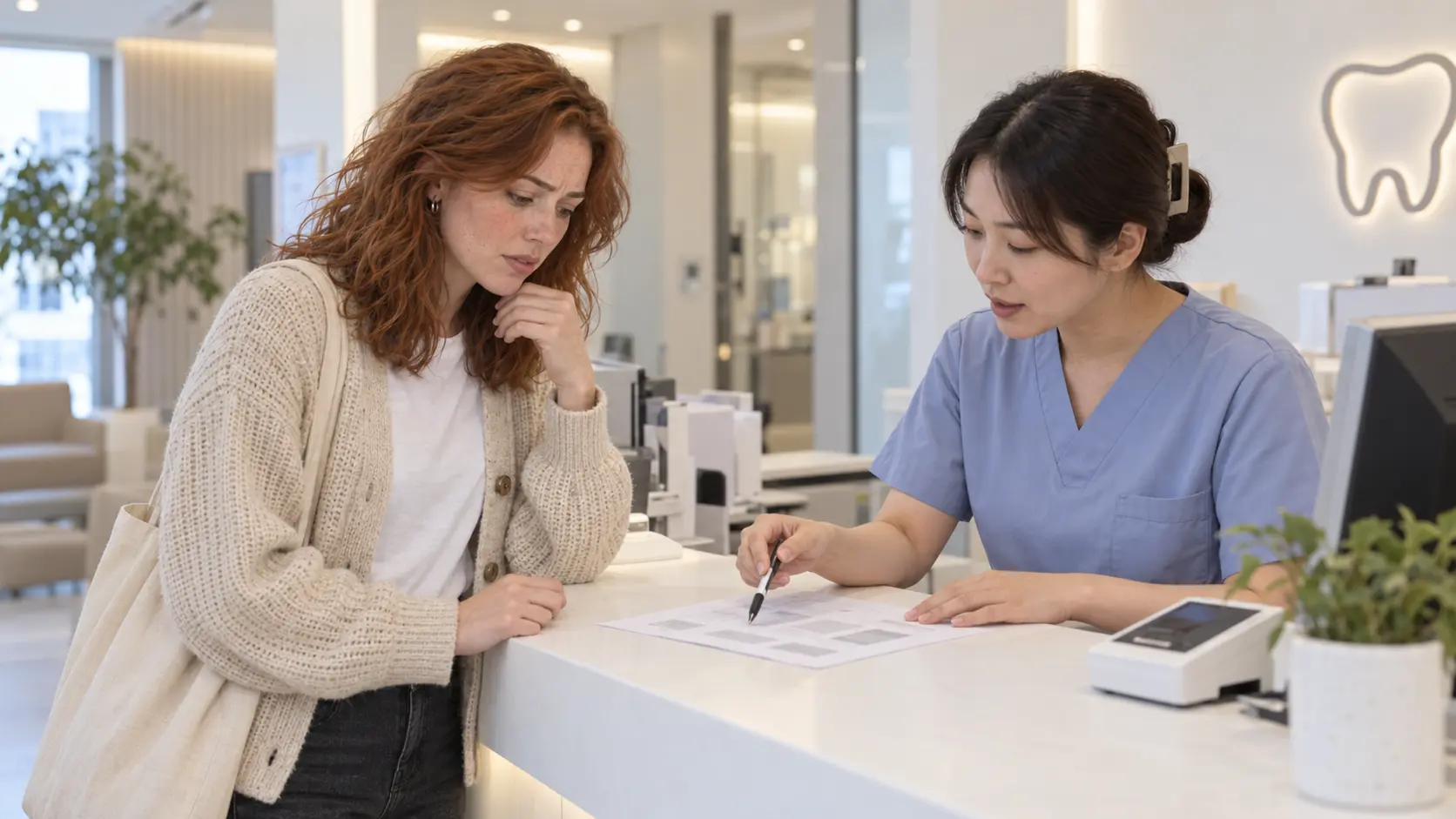
What comes next tends to happen quickly, and often at the front desk rather than in the chair. You’re shown two or three options for the same tooth. One is covered. The others aren’t. The explanation may come in rapid Korean, or in careful English that never quite uses the word “insurance.” And if you don’t ask which option the insurance actually pays for, that question may simply not come up.
This is the moment the bill gets decided. Not at the payment terminal. Here, when you nod.
How a Korean Dentist Prices Two Kinds of Treatment
Every treatment in Korea falls into one of two buckets. Covered items follow a national fee schedule set through the health insurance system, and at a clinic-level practice you generally pay about 30% of that fee. Non-covered items are priced by each clinic on its own, and you pay all of it.
For adults, dentistry is where the non-covered bucket gets big. And the line doesn’t fall where most people from Europe, North America, or Australia would guess.
| Treatment | Adults 19–64 with NHIS | Reference point |
|---|---|---|
| Scaling (cleaning) | Covered once per calendar year | About ₩15,000–20,000 at a clinic |
| Amalgam (silver) filling | Covered | National fee schedule |
| Tooth-colored resin filling | Not covered (covered only for permanent teeth, age 12 and under) | Clinic average about ₩92,500 per surface (2024 data) |
| Root canal treatment | Covered | National fee schedule |
| Crown (zirconia, gold, porcelain) | Not covered | Zirconia clinic average about ₩510,000 (2024 data) |
| Implant | Not covered (65+ can get up to two per lifetime at a 30% copay) | Clinic average around ₩1.1 million per tooth; hospitals far higher |
| Braces, whitening, veneers | Not covered | Clinic-set |
These are reference points from public price disclosures, not quotes. Coverage comes with conditions — tooth type, diagnosis, frequency — that clinics apply case by case. Confirm with the clinic and the National Health Insurance Service before treatment.
One condition sits underneath the whole table: you have to be enrolled. Employees are usually enrolled through work, and most other foreign residents are enrolled after six months of stay. Before that, the “covered” column doesn’t help much. The health insurance gap between arrival and ARC explains when that switch actually happens.
Where Foreigners Overpay Without Noticing
Most of what goes wrong at a Korean dentist isn’t a scam. It’s a gap between what people assume and how the system is built.
“White fillings are standard, so they must be covered”
In a lot of countries, tooth-colored composite is simply the default filling. In Korea, light-cured composite resin (광중합형 복합레진) is covered only for permanent teeth in children 12 and under. For everyone else, it’s a clinic-priced item — and it adds up fast when three teeth need work.
Amalgam is covered. Whether it’s the right material for a particular tooth is a clinical call that belongs to the dentist. Whether it’s offered is something you’re allowed to ask about.
“The cleaning resets a year after the last one”
Covered scaling for adults (19 and older) runs on the calendar year, January through December, and resets on January 1 — that’s how the NHIS scaling guide frames it. Clinics often describe it as “once a year,” which many people hear as “once every twelve months.” In practice, a cleaning on December 28 and another on January 5 can both be covered.
Not sure whether you’ve used this year’s? The front desk can usually check when you hand over your ARC. A short way to ask: 올해 스케일링 보험 되나요? (olhae seukeilling boheom dwaenayo — “Is scaling covered for me this year?”).
“The root canal was covered, so the tooth is covered”
Root canal treatment is a covered item. The crown that usually follows it is not, for adults. So the covered half of the job might cost tens of thousands of won, and the half that finishes it several hundred thousand. People tend to hear the first number and stop listening. Ask for both numbers at the same time.
“An implant price is the price of an implant”
Some advertised implant prices refer to the fixture alone — the post that goes into the bone. The abutment, the crown on top, and bone grafting if it’s needed can each be billed separately. Public data puts clinic-level averages at roughly ₩1.1 million per tooth, while some large hospitals charge several times that. A quote far below the average isn’t automatically suspicious, but it deserves one question: what does this number leave out?
If you’re 65 or older and enrolled in national health insurance, the picture changes — up to two implants per lifetime are covered at a 30% copay.
Questions That Come Up at the Front Desk
Will a Korean dentist speak English?
Many clinics in central Seoul, Busan, and neighborhoods near universities advertise English. Outside those areas, expect less. The Korean phrases for hospital and pharmacy visits cover most of a dental appointment, and a translation app handles the rest.
Can travel insurance or insurance from home pay for it?
Often, yes — as a reimbursement after you’ve paid. Ask the clinic for a receipt (진료비 영수증) and an itemized statement (진료비 세부산정내역서). Most insurers want both. Check the policy’s dental terms first, since many travel plans limit dental cover to emergency pain relief.
Should I wait until I’m enrolled in national health insurance?
Pain, swelling, or a broken tooth shouldn’t wait. For planned work that’s mostly non-covered — crowns, implants — enrollment changes less than people expect, because those prices are clinic-set either way. For covered items like fillings and root canals, it matters a lot more.
Is a cheaper clinic a worse clinic?
Not necessarily. When Korea’s Health Insurance Review and Assessment Service (HIRA) released its latest price data, it noted that gaps between clinics come from materials, treatment scope, staffing, and equipment, and that a lower price doesn’t automatically mean lower quality — nor a higher one better care. Compare what’s included before you compare totals.
What Actually Works Before You Say Yes
The fix isn’t hunting for a “foreigner-friendly” clinic. It’s walking in with a price range already in your head, so the number on the printout means something.
Look up the range first
HIRA runs a public database of non-covered prices at hira.or.kr (비급여 진료비 정보), and the same data sits in its app, 건강e음. You can search by region and item — for example 치과의 보철료 → 치과임플란트(1치당), then the material — and see the minimum, average, and maximum prices in that area, plus individual clinic listings.

The site is in Korean. Browser translation turns it into something rough but usable. The figures are refreshed once a year, so treat them as a range to anchor on, not a promise from any specific clinic.
Ask for the non-covered items in writing
For listed non-covered items, clinics are required to explain the item and its price before providing it. That rule exists; using it is up to you. One sentence does it: 비급여 항목이랑 가격 적어 주실 수 있어요? (bigeupyeo hangmogirang gagyeok jeogeo jusil su isseoyo — “Could you write down the non-covered items and prices?”).
Get the breakdown, then a second quote
For crowns and implants especially, ask for each component on its own line. Then take that sheet to another clinic. Getting two or three quotes before expensive work is completely ordinary here. No Korean dentist will be offended.
Keep every piece of paper
The receipt and the itemized statement. You’ll need them for any insurance claim — and possibly for the step below.
After Treatment: The Check Most People Skip
Suppose you paid for something as non-covered and later suspect it should have been covered. HIRA runs a service for exactly this: 진료비 확인 (medical fee verification). You submit your receipt, HIRA requests records from the clinic, reviews the case, and if overbilling is confirmed, the clinic has to refund the difference.
It’s used more than you’d think. Korean news coverage in September 2026 reported about 15,900 refund cases and roughly ₩6.8 billion returned to patients this way between 2023 and August 2026 — across all medical fields, not dentistry alone. Apply sooner rather than later, since records don’t stay available forever. The online application may ask for Korean identity verification — often the same wall foreigners hit with other Korean websites — so a Korean-speaking friend can be genuinely useful here.
Two smaller habits help too. Note the month of your covered cleaning at the Korean dentist you use, so you know where you stand each year. And if a quote feels off, remember the clinic’s first number is a proposal, not a verdict.
What This Comes Down To
A Korean dentist isn’t expensive, exactly. Covered care here is some of the most affordable in any high-income country. The expense lives on a separate price list that each clinic writes for itself.
So the useful question isn’t “how much does the dentist cost?” It’s “which of these is covered — and what does the rest cost here compared with the clinic down the street?”
Ask it before the nod. Not after.
For how the rest of the medical system works, see what slows down a hospital visit in Korea, and for after-care medicine, what you can buy at a Korean pharmacy.
This article is general information, not dental, medical, or legal advice. Coverage rules and prices change and vary by clinic and individual situation — verify current details with the clinic, NHIS, or HIRA before treatment.